Mirror Hack: False Nuclear Alarms on Both Sides of the Front
Late on 1 November, phones across Ukraine lit up with warnings of radiation, a chemical attack, street fighting and an incoming Oreshnik missile. None of it was real. The same night, Russia's Emergencies Ministry admitted that its own warning app had been hijacked to spread false alarms. No link…

Baltic Security Monitor | Material Update
Security Watch: 2 November 2026, 08:00 EET · Materiality: MODERATE · Domain: cyber / civil-defence warning
Late on 1 November, phones across Ukraine lit up with warnings of radiation, a chemical attack, street fighting and an incoming Oreshnik missile. None of it was real. The same night, Russia's Emergencies Ministry admitted that its own warning app had been hijacked to spread false alarms. No link between the two incidents has been established, but the coincidence points to a new front line: public trust in the warning signal itself.
What happened
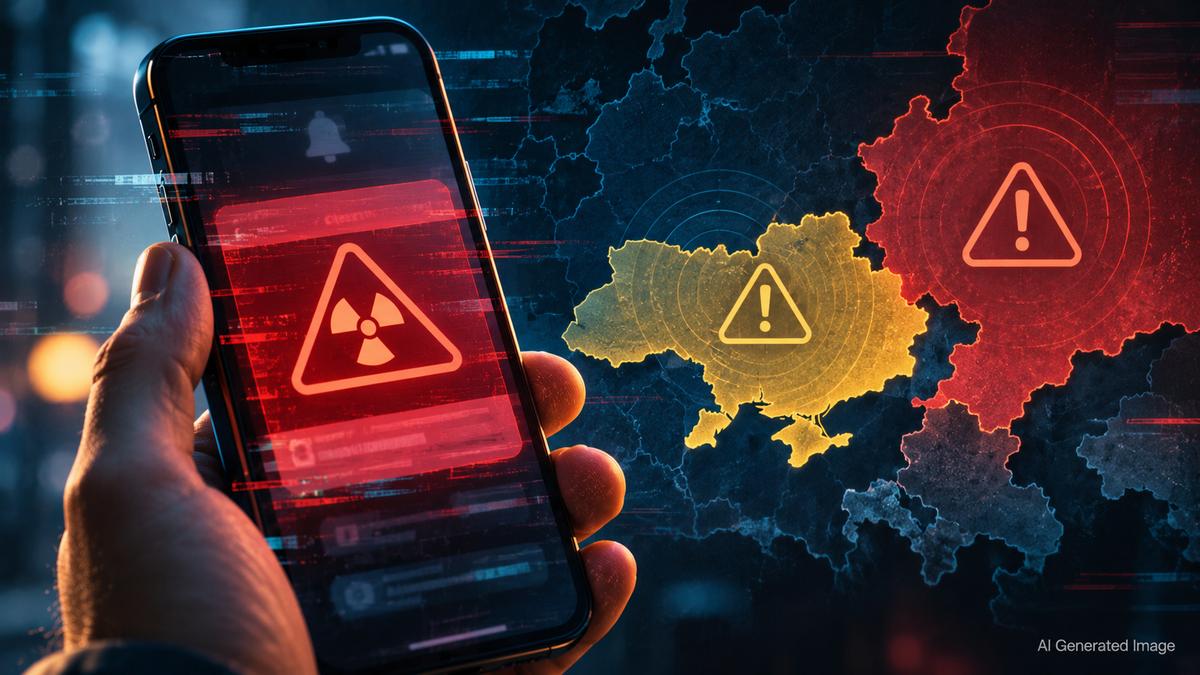
At around 22:47 Tallinn time, Air Alert, the officially backed Ukrainian warning app developed with the Ministry of Digital Transformation and Ajax Systems, began pushing fabricated notifications. The messages were written in Russian and claimed a nuclear threat, a radiation or chemical attack, street fighting and an Oreshnik launch. Some carried links, and regional governors warned that the attack may have had a phishing component.
At 23:02, Ukraine's Air Force said the app had likely been compromised by the enemy and stated plainly that there was no radiation threat. Air Force spokesperson Yurii Ihnat confirmed the messages were fake. Governors in Ivano-Frankivsk and Vinnytsia oblasts urged residents to stay calm and not to open any links.
After midnight, the developers confirmed unauthorised interference by third parties, disabled push notifications and temporarily took the service offline. They said the app does not store users' personal data, so no data leaked; that claim has not yet been independently verified. The Ministry of Digital Transformation pointed users to the state emergency alert system, which works even on silent mode, and said the nationwide warning system was operating normally.
By 02:18 on 2 November the service was partially back. Yellow and red threat levels have returned to the map and push alerts are working again. The display of air targets on the map remains switched off.
One question is still open. Some international reports say similar messages were also heard over loudspeakers in Kyiv that evening. There is no official confirmation that street warning systems were affected, and the ministry maintains that the state system worked as normal.
BSM analysis
What sets this apart from the usual Telegram fakes is the delivery channel. The lie arrived through a trusted source. People who have reacted to Air Alert notifications for years do not stop to check where one came from, and the attack was built around that habit. The choice of content was deliberate too: radiation, chemicals and Oreshnik are the scenarios that cause the most panic and are the hardest to check in the moment.
Yet the system held. The Air Force debunked the alert within fifteen minutes, the service was shut down within hours, and backup channels (state alerts, sirens, official Telegram channels) stayed available. That is the real lesson. Warning resilience does not depend on how well one app is protected, but on having several independent channels and an official rebuttal that arrives fast.
The mirror incident in Russia
On the same night, Russia's Emergencies Ministry reported a "massive cyberattack" on its own mobile app, which the attackers used to push false information about a threat to the public. According to Ukrainian media, the messages claimed that nuclear warheads had been launched over Russian regions. The ministry said it was fixing the vulnerability.
Who is behind either attack is unknown, and there is no evidence of a coordinated operation. But two state warning systems compromised with the same nuclear script on the same night suggest that civilian alert channels have become a full-fledged target of information warfare for both sides.
Why it matters for the Baltic states and Poland
Estonia, Latvia, Lithuania, Poland and Finland have spent recent years building civil preparedness: mobile alerts, sirens, apps and public guidance for air threats. Only hours before the Ukrainian hack, on 1 November, Latvia's armed forces told residents of Krāslava and Ludza to stay indoors because of an object in Latvian airspace.
The Ukrainian case shows that this infrastructure is attractive to an adversary precisely because people trust it. A hijacked warning channel in a NATO country could spread panic, overload emergency services and devalue the next genuine alert, all at once. Protection has to cover procedures as well as servers: who debunks a fake and how fast, which channels back each other up, and how the public is taught in advance to check the source of an alarm.
What to watch
Full restoration of the service, including the air-target display. Findings of the technical investigation into how access to the notification system was obtained. Official attribution. Details of the attack on the Russian Emergencies Ministry app and any technical link between the two incidents.
Bottom line
The attack caused no physical damage, but it struck the most sensitive part of civil defence: the reflex of trust. Ukraine responded quickly and its backup channels worked. For countries still building a culture of civil preparedness, this is a free lesson. A siren is worth exactly as much as the trust behind it.
Baltic Security Monitor (osint-baltic.com) — an analytical publication on security on NATO's northeastern flank.
Based on automated open-source monitoring with independent verification of key facts.