Smoke Confirmed, Damage Not: Ufa, Kstovo and a New Wave of Refinery Strikes
The fire at the Bashneft-Novoil refinery in Ufa is now backed by geolocated footage, not just eyewitnesses. Novokuibyshevsk was hit two days earlier, and Kstovo burned overnight into 1 November. Yet the gap between visible fire and lost refining capacity remains open.

Baltic Security Monitor | Material Update | 1 November 2026, 08:00
The fire at the Bashneft-Novoil refinery in Ufa is now backed by geolocated footage, not just eyewitnesses. Novokuibyshevsk was hit two days earlier, and Kstovo burned overnight into 1 November. Yet the gap between visible fire and lost refining capacity remains open.
What happened
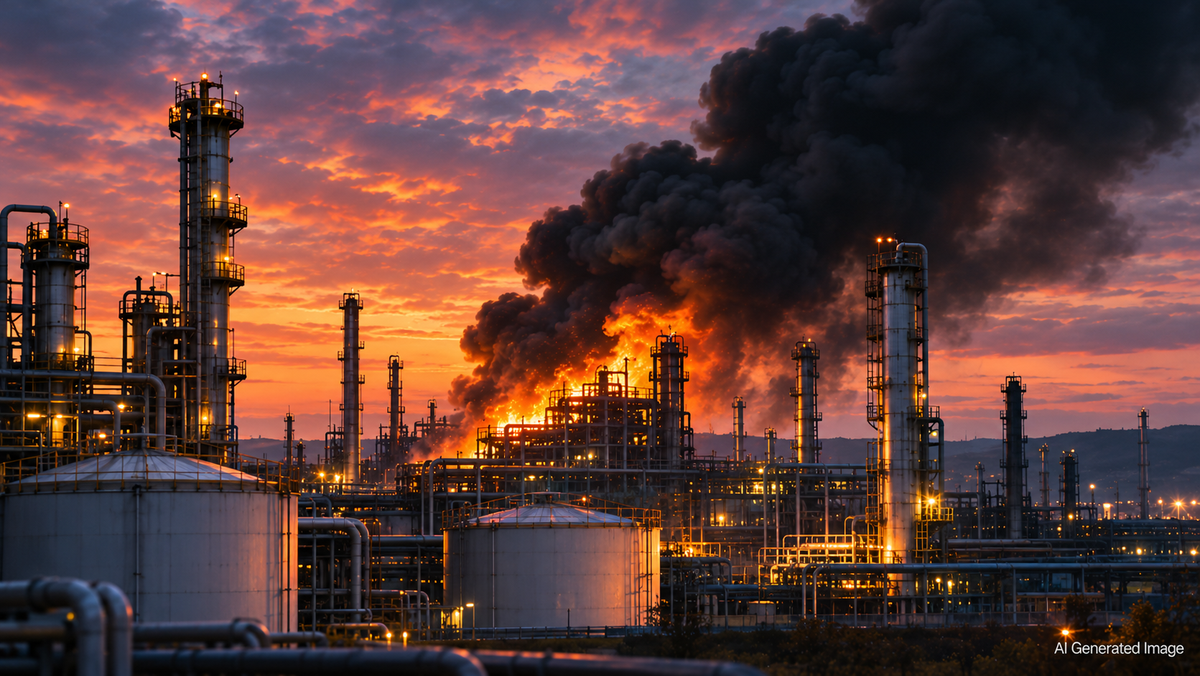
Overnight into 31 October, drones attacked the industrial zone of Ufa in Bashkortostan. Local outlet UFA1 recorded smoke over the Chernikovka district, and residents in the city centre saw two separate columns. Local authorities did not comment on the consequences. Russia's Defence Ministry claimed 433 Ukrainian drones downed over 19 regions, and Ufa airport was temporarily closed.
Russian independent outlet ASTRA, working from eyewitness photos, identified the burning site as Bashneft-Novoil. It reported that the fire reached the L-35 catalytic reforming unit, a key component for high-octane gasoline production.
On 31 October, ISW reported geolocated footage of smoke rising from Bashneft-Novoil specifically. Ukraine's Strategic Communications Center named Bashneft-Novoil and Bashneft-Ufaneftekhim as targets, with a combined capacity of about 24 million tonnes of crude a year. ISW describes strikes on both plants as "likely", not proven.
What changed
At the 20:00 snapshot the incident stayed on WATCH because the burning facility was unclear. The new delta is geolocation tying the fire to a specific plant, plus official Ukrainian identification of the targets. That is enough to promote Bashneft-Novoil to MATERIAL, but not enough to judge the scale of damage.
Damage to the L-35 unit is known only from visual analysis and is unverified. 🟡 Involvement of the second plant, Ufaneftekhim, has no geolocated evidence. 🟡 Andriy Kovalenko, head of Ukraine's Center for Countering Disinformation, said one Ufa refinery suspended operations, without naming it and without independent confirmation. The 24-million-tonne figure is design capacity, not lost output.
Kstovo: after the snapshot
Overnight into 1 November, OSINT channels and residents reported a series of explosions and a fire at Lukoil-Nizhegorodnefteorgsintez (NORSI) in Kstovo, Russia's fourth-largest refinery and its second-largest gasoline producer. At the 08:00 snapshot it remained on WATCH, with no official confirmation.
Since then, Nizhny Novgorod governor Gleb Nikitin has reported a massive drone attack and "significant damage" to an industrial facility in Kstovo district. He said more than 100 drones were downed, there were no casualties, and power, hot water and heating could be disrupted. He did not name the plant, though the Kstovo industrial hub and NORSI largely coincide. That is the official signal the incident lacked for MATERIAL status. It will be checked in the 14:00 cycle.
BSM analysis
Three strikes in three days, Novokuibyshevsk on 30 October, Ufa on the 31st and Kstovo on 1 November, look like a resumed campaign against Russian refining after a lull from mid-October. On 30 October, Deputy Prime Minister Alexander Novak acknowledged that three refineries and a gas-chemical complex had been hit, without naming them.
Ufa sits roughly 1,200 km from the border. Strikes at that range force Russia to spread air defence across the entire Volga and Urals belt, not just the border regions.
For the Baltic region the link is real, if not immediate. Part of Russia's refined product exports moves through Baltic Sea ports, and sustained refining outages shift the volumes and routes of that flow. More crude tankers in place of diesel cargoes would change the picture of shadow-fleet traffic near Estonian and Finnish waters. One fire does not prove any of that; what counts is how long units stay offline, not how high the flames rise.
Still unknown
There is no independent data on damage to specific units in Ufa. 🟡 Neither Rosneft, the operator, nor industry throughput data has spoken. For Kstovo, it is not confirmed which units were hit. Thermal satellite data, industry refining statistics and possibly Reuters reporting from industry sources, as after earlier NORSI strikes, will settle the question.
Bottom line
Ufa is a justified promotion: the plant is identified and the fire geolocated. Kstovo is likely to be the next MATERIAL. But this campaign is measured not in fires but in days when refineries stop processing crude.
The next important news from Ufa won't be about smoke. It will be about tonnes.
(Marinovka and the full WATCH register are covered in the companion BSM update of 1 November.)
Sources: Institute for the Study of War, Russian Offensive Campaign Assessment, 31 Oct 2026; UFA1 (31 Oct 2026); Meduza (31 Oct 2026); Kyiv Post (31 Oct 2026); 24 Kanal (1 Nov 2026); Euronews (1 Nov 2026).
Baltic Security Monitor (osint-baltic.com) is an analytical publication covering security on NATO's northeastern flank.
All OSINT assessments are produced by an automated monitoring system based on open sources.