Two Fleets, One Sea: OSINT Digest — 12 June 2026

Baltic Security Monitor | Analytical Brief
Snapshot: 2026-06-12T11:18:56Z
OSINT Indices
| Indicator | Value | Delta 6h / 24h |
|---|---|---|
| Composite Threat Index | 0.15 | 0.00 / 0.00 |
| Force Posture | 0.17 | ↑ from 0.13 |
| Logistics | 0.15 | ↓ from 0.24 |
| Info/Cyber | 0.00 | — |
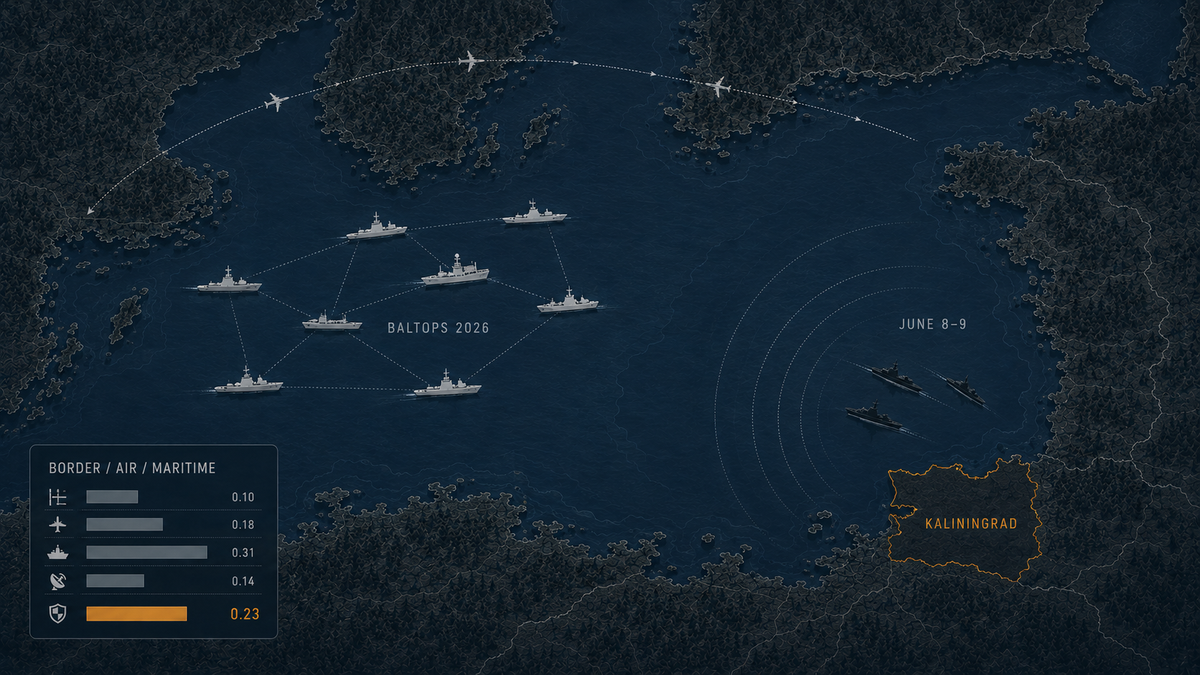
| Border/Air/Maritime | 0.23 | = stable |
Events logged (24h): 10 · High-confidence: 0 · Quarantine: 0 · Source failures: 0
Composite at 0.15 sits in the same narrow band as the past two days. The most informative reading today is Border/Air/Maritime holding at 0.23 for a second consecutive day, even as Logistics retreats from 0.24 to 0.15 and Force Posture ticks upward. A sub-index that stabilises rather than spikes or fades is a structural signal: maritime and air-domain tension is no longer driven by a single event but by the sustained parallel operation of BALTOPS 2026 and Russia's direct military response to it.
Week-in-Numbers: OSINT Sub-Index Trajectory (8–12 June)
| Date | Composite | Force Posture | Logistics | B/A/M |
|---|---|---|---|---|
| 8 June | 0.17 | 0.37 | 0.00 | 0.18 |
| 9 June | 0.14 | 0.30 | 0.00 | 0.16 |
| 10 June | 0.16 | 0.27 | 0.04 | 0.23 |
| 11 June | 0.13 | 0.13 | 0.24 | 0.16 |
| 12 June | 0.15 | 0.17 | 0.15 | 0.23 |
The week's pattern is now legible: Force Posture declines steadily as exercises stabilise; Logistics pulses (spike then retreat); Border/Air/Maritime holds persistently above baseline. That stability is the signal.
Top Events
🟡 1. Eastern Sentry: IAMD Training Over the Baltic States
OSINT score: 0.56 — WARNING (fifth consecutive day)
The score holds at 0.56 for a fifth straight day — the longest unbroken WARNING signal in this digest's recorded history. The constancy itself is the analytical point. A single exercise would decay in the index; a structural operational cycle does not. Eastern Sentry is now registered as background architecture, not an event.
The practical dimension: the French Rafales that shot down a drone over Latvia on 8 June and the aircraft rehearsing IAMD scenarios under Eastern Sentry are the same airframes, the same crews, on the same rotation at Šiauliai. Combat air policing and collective air-defence training are not separate activities — they are the same mission, performed simultaneously. (Full analysis in the 8 June digest.)
🔵 2. SNMG1 and BALTOPS 2026: Russia Responds Near Kaliningrad
OSINT score: 0.45 — WATCH
BALTOPS 2026 — current phase. The exercise is in its second active week (4–19 June). Allied forces are training across the Baltic Sea region in a wide range of mission areas, including amphibious operations, air defence, anti-submarine warfare, mine countermeasures, crisis response, and unmanned systems experimentation. For the first time since 1972, the exercise is command-and-controlled from Allied Joint Force Command Brunssum, realistically imitating the NATO command structure that would be activated in an actual contingency.
U.S. Marines in Estonia. During the exercise, U.S. Marines are cooperating with Estonian naval personnel in surveillance and maritime situational awareness around the Estonian coast — the fifth time this format has operated since 2022. Marines with 2nd Light Armored Reconnaissance Battalion, 2nd Marine Division transited by small boat to Estonian Naval Ship Kindral Kurvits in the Gulf of Finland on 5 June 2026, integrating into coastal defence operations rather than conducting large-scale amphibious landings.
Russia's parallel exercise. Russia carried out its own drills from 8 to 9 June in and near its Kaliningrad exclave, involving around 10 military aircraft, including fighter jets and bombers, as well as two small missile ships. The exercises included practice in firing unguided missiles, conducting bombing runs and launching missile strikes.
Putin's warning. President Putin said in late May that Russia has all necessary means to destroy any force attempting to attack Kaliningrad, following Lithuania's foreign minister's statement that NATO should show Moscow it could penetrate the exclave.
BSM assessment: The simultaneity of BALTOPS and Russia's Kaliningrad drills — separated by days, not weeks — is the direct explanation for Border/Air/Maritime holding at 0.23. Both actors are signalling through military activity without entering into contact. This is parallel deterrence in operation: a managed standoff where the communication is kinetic but the intent, for now, is to demonstrate capability rather than deploy it.
🔵 3. NATO Military Committee Visits Iceland — GIUK Gap
OSINT score: 0.45 — WATCH
(Full analysis in the 8 June digest.)
🔵 4. British Army AR3 Evolution Drone — First Deployment in Estonia
OSINT score: 0.44 — WATCH
The maritime surge of BALTOPS 2026 runs in parallel with the ground forces' doctrinal modernisation. British 47th Regiment Royal Artillery's AR3 Evolution deployment at Spring Storm — the first organic reconnaissance UAS at artillery battery level in the region — continues to register as a structural change in the Alliance's ground posture. (Full analysis in the 10 June digest.)
🔵 5. Project Flytrap 5.0: Counter-UAS Integration
OSINT score: 0.44 — WATCH
(Full analysis in the 8 June digest.)
Context: Kaliningrad — the Region's Most Combustible Variable
Kaliningrad remains the most diplomatically and operationally volatile element in the Baltic security architecture.
What it is. Kaliningrad is a Russian exclave located on the Baltic coast between NATO members Lithuania and Poland, with no land connection to Russian territory. It is heavily militarised and serves as the headquarters of Russia's Baltic Fleet. Iskander missile systems and layered air defences give Kaliningrad the ability to threaten targets across Poland, Lithuania and the Baltic states simultaneously.
The escalatory chain (May–June 2026):
- Lithuanian Foreign Minister Budrys: NATO must show it can "neutralise" Kaliningrad and prevent Russia from using it to cut off the Baltic states
- Putin, 29 May: Russia "has all the means to raze to the ground anyone who tries" to attack Kaliningrad, reiterating that alleged Ukrainian drone operations from Latvia constitute legitimate targets for Moscow
- Croatian President Milanović: broke Alliance ranks, calling Budrys's statement "irresponsible"
- Russia, 8–9 June: missile strike practice near Kaliningrad, parallel to BALTOPS
BSM assessment: Kaliningrad is not merely a forward base — it is the geographic fulcrum where any NATO–Russia crisis automatically becomes a crisis involving Poland and Lithuania simultaneously. The Suwalki corridor — the narrow land strip between Kaliningrad and Belarus — remains the Alliance's single most strategically exposed land link. Protecting sea lanes is of paramount importance precisely because the Baltic states remain connected to the rest of NATO territory only by this narrow land corridor, making maritime supply routes an economic and military lifeline.
Regional Context: Finland as the Nordic-Baltic Anchor
BALTOPS 2026 planning took place in April in Turku, where the Finnish Naval Command hosted nearly 160 planners from all Allied countries. The fact that Finland — a country that only joined NATO in 2023 — hosted the planning conference illustrates how quickly the Alliance's Nordic-Baltic arm has gained operational maturity.
In 2026, the presidency of the Nordic-Baltic Eight format is held by Estonia, which has made deepening regional defence integration a top priority. In April, NB8 foreign ministers pledged to deepen cooperation through the Joint Expeditionary Force, with the aim of increasing situational awareness and intelligence sharing, stressing that Russia remains the most serious, immediate and long-term threat to Euro-Atlantic security.
In late May 2026, Reuters reported that NATO is strengthening the defence of its eastern flank with a new command structure designed to enable rapid deployment of troops to Latvia and Estonia in the event of conflict with Russia.
Weekly Assessment
Five days of digests deliver one coherent signal: the composite index remains in neutral territory (0.13–0.17), but three sub-indices have each delivered elevated readings from separate sectors — Force Posture, Logistics, Border/Air/Maritime — cycling through in sequence as the Alliance's exercise tempo peaks and plateaus.
This is not noise. It is the structured signature of an Alliance operating in sustained broad-front readiness: Eastern Sentry in the air, BALTOPS at sea, AR3 Evolution and Flytrap 5.0 on the ground. Russia responds with Kaliningrad drills, not crossing any threshold.
The week's fundamental conclusion: The Baltic Sea in June 2026 is not a space of conflict. It is a space of continuous mutual signalling between two military alliances, where each side demonstrates capability and restraint simultaneously. The equilibrium holds — until one side decides that signalling is no longer sufficient.
Baltic Security Monitor (osint-baltic.com) — analytical publication covering NATO's northeastern flank.
All OSINT coefficients are calculated by an automated indexing system from open sources.