A Second Nord Stream Suspect in Custody: German Investigators Move Closer to Reconstructing the Whole Baltic Sea Operation

Baltic Security Monitor | Analytical Review 19 August 2026
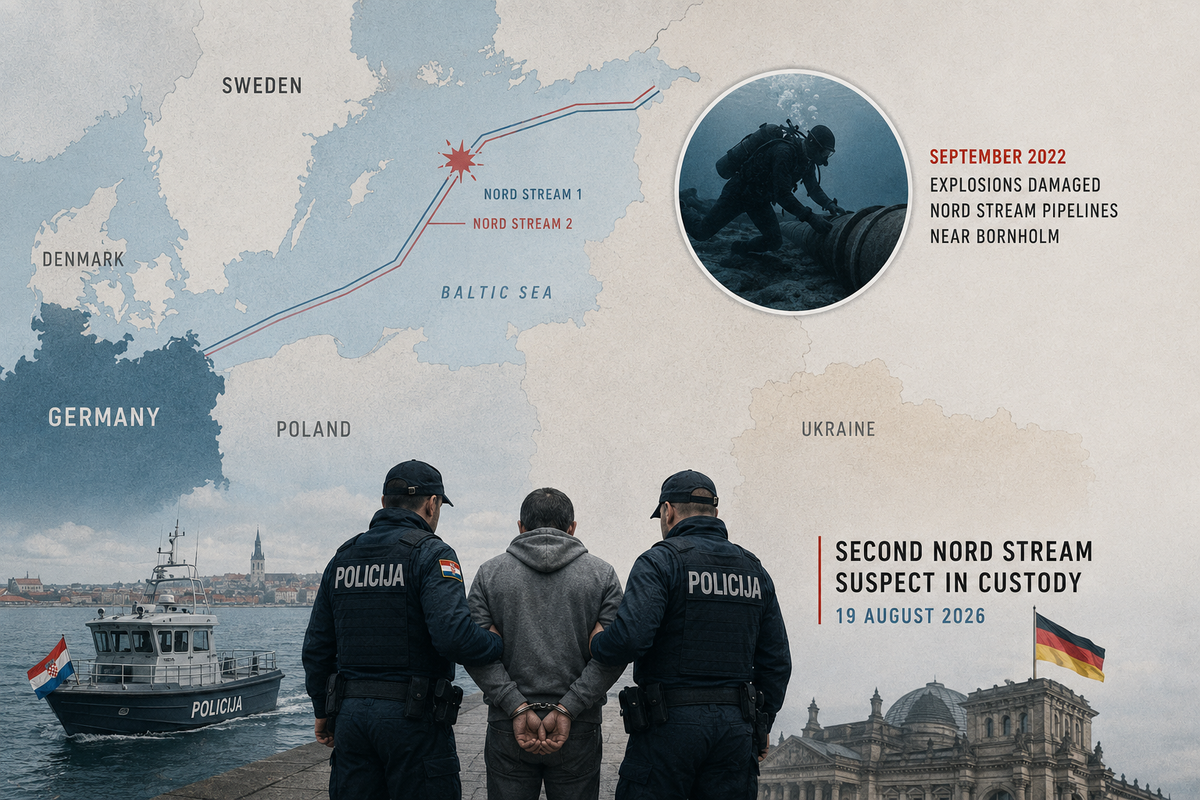
German federal prosecutors announced on 19 August that Croatian police had arrested Ukrainian national Vladimir Z. in Pula on a European Arrest Warrant in connection with the September 2022 Nord Stream explosions. Prosecutors describe him as a trained diver who, per the investigation, directly participated in the dives used to place explosives on Nord Stream 1 and Nord Stream 2 near Bornholm. He is expected to be transferred to Germany.
The sabotage itself is nearly four years old; what's new is the 19 August arrest, not a newly discovered attack. This is now the second suspect taken into custody in Germany's case. Former Ukrainian army officer Serhii K., whom prosecutors accuse of coordinating the operation, was arrested in Italy in 2025, extradited to Germany, and formally charged in July 2026. Per the investigation, K. led a team of divers, a ship captain, and an explosives expert who transported and placed the charges using a boat rented with forged documents.
The arrest does not establish Ukrainian government responsibility. Kyiv formally rejected that conclusion in July: Ukraine's Prosecutor General's Office said "no facts have been established that would indicate the involvement of the state of Ukraine, its authorized bodies or officials" in the sabotage, and proposed setting up a joint investigation team with Germany.
What changed
Germany had already identified multiple Ukrainian suspects and brought its first prosecution against Serhii K. The new element is that investigators have now secured another alleged member of the operational team, this time a diver accused of physically participating in placing the explosive charges.
BSM analysis: This moves the case further beyond intelligence reconstruction and outstanding arrest warrants, toward a multi-defendant criminal case in which prosecutors may be able to test their account of the operation, command relationships, and logistics through courtroom evidence and testimony — not just investigative files. It does not, however, strengthen the still-contested claim of Ukrainian state direction to the same degree: the new arrest concerns alleged operational participation, while the question of who authorised the attack remains unresolved.
Why it matters for Ukraine and the Baltic region
Nord Stream remains the most consequential act of physical sabotage against critical infrastructure in the Baltic Sea during the current European security crisis. Germany's ability to identify, arrest, and prosecute alleged participants therefore matters directly to Baltic infrastructure-security doctrine, attribution standards, and future deterrence.
For Ukraine, the political sensitivity is substantial. German prosecutors have already alleged that Serhii K. acted for Ukrainian state entities, while Ukraine denies state involvement. A second detained alleged operative gives German investigators another potential evidentiary route into how the sabotage team was organised, financed, and tasked.
BSM analysis: Denmark, Sweden, Poland, and other Baltic states will be watching the proceedings closely — the attack demonstrated how vulnerable subsea pipelines, cables, and energy infrastructure are to small covert teams operating from civilian vessels. That is a structural lesson independent of the eventual answer on state sponsorship: the technical fact that a small diving team can disable strategic infrastructure remains relevant regardless of what a German court ultimately rules.
What comes next
The extradition and interrogation of Vladimir Z. could allow German investigators to corroborate or challenge their existing reconstruction of the sabotage crew and the roles assigned to individual members. If prosecutors eventually produce evidence linking operational participants to identifiable Ukrainian government or military command structures, the case could become a major diplomatic issue between Berlin and Kyiv, despite Germany's continuing support for Ukraine. Conversely, if the evidence establishes an independently organised Ukrainian group without state authorisation, that would materially narrow the attribution and reduce the broader interstate implications.
The case is also likely to reinforce Baltic and NATO efforts to treat subsea infrastructure protection as a counter-sabotage and counter-intelligence problem, not merely a maritime-surveillance task.
Bottom line
The second Nord Stream arrest matters not because it answers the case's central political question — who authorised the attack — but because it changes the architecture of the investigation itself: from a single defendant and an intelligence reconstruction to a multi-defendant criminal case that can eventually be tested with courtroom evidence.
Baltic Security Monitor (osint-baltic.com) — an analytical publication covering security on NATO's northeastern flank.