Fire at Milrem Robotics: Estonia Investigates Possible Russian Sabotage Against a Combat-Robotics Supplier to Ukraine

Baltic Security Monitor | Analytical Review Material OSINT Update — 19 August 2026, 08:00 Europe/Tallinn
Materiality assessment
| Parameter | Value |
|---|---|
| Status | MATERIAL UPDATE |
| Category | Hybrid Operations / Defence Industry / Counter-intelligence |
| Materiality | medium-high |
| 🟡 markers (unconfirmed/hypothesis) | 4 |
| 🔴 markers (confirmed fact) | 0 |
The fire at a Milrem Robotics facility happened overnight into 15 August — the news is not the fire itself but what Estonian Prime Minister Kristen Michal did on 18 August: he publicly elevated the case from a criminal arson investigation to a national-security question, confirming that suspects have been identified and that possible Russian involvement is one of the leading investigative lines. The attribution threshold has not been crossed. What defines this piece's tone is precisely that balance — a serious precedent, paired with an unproven link to Moscow.
What happened
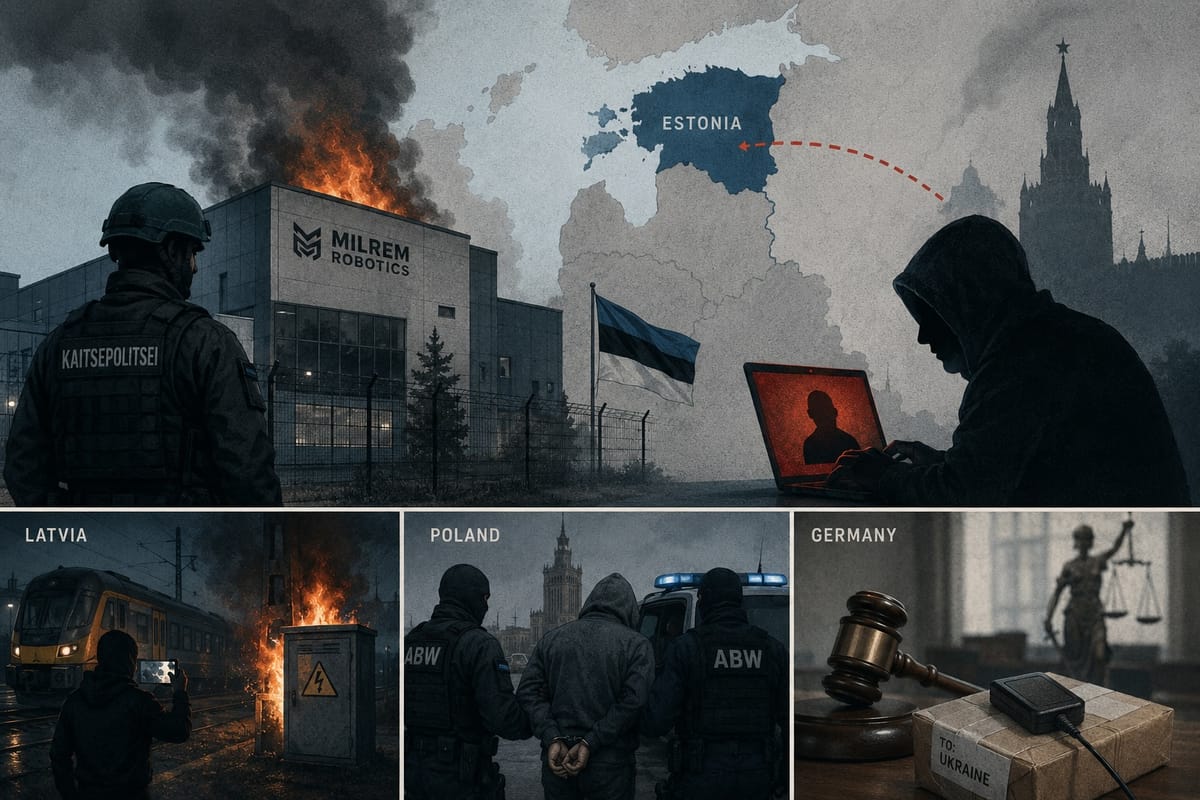
A fire at premises used by Estonian defence-technology company Milrem Robotics broke out late on Friday, 14 August. Estonian prosecutors have confirmed the building was deliberately targeted. The material change within this monitoring window is not the four-day-old fire itself, but Prime Minister Kristen Michal's public disclosure on 18 August that suspects have already been identified, and that possible sabotage and Russian involvement are among the principal investigative lines. <cite>Reuters</cite>
Estonia's Prosecutor General Astrid Asi confirmed the investigation is drawing on evidence gathered by the security services, and that prosecutors have already sought court approval to detain suspects while establishing motive, including the sabotage hypothesis. Michal himself wrote on X that one investigative line is "a possible act of sabotage and the involvement of Russia," adding: "Attempts to intimidate us or undermine our security will not succeed." <cite>Kyiv Post</cite>
The Russian link is not established. 🟡 Prosecutors have confirmed only the deliberate character of the arson; Michal explicitly described Russian involvement as an investigative hypothesis, not a completed attribution. Reuters sought comment from the Russian embassy in Tallinn but had received none at time of publication.
Why Milrem is not a generic target
Milrem Robotics makes autonomous military systems, including the THeMIS unmanned ground vehicle — combat-proven and deployed in Ukraine since 2022 for logistics, casualty evacuation, and route clearance. In June the company began delivering more than 100 THeMIS systems to Ukraine under a Netherlands-funded initiative. <cite>Kyiv Post</cite> The firm is deeply integrated into European defence projects and is developing robotic and counter-UAS systems specifically for NATO's eastern-flank defence.
BSM analysis: This is precisely the class of target where an attack raises materiality regardless of eventual attribution. Milrem is not a generic industrial company: its output simultaneously supplies Ukraine and forms part of Estonia's rapidly expanding defence-industrial base. Estonia's government has already officially classified physical sabotage, cyberattacks and influence operations as growing threats requiring enhanced protection of defence and critical infrastructure. <cite>Eesti Vabariigi Valitsus</cite>
Regional pattern: not the only case of its kind in two weeks
The Estonian arson does not sit in isolation. It follows a run of cases across the Baltic states and wider Europe that share the same operational signature: locally recruited operatives used against infrastructure and defence-related targets.
Latvia. Latvia's State Security Service reported that two individuals set fire to a train and to railway relay cabinets, acting, in the service's own words, "in Russia's interests." The perpetrators filmed the arson and sent the footage to their handlers, after which Russian operatives reportedly used the material for propaganda purposes, presenting it as fires in Ukraine. Latvian security officials place this among at least 151 documented cases of Russia-linked sabotage across Europe since February 2022. <cite>Latvia's State Security Service</cite>
Poland. On 13 August, Prime Minister Donald Tusk disclosed that the Internal Security Agency (ABW) had detained a 29-year-old Russian national, recruited — per Tusk — by Russian intelligence services to kill a dual US-Ukrainian citizen described as "inconvenient for Putin's regime." The arrest took place on 7 August. Tusk called it "the first time someone on Russian orders has decided to attack an American citizen on the territory of another NATO country," saying the plot was foiled "at the last minute." <cite>Notes from Poland</cite>
Germany. On the very same day Michal spoke on Milrem — 18 August — a Munich court delivered a verdict in a separate sabotage case: a 30-year-old Ukrainian national was sentenced to one year and three months for espionage for sabotage purposes, over a plan to mail test packages containing GPS trackers to Ukraine intended to disrupt transport infrastructure; two co-defendants were acquitted. The case fits a broader pattern RFE/RL has described as Russia's use of "disposable agents" — operatives recruited over messaging apps, often with no direct contact with career intelligence officers. <cite>Euronews</cite>
BSM analysis: The Estonian case does not, at this stage, establish that the Milrem fire belongs to this pattern — investigators are explicitly testing the hypothesis, not confirming it. 🟡 But the fact that a single two-week stretch of August produced a foiled assassination plot in Poland, an attributed contract arson in Latvia, a sabotage conviction in Germany, and now an arson under investigation in Estonia builds a statistical picture in which any single incident deserves to be read against an already-documented curve, not in isolation.
Likely implications
These are forward-looking assessments as of 19 August, each carrying its own separately flagged uncertainty:
- Estonia is likely to step up physical security and counter-intelligence attention around defence manufacturers, particularly those supplying Ukraine or working on strategically sensitive unmanned and counter-UAS technologies. 🟡
- If investigators establish communications, payments, or tasking linking the identified suspects to Russian intelligence or intermediaries, the case would become a substantially more serious material delta — potentially triggering arrests, diplomatic measures, and broader Baltic intelligence coordination. 🟡
- Conversely, if investigators establish a non-state motive, the Russian-sabotage hypothesis should be closed rather than preserved through inference. 🟡
BSM analysis: The third point is the methodologically important one. The recent run of comparable cases across Latvia, Poland and Germany creates a temptation to attribute a new incident to the same source before the investigation concludes. BSM deliberately withholds that step: in this window, Russian attribution is the investigation's working hypothesis, not an established fact.
Bottom line
The Estonian Milrem case qualifies as a material update not because Russian attribution has been proven — it hasn't — but because the case's official status has changed: from a criminal arson investigation to a matter the country's prime minister has publicly and directly linked to possible involvement by a hostile state, at a facility that supplies combat robotics to Ukraine. Combined with parallel cases in Latvia, Poland and Germany within the same two-week window in August, this forms a pattern worth tracking across BSM's next cycles — regardless of whether the Russia hypothesis specific to Milrem is eventually confirmed or closed.
Baltic Security Monitor (osint-baltic.com) — an analytical publication covering security on NATO's northeastern flank. Materiality assessments and 🟡/🔴 status markers are reproduced from the source BSM analytical cycle; underlying facts were independently cross-checked and supplemented from open sources.