The United States Shifts to Transactional Security: Congress Defends NATO While the Administration Dismantles It


Baltic Security Monitor | Analytical Commentary
June 2026
American lawmakers advanced legislation on military assistance to Ukraine and tightened sanctions against Russia for the first time since Trump's return to power — over the explicit objection of the White House. A 218–204 vote in the Republican-controlled House of Representatives cleared the path for a final vote on the Ukraine Support Act. The legislation provides $8 billion in military loans to Ukraine, extends the Ukraine Security Initiative through 2027, and imposes additional sanctions on Russia.
This looks like a win for NATO's defenders. In reality it is a desperate tension between two branches of government, exposing a fundamental fracture in American grand strategy.
The Parallel Signal from the Pentagon
While Congress voted, the administration sent the opposite message. Secretary of Defense Hegseth ordered the withdrawal of 5,000 U.S. troops from Germany within one year, framing the decision as the outcome of "a careful review of force posture in Europe." The timing — coinciding with Chancellor Friedrich Merz's public criticism of U.S. involvement in the Iran campaign — is not coincidental. It is, in effect, a penalty for geopolitical insubordination.
This is where the real story lives. The Trump administration is systematically transitioning the United States to a transactional model of European presence. Demands that allies pay more, territorial claims on Greenland, tariff threats against eight NATO members for participating in joint exercises — these are not separate incidents. They are elements of a single logic: American presence in the Alliance is no longer a standing guarantee. It is a condition that must be renegotiated each time.
Strategic Doctrine: Russia as "Manageable," Europe as Self-Reliant
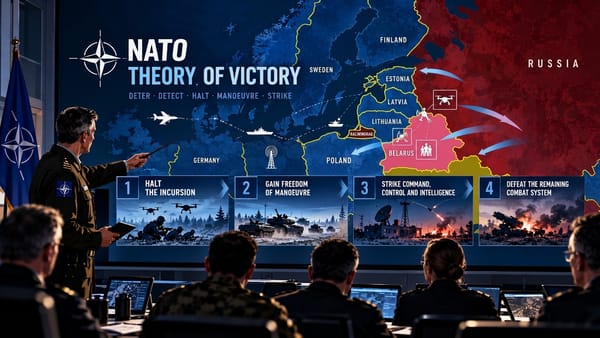
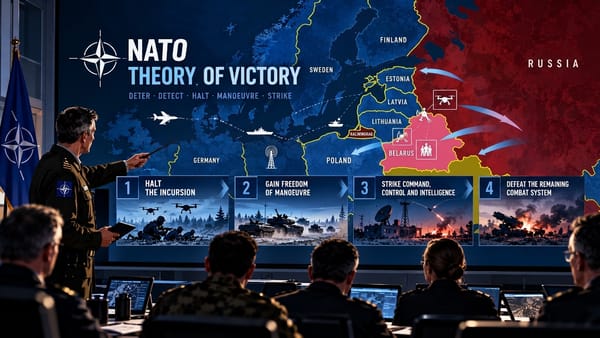
The Pentagon's strategic posture document frames Russia as a serious but manageable threat. European allies are expected to assume primary responsibility for the conventional defence of the continent. In February of this year, the Chairman of the Joint Chiefs formally instructed NATO to "assume primary responsibility for conventional defence of Europe." This is not a warning — it is a doctrinal change on the record.
Congress Tries to Arrest the Slide
Legislators are attempting to constrain the drift. The NDAA requires maintaining U.S. force levels at 76,000 personnel and prohibits the withdrawal of equipment valued at $500,000 or above. But legislation is an inadequate instrument for this purpose. Congress can block a formal U.S. withdrawal from NATO. What it cannot block is the gradual dismantling of presence: the reprioritisation toward the Indo-Pacific, the reduction of intelligence-sharing, the quiet hollowing-out of forward commitments — all of which change the Alliance without technically violating it.
The distance between "NATO membership" and "credible NATO guarantees" is widening.
Europe Responds With Money — But Money Is Not Presence
European allies exceeded defence spending expectations in 2025. For the first time in NATO history, a European ally — Norway — surpassed the United States in defence spending per capita. The Baltic states are committing between 3.4% and 5.4% of GDP. Poland is building East Shield. Finland is scaling up artillery ammunition production toward one of the highest output levels in Europe.
But money does not replace presence. NATO is built around an American military spine: command architecture, nuclear deterrence, strategic air and maritime assets. No budget can replicate these functions in a year or two.
The Scenario for the Year Ahead
Congress will continue voting to fund Ukraine — but the White House will retain the power of non-compliance. Europe will continue raising defence budgets — but will gradually internalise that American guarantees depend on the sitting president's current disposition. And Russia will watch the world's most powerful Alliance transition from collective security to transactional security: a regime under which the alliance exists not while someone is threatened, but for as long as the president has not changed his mind.
Transactional security is not security. It is a condition.
Baltic Security Monitor (osint-baltic.com) — analytical publication covering NATO's northeastern flank.