The Border, Not the Sea: OSINT Digest — 1 July 2026

Baltic Security Monitor | Analytical Brief
Snapshot: 2026-07-01T08:04:11Z
OSINT Indices
| Indicator | Value | Delta (24h) |
|---|---|---|
| Composite Threat Index | 0.19 | ↑ from 0.13 — highest in 5 days |
| Force Posture | 0.28 | ↑ from 0.18 |
| Logistics | 0.07 | = stable |
| Info/Cyber | 0.00 | ↓ from 0.06 — back to zero |
| Border/Air/Maritime | 0.31 | ↑↑ from 0.17 — new cycle high |
Events logged (24h): 10 · High-confidence: 0
Quarantine: 0 · Source failures: 0
The first day of July opens with the sharpest composite reading in five days (0.19) and an outright record for Border/Air/Maritime across the entire monitoring cycle — 0.31, surpassing the previous high of 0.24 (18–19 June). At the same time, the two-day Info/Cyber signal (0.05→0.06) has vanished entirely, returning to zero. This is not a contradiction — it is a shift in focus: the OSINT system responded to a specific regional development on the Latvia–Russia border rather than to diffuse cyber-domain activity.
Why Border/Air/Maritime Hit 0.31
The primary driver is not a military incident but a political-industrial decision with direct security implications.
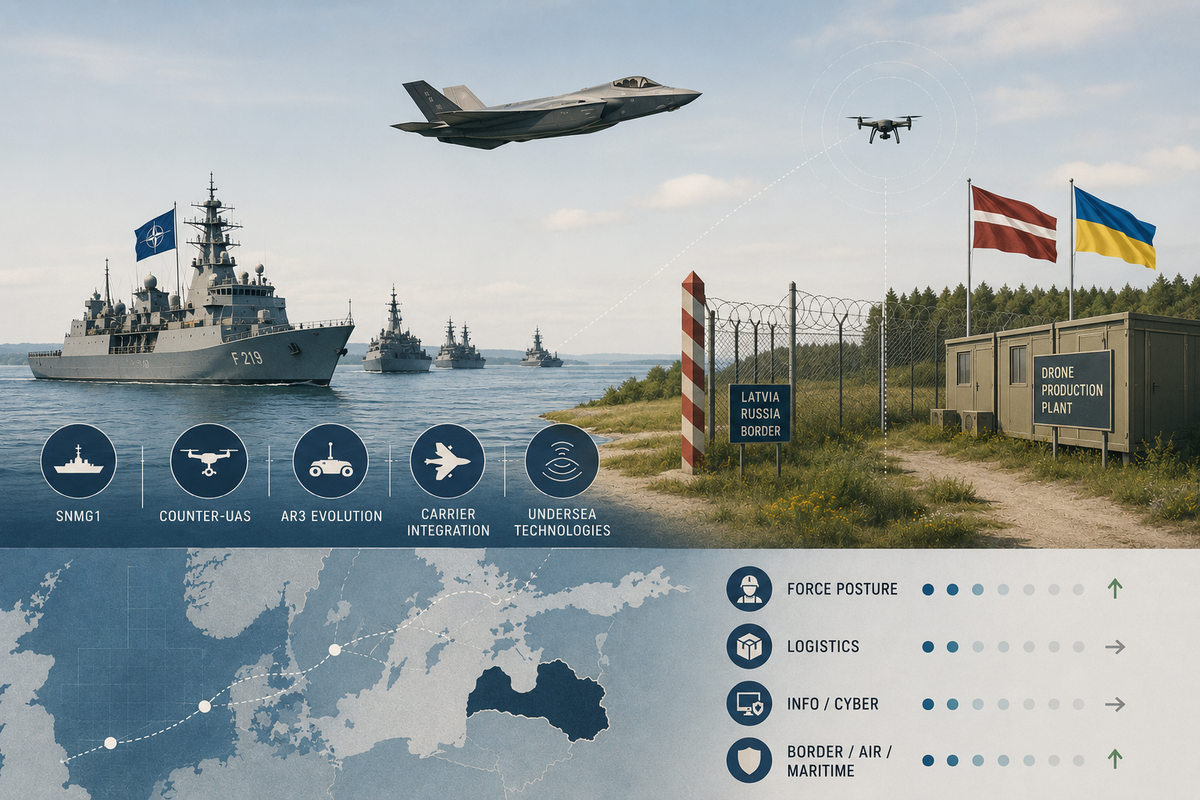
On 29 June 2026, Latvian Prime Minister Andris Kulbergs, visiting a military base in the Latgale region, announced that Latvia and Ukraine will build a joint drone manufacturing facility in Latgale — the eastern Latvian region bordering both Russia and Belarus.
This gives operational shape to the so-called "Drone Deal" signed on 9 June between Kulbergs and Ukrainian President Volodymyr Zelensky on the sidelines of the Nordic-Baltic Eight summit in Tallinn — the two leaders' first-ever meeting. Latvia became the sixth country to join Ukraine's bilateral drone cooperation framework. Under the agreement, Ukraine will supply Latvia with strike drones, ground robotic complexes and maritime drone systems, while Latvia will supply Ukraine with domestically produced systems in return.
Why the location matters. Placing the facility directly in the border region is a deliberate choice carrying two simultaneous messages: military-logistical (shortening the supply and production chain toward a potential contact line) and political (a demonstration of resolve in the face of Russian pressure).
Moscow's reaction. Russia has been publicly outraged at the Baltic states' alleged role in Ukraine's drone warfare against the Russian hinterland, accusing the three republics of opening their airspace to Ukrainian drones striking targets more than a thousand kilometres from Kyiv — including Russia's Baltic region and the St. Petersburg area. More outlandish accusations, including from Russia's Foreign Intelligence Service (SVR), have alleged that the Baltic states allow Ukraine to launch drones directly from their territory. The announcement of a border-region drone factory will almost certainly draw criticism from Moscow and is likely to be characterised as an escalatory move.
The political backdrop. The announcement comes against a fraught political backdrop in Riga. On 7 May, a suspected stray Ukrainian drone that entered Latvian airspace from Russia exploded at an oil storage facility in Rēzekne, damaging four empty fuel tanks. The incident triggered the resignation of both the defence minister and Prime Minister Evika Siliņa within days. Kulbergs took office shortly thereafter. In other words, the decision to build the factory is being made by a prime minister whose predecessor lost office over a drone incident in precisely this region.
BSM assessment: Border/Air/Maritime at 0.31 captures exactly this combination of factors: a concrete industrial decision with a deliberately chosen border location, an anticipated Russian response, and a backdrop of the 2026 drone incursion series. This is not military escalation in the conventional sense — it is a structural decision reinforcing border-region defence industry precisely at the point of highest risk exposure.
Top Events
🟠 1. Italy Hands Command of NATO Maritime Task Group to Greece
OSINT score: 0.44 — WATCH (new entry)
In a ceremony overseen by MARCOM Chief of Staff, Italian Navy Rear Admiral Luca Pasquale Esposito, Italian Navy Rear Admiral Cristian Nardone formally handed command of Standing NATO Maritime Group 2 (SNMG2) to Hellenic Navy Commodore Georgios Kypriotis.
Under Rear Admiral Nardone's command, the task group maintained a continuous presence in strategically significant waters while contributing to major Allied exercises, including Neptune Strike, Maritime Combat and Advanced Training (MCAT), and Dynamic Manta. A key highlight of the Italian command was advanced interoperability training, working with Allies across the region — reciprocal ship visits, close manoeuvring drills, and communications exercises. The group also conducted numerous Passing Exercises (PASSEX) with Mediterranean Partner navies, including Algeria, Egypt and Morocco.
Regional context of SNMG command rotations. SNMG2's rotation comes against a broader transformation of NATO's maritime command structure: in April 2026, the Royal Navy took over command of SNMG1 from Spain, under whose leadership the group conducted sustained operations as part of Baltic Sentry, maintaining a persistent naval presence in the Baltic Sea focused on monitoring critical sea lanes and protecting undersea infrastructure including pipelines and cables. The group also deployed in support of Arctic Sentry, NATO's high-vigilance mission in the High North.
BSM assessment: A routine SNMG2 command handover, occurring on its regular six-to-seven-month cycle, would not normally warrant close attention. Its appearance in today's top five, however, immediately following April's SNMG1 handover (Spain→UK), underscores a broader structural trend: NATO is systematically refreshing leadership across its standing maritime groups throughout 2026, synchronised with the Alliance's wider command-structure reform agreed on 6 February 2026, under which European allies assume greater responsibility across NATO's military leadership.
🔵 2. NATO Allies and Industry Test Counter-Drone Technologies
OSINT score: 0.44 — WATCH
(Full analysis in the 17 June digest: TIE 26, Latvia's Sēlija range, Eurosatory marketplace agreement.)
🔵 3. UK Carrier Strike Group and Ramstein Flag 2026
OSINT score: 0.39 — WATCH
(Full analysis in the 25 June digest: HMS Prince of Wales, F-35Bs over Finland.)
🔵 4. NATO Invests in Future Maritime Technology and Experimentation — CMRE
OSINT score: 0.39 — WATCH
(Full analysis in the 26 June digest: TFX-Arctic, acoustic sensors near Gotland, MAINSAIL.)
🔵 5. The Chair of the NATO Military Committee Visits Ramstein Flag 2026
OSINT score: 0.36 — WATCH
(Full analysis in the 30 June digest: Admiral Cavo Dragone, Bodø–Kallax–Rovaniemi.)
Regional Context: NATO's Ninth Battlegroup in Finland
In June 2026, NATO officially established Forward Land Forces (FLF) Finland — the Alliance's ninth multinational battlegroup, led by framework nation Sweden — to enhance deterrence and defence along NATO's northeastern flank. This formally completes the deployment of forward Allied presence across every sector of the eastern flank, from the Baltic to Scandinavia.
In parallel, NATO continues enhancing protection for Allies along the eastern flank in the cyber and space domains, helping build resilience against Russia's hostile actions. In September 2025, NATO launched Eastern Sentry, a flexible, multi-domain activity to strengthen the Alliance's vigilance along the entire eastern flank; it is under this umbrella concept that Allies continue contributing additional capabilities and assets to NATO's strengthened deterrence and defence posture.
Pre-Ankara Trajectory: Full Weekly Tracker
| Date | Composite | Force Posture | Logistics | Info/Cyber | B/A/M |
|---|---|---|---|---|---|
| 25 June | 0.14 | 0.23 | 0.00 | 0.00 | 0.23 |
| 26 June | 0.11 | 0.11 | 0.07 | 0.00 | 0.21 |
| 29 June | 0.17 | 0.35 | 0.07 | 0.05 | 0.10 |
| 30 June | 0.13 | 0.18 | 0.08 | 0.06 | 0.17 |
| 1 July | 0.19 | 0.28 | 0.07 | 0.00 | 0.31 |
Today's readings show composite reaching a five-day high, driven entirely by Border/Air/Maritime, while Info/Cyber has fully reverted to zero — confirming that its two-day appearance (29–30 June) was linked to a specific processing cycle around CyCon material and pre-summit cyber discourse rather than the formation of a lasting trend.
Six days remain until the NATO Ankara Summit (7–8 July).
Baltic Security Monitor (osint-baltic.com) — analytical publication covering NATO's northeastern flank.
All OSINT coefficients are calculated by an automated indexing system from open sources.