Quiet Everywhere Except Force Posture

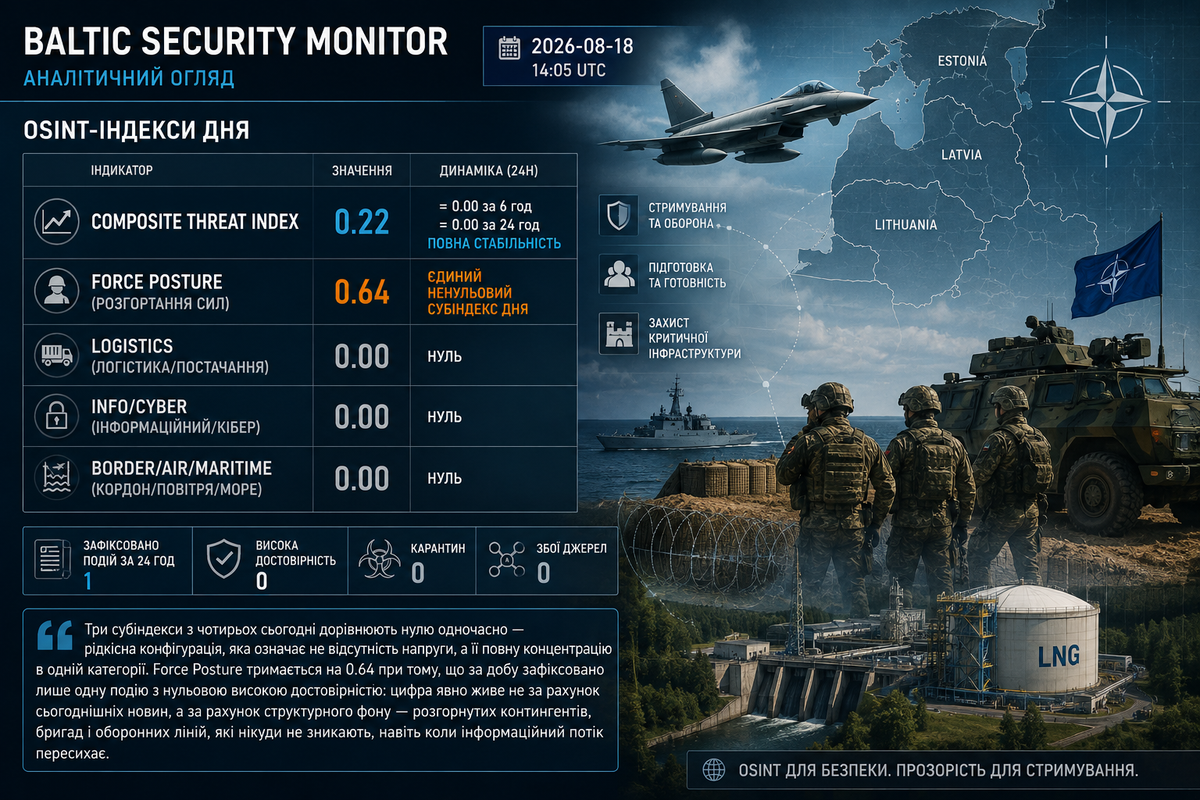
Baltic Security Monitor | Analytical Review Snapshot: 2026-08-18T14:05:40.629Z
Today's OSINT indices
| Indicator | Value | 24h movement |
|---|---|---|
| Composite threat index | 0.22 | flat: 0.00 over 6h, 0.00 over 24h |
| Force Posture | 0.64 | the only non-zero sub-index today |
| Logistics | 0.00 | zero |
| Info/Cyber | 0.00 | zero |
| Border/Air/Maritime | 0.00 | zero |
Events logged, 24h: 1 · High-confidence: 0 Quarantine: 0 · Source failures: 0
Three of four sub-indices sit at exactly zero simultaneously today — a rare configuration that signals not the absence of tension, but its complete concentration in a single category. Force Posture holds at 0.64 despite just one logged event in 24 hours, none of it high-confidence: the number is clearly being carried by structural backdrop rather than today's headlines — deployed battalions, hardened infrastructure, a defence posture already in place along the eastern border that doesn't switch off when the news cycle runs dry. Today's top-5 list is filled mostly with entries two to six days old, a sign the algorithm simply had little fresh material to choose from.
Top 5 digest events
🔴 1. Air defense neutralizes 85 drones, three missiles overnight
OSINT score: 0.53 — WARNING Ukrinform · age 2d 8h
The event is effectively two days stale: per Ukrinform, Ukrainian air defence intercepted 85 drones and three missiles during one of Russia's overnight strikes. This sits within the already-established daily intensity of Russia's air campaign against Ukraine — no sign of a qualitative shift in munition type, trajectory, or target region.
BSM analysis: This entry's presence in the 18 August top-5 is more an artifact of the 24–72 hour relevance window than a marker of current relevance. It remains listed simply because nothing fresher has come along to displace it.
🔴 2. Air defense neutralizes 124 drones, three Banderol munitions overnight
OSINT score: 0.49 — WARNING Ukrinform · age 3d
Another repelled overnight strike — 124 drones and three Banderol-type munitions. Somewhat larger in scale than the previous entry, but chronologically even older (3 days). Both Ukrinform entries illustrate the same daily rhythm of Russian air pressure on Ukraine, which does not automatically translate into elevated Baltic/NATO sub-indices — and today it didn't: Border/Air/Maritime sits at zero.
BSM analysis: Taken together, the two Ukrinform entries (85 drones + 3 missiles; 124 drones + 3 Banderols) read as background war density rather than a Baltic-flank signal. Both are older than 48 hours, and neither has been updated with fresh detail in the last 24.
🖼 3. DeepStateUA: map updated
OSINT score: 0.51 — WATCH DeepStateUA · age 5d
A routine update to DeepStateUA's interactive front-line map, with no accompanying text in the entry itself. The 🖼🔄 marker indicates a technical update (a new map image/layer), not a textual event.
BSM analysis: A five-day-old entry still making the top-5 is another marker of a thin news day: DeepStateUA updates its map on close to a daily basis, so the update itself rarely qualifies as an "event" in the ordinary sense. Its top-5 placement today reflects the absence of fresher competition, not its own weight.
🔄 4. DeepStateUA: map updated (repeat)
OSINT score: 0.43 — WATCH DeepStateUA · age 6d
Duplicates the entry type above, only older (6 days) and without the image marker. Two DeepStateUA entries in a single top-5 is a direct consequence of a thin day: the algorithm lacks fresh, high-scoring events and is holding old technical map updates as filler.
BSM analysis: (Recurring entry type — no separate breakdown needed; the presence of two such entries back to back is itself worth noting as a thin-day indicator; see the section below.)
5. NATO fighters shoot down drone in north-east Latvia
OSINT score: 0.40 — WATCH LSM · age 2d
This is the same Rugāji incident from 14 August that BSM already covered in detail in the previous piece: a drone shot down by an Italian Eurofighter, still formally unattributed — even though Latvian Defence Minister Raivis Melnis publicly named a likely entry route (via Belarus) on 17 August and floated a working hypothesis of Ukrainian origin diverted by Russian electronic-warfare jamming. (Full analysis — BSM's 18 August piece covering the 08:00/14:00 Security Watch cycles.)
BSM analysis: This entry's presence in today's aggregated digest — on the same day the same story already moved through two separate Security Watch cycles — shows how long the attention tail runs for an unresolved border incident: it now sits simultaneously in real-time monitoring (Security Watch) and the daily aggregated digest.
Today's key signal: an empty day as data
Only one new event was logged in 24 hours, and none of it high-confidence. Meanwhile the top-5 is built entirely from old entries (2–6 days), including two technical DeepStateUA map updates with no accompanying text. This is exactly the kind of day where the story is not the top-5 itself, but the emptiness around it.
A regional search confirms the broader picture of relative calm in the news flow over the past 1–3 days: no fresh incidents or statements were found that would obviously belong in the digest. What does explain the structural backdrop keeping Force Posture at 0.64 without any new trigger is visible in mid-August reporting: on 10 August, Lithuania, Latvia and Poland tightened security at critical infrastructure — an LNG and oil-products import terminal, the Kruonis pumped-storage plant, the Daugava dam near Riga, the Inčukalns underground gas storage facility, a nuclear construction site, and the energy interconnector with Ukraine — against intelligence warnings of a possible Russian false-flag drone operation using Ukrainian-type drones, intended to split allied response rather than cause direct damage. Lithuania's defence minister put it plainly: "We are not naive: we see the information, we read between the lines."
BSM analysis: This is the resolution of the "0.64 with zero fresh events" paradox: in BSM's model, Force Posture responds not only to new incidents but to sustained readiness — deployed battalions, hardened facilities, a defensive stance already held along the border. When the news flow dries up, the index doesn't fall to zero — it reflects a structure that is already in place and isn't going anywhere.
Regional context
The same structural backdrop explains why Force Posture has been running above the "background" 0.00–0.20 range for months: NATO continues to expand its command architecture on the Baltic flank. This spring the alliance decided to assign the German-Netherlands Corps (1 German-Netherlands Corps, headquartered in Münster) to cover Estonia and Latvia separately from the existing Multinational Corps Northeast in Poland, under the stated goal of "mass at speed." UK-led (Estonia), Canada-led (Latvia), Germany-led (Lithuania) and US-led (Poland) battlegroups remain in place, Latvia has already scaled its presence to brigade level, and the Baltic Defence Line of border fortifications continues to be built. None of this is an 18 August event — but it is precisely what forms the "floor" below which BSM's Force Posture index doesn't drop, even on the quietest days.
Bottom line
18 August is an example of a day when the composite index and three of four sub-indices go silent, while the one active reading is carried not by news but by structure already deployed on the ground. Today's top-5 is best read not as a list of significant events, but as an indicator of a thin information day: two stale air-defence intercepts, two technical front-line map updates, and one border incident that has already received a separate write-up in the same day's Security Watch cycles. The next material shift will most likely come not from routine news flow, but from one of the open files BSM is already tracking: attribution of the Rugāji drone, the status of British drones in deep strikes, or the first confirmed Russian detention of a vessel.
Baltic Security Monitor (osint-baltic.com) — an analytical publication covering security on NATO's northeastern flank. All OSINT coefficients are calculated by an automated indexing system based on open sources.