A Workshop, Not an Arsenal: Poland Wins Europe's PAC-3 Maintenance Hub
The United States and Lockheed Martin have chosen Poland to host the first PAC-3 interceptor repair and recertification centre outside America. The decision is confirmed by Warsaw and by the manufacturer. But this is not a new factory and not new missiles: the facility still has to be built, and…

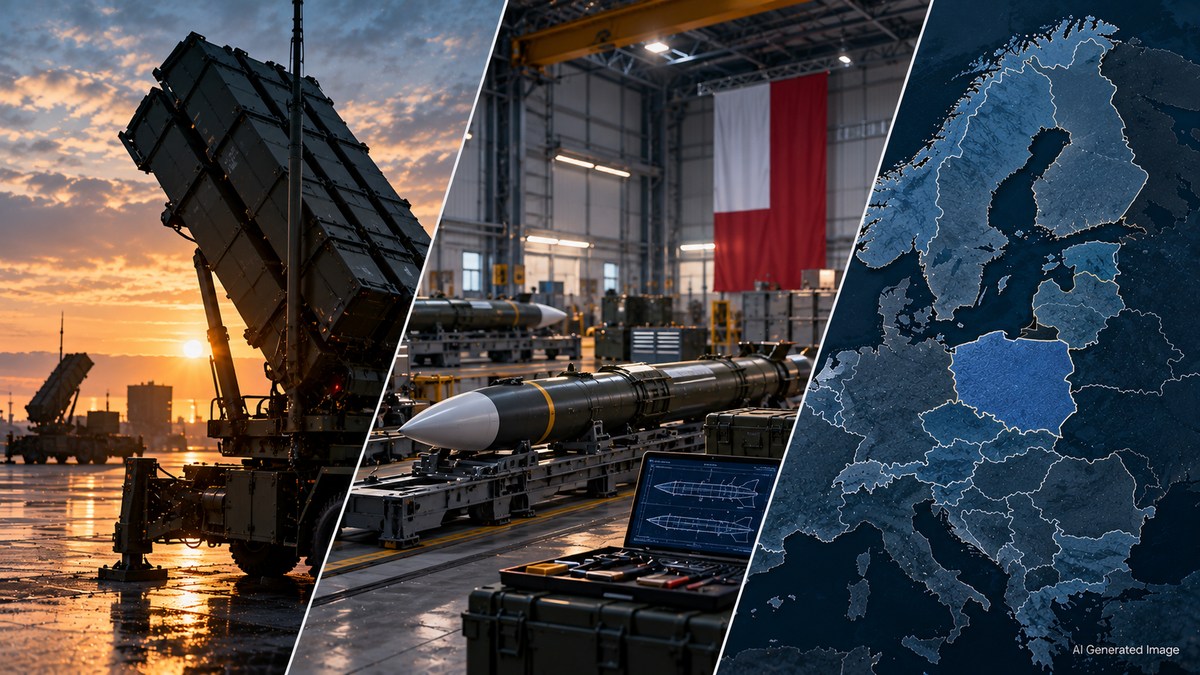
The United States and Lockheed Martin have chosen Poland to host the first PAC-3 interceptor repair and recertification centre outside America. The decision is confirmed by Warsaw and by the manufacturer. But this is not a new factory and not new missiles: the facility still has to be built, and it is more than a year from opening.
Baltic Security Monitor | MATERIAL UPDATE — MODERATE | Snapshot: 28 October 2026, 08:00 EET
What happened
On 27 October, Polish Deputy Prime Minister and Defence Minister Władysław Kosiniak-Kamysz announced that the US government, working with Lockheed Martin, will establish a new PAC-3 missile maintenance centre in Poland. The manufacturer issued its own statement from Brussels the same day.
According to Lockheed Martin, the facility will carry out repair, refurbishment, lifecycle support, recertification and integrated testing for interceptors operated by European NATO allies. Germany, the Netherlands and Sweden — signatories to the July agreement alongside the US and Poland — will take roles in the supply chain.
Deputy Defence Minister Magdalena Sobkowiak-Czarnecka said four countries competed for the site: Poland, Germany, the Netherlands and Norway, with the Polish bid ranked highest from the application stage. She put the investment at roughly PLN 1 billion (about $253 million) and said the centre would take a dozen or so months to become operational. Reuters reported it will be the only such facility outside the United States.
US Ambassador to Poland Tom Rose described President Trump's decision as a milestone in US–Polish defence cooperation. Defence outlet Army Recognition reports that the US Department of War announced the selection on the margins of NATO's Conference of National Armaments Directors (CNAD).
What changed
7 July 2026 — At the NATO summit defence industry forum in Ankara, the US, Poland, Germany, the Netherlands and Sweden signed an agreement to explore a European PAC-3 maintenance facility. No host was named.
27 October 2026 — Poland is formally selected as host; the facility's functions and partners' industrial roles are confirmed.
This is an implemented siting decision rather than another statement of intent. The exact site, contracts and construction timetable, however, have not been published.
BSM analysis: Europe's Patriot problem is not only how many new interceptors arrive, but how many existing ones sit idle. Poland's defence ministry says a missile needing recertification currently has to travel to the US and back, a cycle lasting well over a year. For a battery, that is ammunition that exists on paper but cannot be fired. A Polish hub targets exactly that bottleneck: it does not raise production, but it raises the share of the inventory that is ready at any given moment. For NATO's northeastern flank this strengthens air-defence logistics; for Poland it adds another pillar to its role as the Alliance's main rear-area hub, alongside its function as the logistics gateway for Ukraine.
What it means for Ukraine
Relevant, but indirect. The decision does not give Ukraine additional Patriot missiles, nor does it unlock its pending US transfers. Over the medium term, faster turnaround of European interceptors could ease pressure on allied stocks — and with it, allies' capacity to share with Kyiv. It offers no immediate relief on air-defence ammunition.
Still unknown
🟡 The specific site has not been disclosed.
🟡 A binding construction schedule and industrial contracts are unconfirmed; "a dozen or so months" is a Polish government estimate.
🟡 Suggestions that the hub could be a first step towards PAC-3 production in Poland remain a political ambition, not a decision.
Next milestones: site approval, industrial contracts, construction, certification and the first completed missile overhaul.
WATCH — no new MATERIAL delta
Oleshky. Both sides say the local ceasefire has been in force since 27 October. Independently confirmed convoy arrivals and completed evacuations have not yet been established. The "expanded corridor" hypothesis is closed as recycled information.
Patriot / NASAMS / PURL for Ukraine. No new confirmed Pentagon authorisation or completed transfer. The Polish hub is a separate industrial story.
Black Sea. Russian claims of strikes on two vessels bound for Chornomorsk and Odesa remain independently unverified.
Bars missiles for Germany. No signed Bundeswehr contract or confirmed delivery.
NATO Black Sea reinforcement. The French Atlantique 2 deployment in Romania has been known since 18 October; no new assets confirmed.
The remaining lines among the 25 open investigations are unchanged; none was promoted to MATERIAL.
Bottom line
For years Europe bought Patriots while keeping the keys to their upkeep across the Atlantic. The 27 October decision moves those keys to Poland — on paper, for now. The real test comes when the first overhauled missile returns to its battery in months rather than a year.
An interceptor in a depot across the Atlantic does not defend Warsaw. One that is ready to launch does.
Sources:
- Polish Ministry of National Defence — 27 October decision
- Lockheed Martin — manufacturer statement
- Reuters (via US News) — competition, investment, timeline
- Lockheed Martin — July agreement in Ankara
Baltic Security Monitor (osint-baltic.com) — an analytical publication on security on NATO's northeastern flank.
All OSINT assessments are generated by an automated monitoring system based on open sources and verified by the editorial team.