Missiles on Paper, Pressure Behind Closed Doors
In a single day, Washington cleared 500 PAC-3 MSE interceptors for Ukraine that Europeans will pay for, while Pentagon officials, according to Reuters, privately urged the Baltic states to soften their language on Russia. Years may separate approval from delivery. Far less separates public…

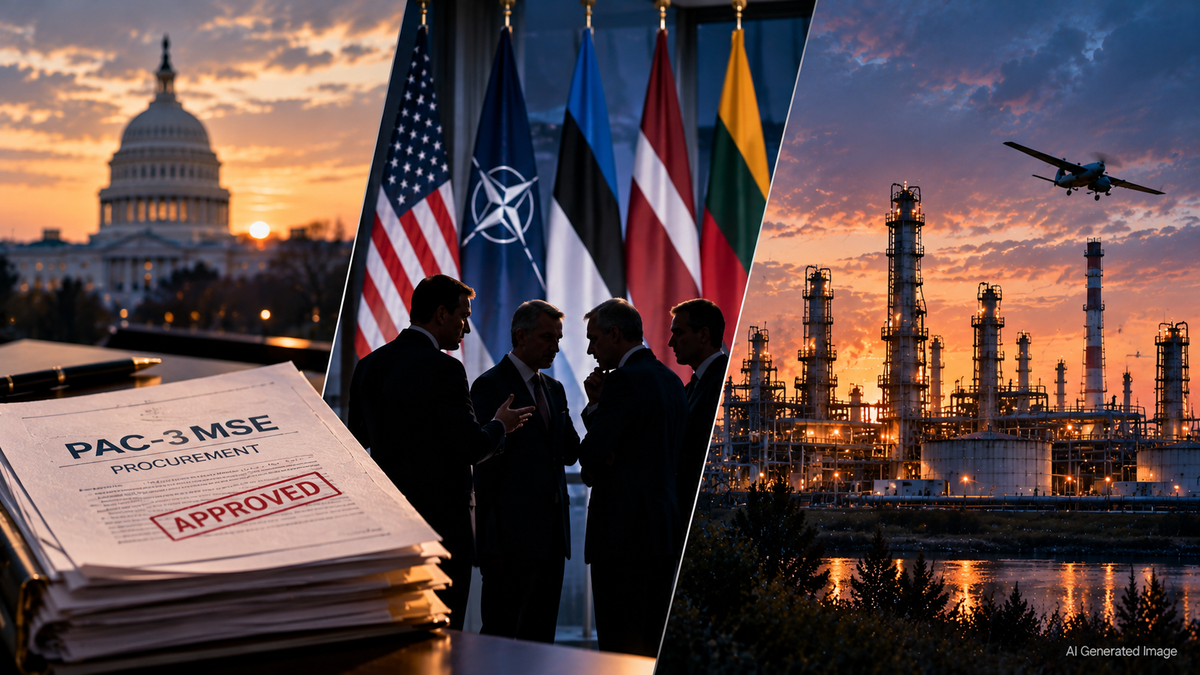
In a single day, Washington cleared 500 PAC-3 MSE interceptors for Ukraine that Europeans will pay for, while Pentagon officials, according to Reuters, privately urged the Baltic states to soften their language on Russia. Years may separate approval from delivery. Far less separates public solidarity from quiet signals.
Baltic Security Monitor | Security Watch, 31 October 2026, 08:00 EET. Monitoring window: 30 October 20:00 to 31 October 08:00.
The cycle in numbers
- MATERIAL UPDATES: 2 (1 HIGH, 1 MODERATE)
- WATCH: 30 investigations (28 retained, 2 added: repeated strikes on Dnipro's rail hub and the US–Lithuania dispute over Belarusian potash transit)
- Uncertainty markers: 🟡 4 · 🔴 0
- Lead development: approval of 500 PAC-3 MSE interceptors (HIGH)
The strongest signal of the cycle is not the number of missiles but the gap between a decision and its delivery. The United States supplies the permission, Europe supplies the money, and Lockheed Martin's production queue decides when interceptors actually reach Ukrainian skies. At the same time, the Pentagon is reported to be telling the Baltic states to talk less about the Russian threat. For NATO's northeastern flank, these are one story: American support increasingly arrives as authorisation rather than as hardware.
🟡 1. 500 PAC-3 MSE: approved, not built
Materiality: HIGH · new entry
On 30 October the US State Department approved a possible Foreign Military Sale to Ukraine of 500 Patriot PAC-3 MSE interceptors, with spare parts and technical support, at an estimated $2.1 billion. The congressional notification has been posted. Lawmakers could in theory delay or block the deal, though continuing bipartisan support for Ukraine makes that unlikely.
No US funds are involved. Canada, Germany and Norway will contribute through the JUMPSTART mechanism, and Ukraine will cover the remainder with national funds drawn from the EU's Ukraine Support Loan.
Timing is the catch. Reuters, citing two people briefed on the decision, reports that the missiles have not yet been manufactured and may not arrive until the early 2030s. President Zelenskyy effectively confirmed the picture, saying deliveries may begin only in a few years.
Kyiv's own figures explain the urgency. Ukraine has received an average of just 12 Patriot interceptors a month this year. It is asking for a winter package of 100 PAC-3s a month, after more than 30 Russian attacks on its power infrastructure in the last two weeks of October alone. Zelenskyy has proposed that the US and European allies release missiles from existing stocks now and refill their own inventories later from the newly approved order.
The earlier Patriot-related shipment confirmed on 30 October by General Alexus Grynkewich is a separate matter. That delivery has happened; these 500 missiles so far exist only as a licence.
BSM analysis
The "America sells, Europe pays" model now has hard numbers attached. Two conclusions follow for the Baltic states and Poland. First, access to US air defence increasingly depends on European money. Second, and less comfortable, money does not buy a place in the queue. If Ukraine, with $2.1 billion on the table, waits until the 2030s, eastern-flank states ordering the same PAC-3 MSE stand in the same line. The milestones to watch are contract signature, the production schedule and, above all, any decision to transfer interceptors from existing stockpiles.
🟠 2. The Pentagon asks the Baltics to lower their voice
WATCH · Pentagon–Baltic messaging
Reuters, citing four people familiar with the discussions, reported that Pentagon officials used private meetings over recent weeks to urge Lithuania, Latvia and Estonia to tone down public warnings about Russia. Elbridge Colby, the under secretary of defense for policy, was among those carrying the message. He reportedly advised a Baltic official against "poking" Russia and singled out the "cornered rat" image of Putin, a comparison Estonian Prime Minister Kristen Michal used in September.
Estonia's defence ministry disputes the account. Spokeswoman Liisa Tagel said no such suggestions had reached Tallinn through official channels. The Pentagon declined to engage, saying only that private conversations among allies remain private. Latvia and Lithuania have not commented on the record.
BSM analysis
With anonymous sourcing on one side and an official denial on the other, the item stays in WATCH. The context, however, makes the report plausible. Colby has long pushed what he calls "NATO 3.0", in which Europe carries most of the conventional defence burden and the US shifts focus to the Indo-Pacific. As Trump renews his push to end the war, the Baltic states are the loudest voices warning that the threat will not stop at Ukraine. A request to speak more softly changes no deployments and no budgets, but it changes the mood: an ally is being asked to describe less of the threat it is arming against. Real change would show up as official policy or a decision on US force presence, not as rhetoric.
🟣 3. Potash through Klaipėda: the pressure that "isn't there"
WATCH · new entry
Politico, citing four European officials, reported that the US special envoy for Belarus, John Coale, has informally discussed easing restrictions on Belarusian transit with Lithuanian diplomats in recent weeks. Two Eastern European officials told the outlet the lobbying has been going on for more than a year.
Lithuanian Prime Minister Mindaugas Sinkevičius said on 30 October that he felt no pressure from American partners and that no written or verbal demands had been made. He described the media reports as an attempt to "take the temperature" of Lithuanian and wider EU reaction, and said Vilnius has no plans to revisit sanctions.
The issue has history. In September Trump announced work on a "massive" deal to buy Belarusian potash, and in the spring, according to RFE/RL, the State Department circulated a nonpaper to Lithuania, Poland and Ukraine proposing that transit be allowed.
BSM analysis
Until 2021, most Belarusian potash left through Klaipėda. Reopening that route would be the most valuable economic concession to Minsk since EU sanctions were imposed. Vilnius is holding its line, but an issue that has circulated for over a year and keeps resurfacing through the press is itself a signal. The timing matters most: two separate American tracks are leaning on Lithuania at once.
🔵 4. Russian refineries: the pause is over
WATCH · Russian refineries
Russian Deputy Prime Minister Alexander Novak acknowledged that three oil refineries and a gas-chemical complex were attacked on 30 October. There had been "a brief pause," he said, but strikes had resumed, with minor damage at one plant. He did not name the facilities.
The independent outlet Astra, working from online footage, identified the Samara target as Rosneft's Novokuibyshevsk refinery, and the Ukrainian manufacturer Fire Point said its FP-1 drones hit the site. Samara's governor reported two people killed during the clean-up. The remaining facilities and the extent of damage are not independently confirmed 🟡.
The pause had an obvious backdrop. On 11 October Trump announced an "energy ceasefire" that neither side had agreed to, and it collapsed as Russian strikes on Ukraine's grid continued. The Wall Street Journal reported on 29 October that Ukrainian long-range units had informally suspended refinery strikes under US pressure, with fuel prices a concern ahead of the midterms. Novak's reference to a pause does not establish that a formal order existed.
BSM analysis
Resuming strikes on the eve of the US midterms shows the limits of Washington's control over the war's tempo. For the Baltic region the relevance runs through fuel exports: damage to Russian refining shifts flows through Baltic Sea ports and, with them, the activity of the shadow fleet off the Estonian and Finnish coasts.
Also under watch
- Latvia and Lithuania. Latvia's amendments on border-guard use of force and Lithuania's universal conscription plans were announced on 29 October. Later republication is not a new decision, and no further implementation step has been verified.
- Poland and the Black Sea. Foreign Minister Radosław Sikorski called for a rapid Black Sea ceasefire to protect grain shipments. No binding arrangement followed.
- Fire Point. Reuters interviewed the company's chief executive about long-range systems operating without SpaceX connectivity. The FP-7's first combat use was announced on 1 October, so no new platform appeared in this window.
Conclusion
30 October showed US policy toward the eastern flank on three levels at once. In public, permission for 500 missiles paid for by allies. In private, requests that the Baltic states talk less about the threat, and pressure over Belarusian potash. In practice, no missiles yet, with production capacity rather than political will setting the clock.
Questions for the next cycle: will any interceptors be released from existing stocks; will the Reuters and Politico reports be officially confirmed or denied; which other Russian refineries were hit on 30 October.
A licence does not intercept a ballistic missile. Only a missile in the magazine does.
Baltic Security Monitor (osint-baltic.com) is an analytical publication covering security on NATO's northeastern flank.
Materiality assessments are produced by an automated open-source monitoring system; key facts are checked against independent sources.