One Headline, Two Ages: The Pipeline Just Caught Itself in the Act

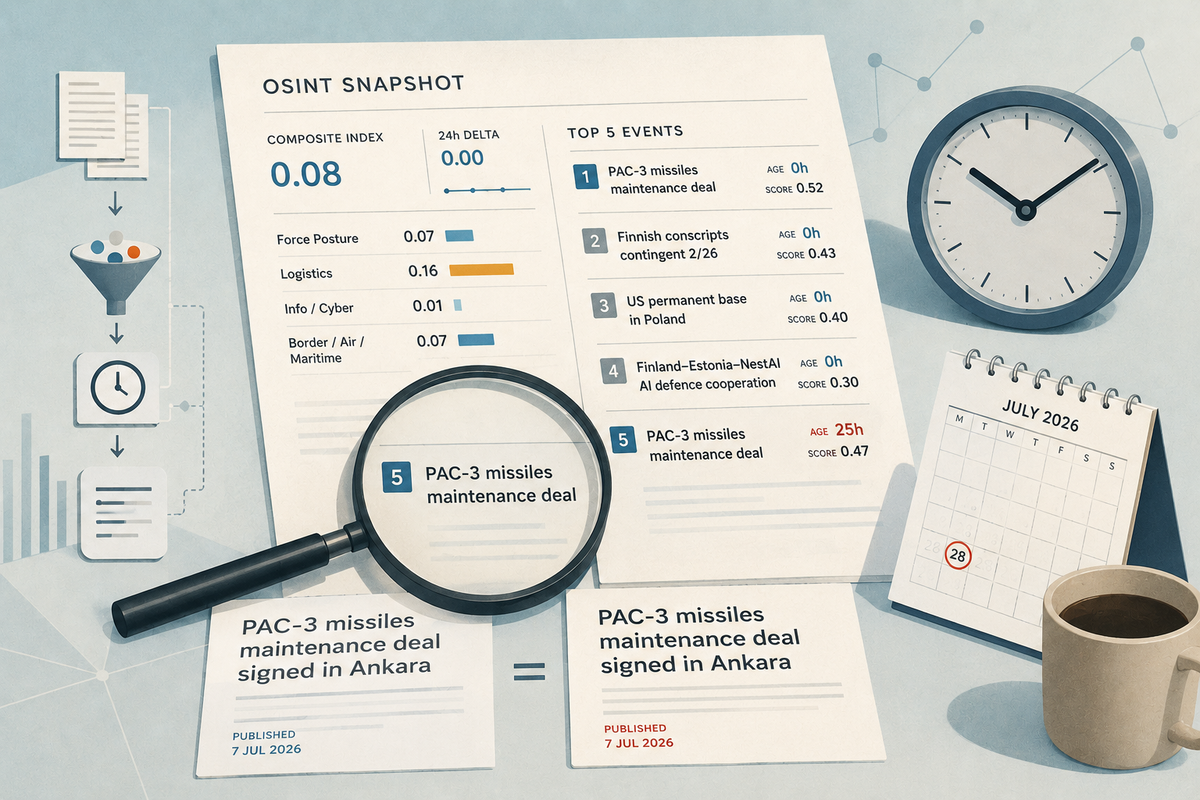
Baltic Security Monitor | Analytical Brief Snapshot: 2026-07-28T12:17:08Z
OSINT Indices
| Indicator | Value | Note |
|---|---|---|
| Composite Threat Index | 0.08 | Δ 6h: 0.00 / Δ 24h: 0.00 — new cycle low |
| Force Posture | 0.07 | collapsed from 0.16 yesterday |
| Logistics | 0.16 | unchanged for a second straight day — the only sub-index holding the composite up |
| Info/Cyber | 0.01 | effectively zero |
| Border/Air/Maritime | 0.07 | still falling (0.10 → 0.07) |
Events logged (24h): 141 — 5.9x yesterday's 24 · High-confidence: 0 Quarantine: 1 (schema-mismatch: 1) · Retry-eligible: 1 · Source failures: 0 Freshness: top-5 median age 0h, median ingest lag 16.5h (up from 13.8h), p90 88.3h (up from 64.4h)
The composite index dropped to a new cycle low of 0.08. But the real story isn't the number — it's that today's top-5 contains direct proof of BSM's hypothesis from yesterday about a broken pipeline clock: the same event appears in the list twice, once tagged "age 0h" and once tagged "age 25h." This is no longer an analyst's suspicion. The pipeline just logged and displayed its own timestamp error — nobody inside the system flagged it.
Top-5: The Evidence Piles Up
1 and 5. PAC-3: same headline, two different timestamps
OSINT score: 0.52 (age 0h) and 0.47 (age 25h)
This is the single most important technical finding of BSM's monitoring cycle so far. The digest lists identical text about the PAC-3 missile servicing agreement (signed 7–8 July in Ankara, as BSM established yesterday) twice in the same top-5 — and for the first time, the system itself tags one copy with a real age: 25 hours, while the other copy of the exact same story still carries "0 hours." This isn't coincidence — it's system-level proof that the pipeline's age calculation is inconsistent even across two records with identical text processed nearly simultaneously.
2. Finnish conscript contingent 2/26 — a third appearance in BSM's digests
OSINT score: 0.43 — WATCH, age 0h (the underlying story dates to 30 June)
The same entry about conscripts starting service on 6 July that BSM flagged on 27 July. It has now climbed to second place with a higher score (0.43) than before, despite the event only getting older, not newer.
3. A permanent US base in Poland — actually 40 days old
OSINT score: 0.40 — WATCH, age 0h
Deputy PM Kosiniak-Kamysz's statement that the US responded positively to Poland's permanent-base proposal is an official Polish Ministry of National Defence release dated 18 June 2026, issued after his meeting with then-US Defense Secretary Pete Hegseth in Brussels. By today's snapshot the story is 40 days old, and the talks have since moved to a new stage — a Pentagon force review — which the digest doesn't mention. It picked up the original month-old statement and presented it as a zero-age event.
4. Finland–Estonia–NestAI — a fourth recurrence of the same agreement
OSINT score: 0.30 — WATCH, age 0h
The 30 June defense-AI cooperation agreement BSM has tracked since 27 July is back in the top-5 — this time with a lower score (0.30, down from 0.43/0.41 yesterday), but with the same corrupted date field and the same "0 hours" status.
Top-5 summary: of five slots today, only two unique event threads remain from yesterday (PAC-3, conscripts), plus two entries that are new to BSM's coverage but, on inspection, are themselves a month old (the permanent base, NestAI). No genuinely fresh event made the top-5.
The Volume Paradox: Six Times the Events, an Eighth of the Quarantine
Logged events jumped from 24 to 141 — nearly sixfold. At the same time, quarantine fell from 8 entries to 1, and retry-eligible from 6 to 1. On its face that looks like a sharp quality improvement. But paired with worsening ingest lag (p90 up to 88.3 hours) and a top-5 built entirely of recycled old news, the more likely explanation runs the other way: the schema-validation filter is today letting far more records through unchecked, not sorting them better. A quarantine count collapsing while volume explodes is a reason to audit the filter itself, not a reason to celebrate cleaner data.
BSM Assessment
For a second consecutive day, the pipeline shows the same structural flaw: it confuses a source's publication date with its own processing date. Yesterday that was a hypothesis, backed by manual verification of each story. Today the pipeline confirmed it directly, showing the identical headline with two different age tags in a single snapshot. This is no longer a question of a few stale stories — it's a question of whether the "age" field can be trusted at all. If the system can't consistently determine the age of one and the same publication, every Freshness calculation, and likely every Delta 6h/24h calculation feeding the composite index, needs independent verification.
Conclusion
A composite of 0.08 is not a signal of calm — it's a signal that the index increasingly fails to reflect reality. For a second straight day the top-5 is dominated by republished month-old news, and today added direct proof that the dating mechanism itself is broken: one event, two different "ages," in the same digest. The operative question is no longer "what's happening in the region" but "can the dates the composite index is built on be trusted at all."
Baltic Security Monitor (osint-baltic.com) — an analytical publication covering security on NATO's northeastern flank. All OSINT coefficients are calculated by an automated indexing system based on open sources.