NATO's Northeastern Flank: OSINT Digest — 8 June 2026

Baltic Security Monitor | Analytical Brief
Snapshot: 2026-06-08T10:30:42Z
OSINT Indices
| Indicator | Value | Delta 6h / 24h |
|---|---|---|
| Composite Threat Index | 0.17 | 0.00 / 0.00 |
| Force Posture | 0.37 | — |
| Logistics | 0.00 | — |
| Info/Cyber | 0.00 | — |
| Border/Air/Maritime | 0.18 | — |
Events logged (24h): 10 · High-confidence: 0 · Quarantine: 0 · Source failures: 0
A composite of 0.17 places today squarely in routine background territory. Zero delta over both six and twenty-four hours confirms the absence of sudden shifts. The only elevated sub-index — Force Posture at 0.37 — reflects an unusually dense cycle of Alliance exercises and command-level meetings rather than any adversarial indicator.
Top Events
🟡 1. Eastern Sentry: Multi-layered Counter-Drone Drill Over Lithuania and Latvia
OSINT score: 0.56 — WARNING (day's highest)
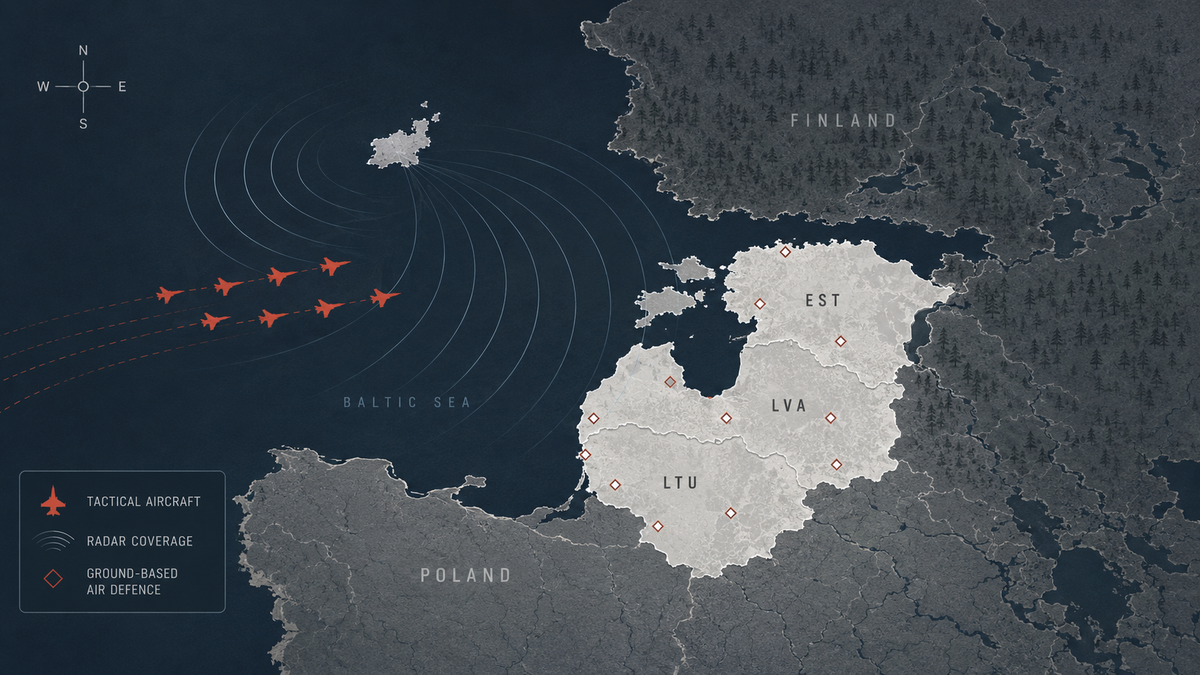
On 27 May 2026, NATO Allied Air Command (AIRCOM) led a counter-UAS exercise over Lithuania and Latvia under enhanced Vigilance Activity (eVA) Eastern Sentry. The drill integrated Romanian and Portuguese F-16s, Lithuanian surface-based air and missile defence (SBAMD) units, Spanish NSAMS batteries and a Romanian Patriot system in a single Integrated Air and Missile Defence (IAMD) scenario. AWACS provided airborne command and control throughout.
The Romanian 'Carpathian Vipers' F-16 detachment, based at Šiauliai Air Base under NATO Air Policing, participated alongside ground-based assets — demonstrating how deployed fighter units can bridge day-to-day airspace vigilance and rapid counter-drone response.
Broader Eastern Sentry timeline in 2026: A 20 February iteration used German and Italian Eurofighters and Spanish F-18s in a Flexible Deterrent Option mission. A 21 May event, directed by Combined Air Operations Centre Bodø (Norway), focused on counter-A2/AD and rapid target engagement. The series signals a sustained, deliberate elevation of AIRCOM's presence across the eastern flank throughout the year.
BSM assessment: A score of 0.56 — entering the WARNING band — reflects the rarity and operational weight of full IAMD integration exercises at this scale. For Estonia, Latvia and Lithuania, the practical significance lies in the refinement of shared procedures between allied air and ground components that would need to interoperate in any real contingency.
🔵 2. NATO Military Committee Visits Iceland — North Atlantic and Arctic Focus
OSINT score: 0.45 — WATCH
From 1 to 3 June 2026, the NATO Military Committee, led by Deputy Chair Lieutenant General Winston P. Brooks, visited Iceland, including the NATO Radar and Communication site at Bolungarvík and the Control and Reporting Center at Keflavik — which feeds recognised air pictures into the NATO IAMD network. Delegates received briefings on Iceland's new Defence and Security Policy, capability development and meetings with Icelandic dual-use technology companies.
Iceland contributes no troops but is a founding Alliance member whose geography straddles the GIUK Gap (Greenland–Iceland–United Kingdom), the critical chokepoint between Atlantic and Arctic waters. The visit formed part of the Military Committee's ongoing assessment of missile defence, long-range strike, drones, ammunition and stockpiles across the Alliance.
BSM assessment: With NATO simultaneously reinforcing Baltic Sea and North Atlantic postures — Baltic Sentry for undersea infrastructure, Task Force X-Baltic for maritime drones — the Iceland visit signals that the High North is now formally integrated into the same strategic calculus as the northeastern flank.
🔵 3–4. 195th Military Committee in Chiefs of Defence Session
OSINT score: 0.44 — WATCH
On 19 May 2026, all 32 Allied Chiefs of Defence convened at NATO HQ in Brussels for the 195th Military Committee in Chiefs of Defence Session (MCCS), chaired by Admiral Giuseppe Cavo Dragone. Supreme Allied Commander Europe (General Alexus G. Grynkewich) and Supreme Allied Commander Transformation (Admiral Pierre Vandier) also attended.
The agenda covered: strengthening Alliance deterrence and defence; integrating emerging technologies into NATO's Defence Planning Process; status of ongoing missions; a dedicated NATO-Ukraine Council session; and a discussion with Secretary General Mark Rutte on milestones toward the Ankara Summit (July 2026). The next MCCS is scheduled for 18–19 September in Denmark.
BSM assessment: Two entries in today's digest with identical scores (0.44) reference separate source documents covering the same event. No northeastern-flank-specific operational decisions were publicly announced, but the Defence Planning Process update and Ukraine Council session carry structural significance for the region's long-term posture.
🔵 5. Project Flytrap 5.0: First Squadron-Scale Counter-Drone Integration in Lithuania
OSINT score: 0.44 — WATCH
From 27 April to 31 May 2026, U.S. Army V Corps led Project Flytrap 5.0 at the Pabradė Training Area, Lithuania — approximately 30 km from the Belarusian border. For the first time, the Flytrap series scaled beyond individual and squad level to full squadron integration. Participating units included the U.S. 2nd Cavalry Regiment, 52nd Air Defense Artillery Brigade and the UK's 3rd Parachute Regiment.
The exercise tested more than 20 systems encompassing some 50–60 technologies: FPV drones, unmanned ground vehicles, counter-UAS platforms, electronic warfare and AI-enabled command and control — all linked within a common U.S.–UK tactical digital architecture. Flytrap 5.0 runs in parallel with Sword 26, Saber Strike, Immediate Response and Swift Response, and directly supports the Eastern Flank Deterrence Initiative.
Programme arc: Iterations 2.0–4.0 (Germany and Poland, May–August 2025) established small-unit counter-UAS tactics. Flytrap 4.5 (Putlos, Germany, November 2025) advanced operator proficiency. Flytrap 5.0 is the first integration at squadron scale; the next step foresees corps-level validation.
BSM assessment: The 30-km proximity to Belarus is deliberate messaging. More substantively, Flytrap 5.0 operationalises Ukraine-derived lessons on drone warfare at NATO formation level — and the data gathered will directly shape procurement requirements, tactics, techniques and procedures across the Alliance.
Regional Context
New corps-level command for Estonia and Latvia. According to sources cited by Estonian World and Reuters, NATO is planning to assign the German-Netherlands Corps (headquartered in Münster) to the defence of Estonia and Latvia alongside the existing Multinational Corps Northeast (Szczecin). The rationale: delivering "mass at speed" into a narrow operational theatre with little strategic depth.
Task Force X-Baltic moves to Phase II. In February 2026, eight Allies — Denmark, Estonia, Finland, Germany, Latvia, Lithuania, Poland and Sweden — signed a Letter of Intent to transition TFX-Baltic from experimental to nationally owned multi-domain maritime capabilities, taskable by NATO, providing persistent Baltic Sea coverage.
BALTOPS 2026 gathers 15 NATO nations across the Baltic Sea, moving from the western basin to the island of Gotland and eastward — rehearsing the protection of maritime supply lines that are a lifeline for the Baltic states given their narrow land corridor to the rest of NATO.
2026 defence expenditure (% of GDP):
- Lithuania: 5.38%
- Latvia: 4.9%
- Estonia: 3.38% (legislated increase to 5.4% by 2029)
- Poland: above 4% (East Shield border fortification ongoing)
- Finland: rapid growth trajectory; hosted BALTOPS 2026 planning
Assessment
Today's digest presents a textbook pattern for the current strategic moment: composite threat index low (0.17), Force Posture sub-index persistently elevated (0.37). This is not a crisis posture — it is a sustained readiness build. The Alliance is testing doctrine, validating command architecture and refining interoperability at scale. The northeastern flank is operating in a mode of managed permanent readiness rather than reactive response.
The structural signal of the week: counter-drone capability is transitioning from a specialist niche to a general combined-arms competency — evidenced by the convergence of Eastern Sentry IAMD drills and Flytrap 5.0 squadron integration happening simultaneously, in Lithuania and over Lithuania's airspace.
Baltic Security Monitor (osint-baltic.com) — analytical publication covering NATO's northeastern flank.
All OSINT coefficients are calculated by an automated indexing system from open sources.