NATO at Sea and in the Sky: OSINT Digest — 10 June 2026

Baltic Security Monitor | Analytical Brief
Snapshot: 2026-06-10T09:52:40Z
OSINT Indices
| Indicator | Value | Delta 6h / 24h |
|---|---|---|
| Composite Threat Index | 0.16 | 0.00 / 0.00 |
| Force Posture | 0.27 | — |
| Logistics | 0.04 | ↑ from 0.00 |
| Info/Cyber | 0.00 | — |
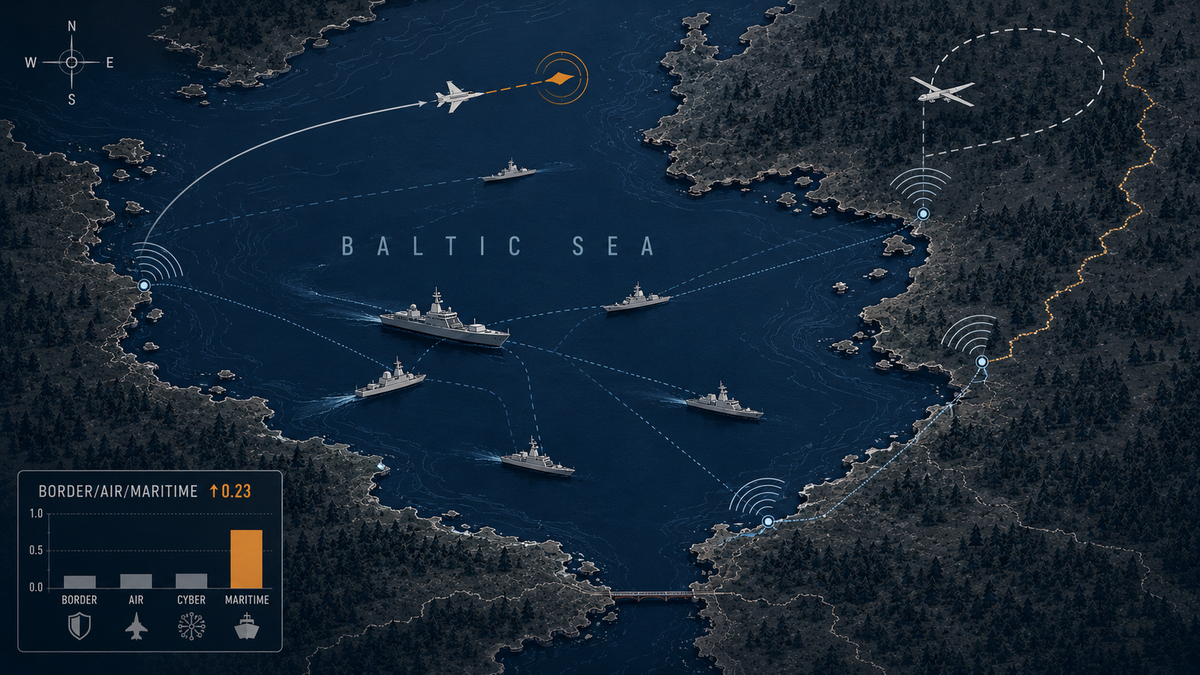
| Border/Air/Maritime | 0.23 | ↑ from 0.16 |
Events logged (24h): 10 · High-confidence: 0 · Quarantine: 0 · Source failures: 0
Composite at 0.16 sits between yesterday's 0.14 and Sunday's 0.17. The more telling movements are in the sub-indices: Border/Air/Maritime climbs from 0.16 to 0.23 — the highest in three days — absorbing the aftermath of the Rafale intercept over Latvia on 8 June and the arrival of SNMG1 in today's top five. Logistics rising from 0.00 to 0.04 for the first time this week is a quiet signal of BALTOPS 2026 logistics activity. The maritime dimension of Alliance activity enters the dashboard in earnest for the first time since Friday.
Top Events
1. Eastern Sentry: IAMD Counter-Drone Training Over Lithuania and Latvia
OSINT score: 0.56 — WARNING (third consecutive day)
Allied Air Command's 27 May IAMD exercise: Romanian and Portuguese F-16s, Lithuanian SBAMD units, Spanish NSAMS, Romanian Patriot, AWACS command and control. The score holds at 0.56 for a third straight day, confirming the monitoring system treats the Eastern Sentry cycle as an enduring structural signal rather than a passing data point. (Full analysis in the 8 June digest.)
2. Standing NATO Maritime Group 1 (SNMG1) — New Entry in the Top Five
OSINT score: 0.45 — WATCH
BALTOPS 2026 and the SNMG1 core. On 4 June 2026, twenty NATO ships departed Gdynia, Poland, opening the 55th edition of Baltic Operations (BALTOPS 2026), running through 19 June. For the first time since BALTOPS was founded in 1972, the exercise operates under a NATO command-and-control structure — Allied Joint Force Command Brunssum — rather than direct U.S. leadership. Approximately 6,000 personnel from 15 Allied nations are participating, including Poland, Denmark, Estonia, Finland, France, Latvia, Lithuania, the United Kingdom and the United States.
SNMG1, currently under Spanish command (Rear Admiral Joaquín Ruiz Escagedo), provides the central surface task group. The training agenda covers anti-submarine warfare, mine countermeasures, amphibious operations, air defence against crewed and uncrewed aerial threats, and the experimental integration of unmanned systems into fleet operations. The USS Mount Whitney serves as the exercise flagship; Commander Task Force Baltic is held by Germany.
Strategic significance. BALTOPS 2026 is explicitly linked to Baltic Sentry, NATO's enhanced vigilance activity focused on undersea critical infrastructure. The exercise area runs from Skagen to the Gulf of Riga — encompassing the sea lines of communication that represent a strategic lifeline for the Baltic states, which can be cut off from the broader Alliance by land if the Suwalki corridor is closed.
BSM assessment: The debut of SNMG1 in today's top five alongside the Border/Air/Maritime rise to 0.23 marks a meaningful shift in the week's pattern. The maritime tier of Alliance posture — undersea cable protection, anti-submarine patrols, drone-defended sea lanes — enters the digest as a co-equal concern with the air domain.
3. NATO Military Committee Visits Iceland — GIUK Gap
OSINT score: 0.45 — WATCH
1–3 June, Bolungarvík and Keflavik. CRC Keflavik feeds the recognised air picture into NATO IAMD. Iceland as the "eyes and ears" of the North Atlantic. (Full analysis in the 8 June digest.)
4. British Army Uses New Drone for First Time in Estonian Defence Exercise
OSINT score: 0.44 — WATCH
During Estonia's annual Exercise Spring Storm 2026, artillerists of the British Army's 47th Regiment Royal Artillery deployed the AR3 Evolution — a Portuguese-manufactured reconnaissance UAS — for the first time in field conditions. The system can be hand-launched or rail-launched; in VTOL configuration it offers extended endurance, while in fixed-wing mode it parachute-lands. During Spring Storm, AR3 was used to locate and track targets for simulated artillery fire missions.
Spring Storm is Estonia's largest annual military exercise, integrating the UK-led Multinational Brigade Estonia (with France as a contributing nation) and Estonian Defence Forces in a scenario of repelling a simulated large-scale incursion.
The Hedgehog reckoning. The context is essential. At Hedgehog 2025 (May 2025, ~17,000 troops from 12 nations), a team of roughly ten Ukrainian drone operators, serving as the adversarial force, conducted approximately 30 simulated strike missions and notched 17 armoured vehicle kills in half a day, effectively eliminating two NATO battalions. British and Estonian commanders described the result as a "cold shower." The British Army subsequently accelerated its drone modernisation, testing the AI-enabled Asgard targeting system in Estonia later that year and now fielding the AR3 Evolution as an organic artillery reconnaissance asset in Spring Storm 2026.
BSM assessment: The AR3 Evolution deployment is a doctrinal signal, not a hardware milestone. British ground forces in Estonia are transitioning from a posture where drones are specialists' tools to one where they are embedded in every artillery battery. The Ukrainian instructors who delivered the lesson at Hedgehog 2025 would recognise the trajectory.
5. Project Flytrap 5.0: Counter-Drone Technology Integration
OSINT score: 0.44 — WATCH
Pabradė, Lithuania, 27 April – 31 May 2026. 20+ systems, ~50–60 technologies. First squadron-scale integration. (Full analysis in the 8 June digest.)
Regional Context
The drone crisis and the EU response. On 26 May 2026, European Commission President von der Leyen, standing alongside the leaders of Latvia, Lithuania and Estonia in Vilnius, stated that the series of drone incursions into EU airspace are "not isolated incidents" but "a deliberate strategy from Russia trying to destabilise our democratic societies." Lithuanian President Nausėda acknowledged that the skies above the Baltic states "are not sufficiently secure." The statement framed drone overspill as a hybrid warfare instrument — blurring the line between Russia's war against Ukraine and its pressure on NATO's eastern members.
Full 2026 drone incursion timeline:
- 23 March — Lithuania (Lake Lavysas, Varėna district)
- 25 March — Latvia (Kraslava region) and Estonia (Auvere power plant chimney)
- 7 May — Latvia, Rēzekne: oil storage facility struck → Defence Minister Sprūds resigns, coalition collapses
- 19 May — Estonia: Romanian F-16 destroys drone over Lake Võrtsjärv
- 8 June — Latvia, Bērzgale: French Rafale destroys drone ← registered in today's Border/Air/Maritime rise to 0.23
BALTOPS 2026 — current status. Running 4–19 June. 15 nations, 30+ ships, ~6,000 personnel. Exercise area: Skagen to the Gulf of Riga. Priorities: ASW, mine countermeasures, critical undersea infrastructure, air defence. This year's command structure shift to NATO JFC Brunssum is the most significant organisational change to BALTOPS since its founding.
Assessment
Today's digest presents three interlocking trends.
Border/Air/Maritime at 0.23 is the week's clearest directional signal. It simultaneously absorbs the Rafale engagement over Bērzgale and the opening week of BALTOPS — two events that share a common denominator: the eastern approaches to NATO territory, by air and by sea, are under active management.
Logistics at 0.04 is quiet background noise from BALTOPS resupply and staging. Unremarkable in isolation; meaningful as confirmation that the maritime exercise is generating a logistical footprint the monitoring system can detect.
AR3 Evolution in Estonia is the week's most consequential doctrinal development. The transition from "no organic drone capability in artillery" to "hand-launched reconnaissance UAS in every fire mission" is exactly what the Hedgehog 2025 failure demanded. It has happened in one year.
Taken together: the northeastern flank's security architecture is in active transformation — not in response to a discrete crisis, but as a deliberate, sustained recalibration that the indices are beginning, gradually, to reflect.
Baltic Security Monitor (osint-baltic.com) — analytical publication covering NATO's northeastern flank.
All OSINT coefficients are calculated by an automated indexing system from open sources.