Moscow Burns, Kostiantynivka Hangs by a Thread: What Telegram Isn't Telling You About the War in June 2026

Baltic Security Monitor | Fact-Checking Analytical Brief
18 June 2026
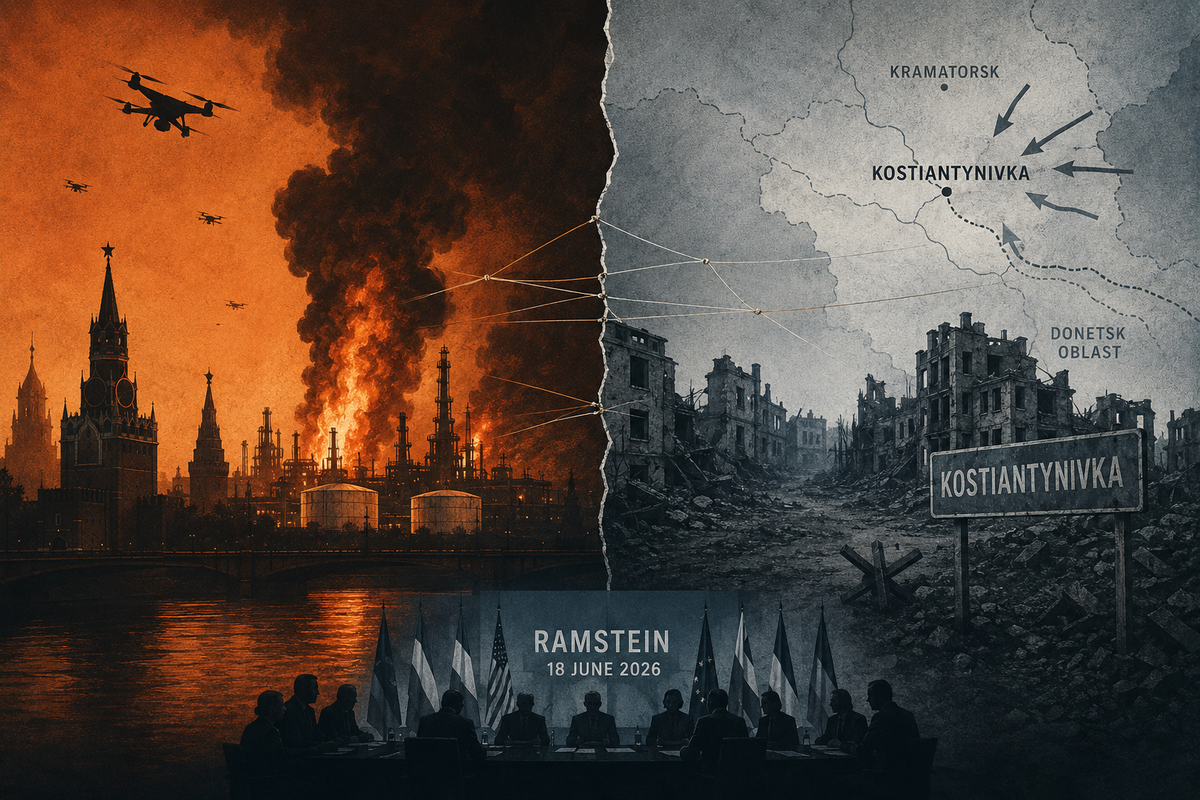
Over three days this week, Ukraine carried out two large-scale strikes on the Moscow Oil Refinery. Overnight on 18 June, hundreds of drones flew toward the Russian capital and more than a dozen regions — the largest single attack on Moscow since the start of the full-scale war. DeepState, "Operational ZSU" and other Telegram channels flooded the network with footage of fires, black smoke over the city, crowds of Muscovites at petrol stations. The reaction was emotional: Russia is shattered, air defence has failed, the war is turning decisively in Ukraine's favour.
But when you read the Reuters, Bloomberg and NBC reporting, the picture is more complicated. And it is that complication — not Telegram triumphalism, and not Telegram catastrophism — that best describes the actual state of the war in mid-June 2026.
Moscow: A Record Strike, With Specific Numbers
The strike on the Moscow Oil Refinery (MNPZ) in the Kapotnya district, in the capital's southeast, was the second this week — and the largest of the entire war. Russia's Defence Ministry said that during the night air defences shot down or otherwise destroyed roughly 555 drones across the country, with almost 200 intercepted as they approached Moscow. Moscow Mayor Sergei Sobyanin said several drones nonetheless reached the refinery, sparking at least five fires.
Ukraine's General Staff confirmed the strike, specifying that the combined oil processing unit, secondary refining units and a storage tank farm were burning. Preliminary data indicated the ELOU AVT-6 primary oil processing unit was damaged. The refinery supplies up to 40% of Moscow's petrol and 50% of its diesel fuel — and this was the second attack on the facility within a week, after which it reportedly halted operations.
The same day, Ukrainian forces also struck a fuel depot in Gukovo, Rostov Oblast, and a bridge over the North Crimean Canal on the critical Kerch–Dzhankoi railway. Rostov Oblast Governor Yury Slyusar reported one person killed and two injured, a damaged locomotive, and fires at "two commercial facilities."
Zelensky: Ukraine's president called the strike "a fully justified response to Russian attacks on our cities and communities," later adding in an audio statement: "If Ukraine burns, your Moscow will burn too." The attack was framed as a response to Russia's strike on the Kyiv Pechersk Lavra on 15 June.
What's worth noting: Telegram monitoring channels (Exilenova+ and others) presented the footage as proof that "the myth of inaccessible Moscow has been definitively debunked." That's a rhetorically powerful claim, but it describes the strike's psychological and symbolic impact — not its strategic weight. The refinery is burning for the second time in a week, but that does not amount to a collapse of Russia's overall fuel infrastructure: 194–216 of more than 700 launched air weapons were intercepted or destroyed that same night, meaning the air-defence system continues to function, albeit with visible gaps.
Kostiantynivka: A Slow, Costly War of Position — Not a Sudden Collapse
While Telegram celebrated the Moscow fires, a very different story was unfolding in parallel in the east.
In early June, Russian forces penetrated deeper into Kostiantynivka, igniting heavy urban fighting. On 10 June, the Institute for the Study of War (ISW) reported that Russian units made tactical gains in eastern Kostiantynivka, entering the village of Novodmytrivka. The commander of Ukraine's 28th Mechanized Brigade told Hromadske that Ukrainian forces are in a state of semi-encirclement as a result of these advances.
Military analyst Kostyantyn Mashovets assessed the prospects of holding Kostiantynivka as "very unfavourable": only two kilometres remained between the forward Russian units on the two arms of a pincer movement, with a river as the last serious obstacle between them. The commander of one company defending the city told Ukrainian journalists at Hromadske: "The enemy has wedged itself into the city centre. This is no longer infiltration." Estimates of Russian troop presence inside the city ranged from 100 to 250.
On 11 June, Russian units displayed flags in several southwestern districts of the city — prompting a pro-Russian Telegram channel to nonetheless concede that "the complete 'liberation' of Kostiantynivka is still a long way off."
Context: Kostiantynivka is the southernmost strongpoint in a 60-kilometre chain of Ukrainian fortifications in Donetsk Oblast stretching toward Kramatorsk and Sloviansk. ISW analysts assess that Russian forces will most likely continue pushing deeper into the city and may establish positions in parts of it over the summer of 2026 — but this advance will come at enormous cost in Russian losses, and operational success across the entire fortress belt remains unlikely.
What's worth noting: Telegram on 16 June described the situation as the "worst-case scenario," with the enemy on all sides. That is not an unjustified exaggeration — the situation is genuinely difficult and dangerous — but analytical sources (ISW, Critical Threats, Mashovets) describe it as a slow, expensive, incremental advance rather than a sudden front collapse. The commander of a Ukrainian Unmanned Systems Battalion operating in the area reported that Ukrainian interdiction has forced Russian forces to stop using heavy armoured vehicles in the Kostiantynivka direction, relying instead on light transport to resupply positions.
Ramstein, 18 June: Numbers Instead of Slogans
On 18 June in Brussels, the Ukraine Defense Contact Group ("Ramstein format") convened — coinciding with the Moscow strike and ahead of the G7 summit.
According to Politico, Ukraine planned to request an additional $20 billion from allies on top of already-agreed 2026 assistance, proposing that each country contribute between $2 billion and $6 billion in direct aid or loans. A senior Ukrainian defence official told reporters bluntly: "Everyone sees that Russia is burning, and we want it to burn even more, but we need financing to do it... The window of opportunity tends to close. Russia is fast and innovative."
What the facts confirm: The total volume of aid agreed at previous 2026 Ramstein meetings has repeatedly reached tens of billions of dollars — from $38 billion in February to roughly $60 billion announced by NATO Secretary-General Mark Rutte at the Berlin meeting. The largest national commitments: Germany at €11.5 billion (focused on air defence, drones, artillery ammunition), Norway at roughly $7 billion, the United Kingdom at £600 million for air defence plus £150 million to the PURL programme.
What's worth noting: The Telegram narrative that "the U.S. under Trump stands aside while Europe pays" is not an exaggeration but, in fact, an accurate description of the aid structure: official sources have repeatedly recorded zero new direct funding contribution from the Trump administration, while Germany, Norway and the UK carry the largest financial burden. At the same time, the claim that "half of what's promised is just promises, not cash" also has merit: a significant share of Ramstein-format aid is historically recorded as planned rather than already-delivered, with final volumes traditionally confirmed only after approval at the level of partner governments.
The Broader Front: Attrition, Not Territory
Analysts assessing the war's state as of mid-June 2026 converge on one point: in the fourth-to-fifth year of the full-scale war, neither side currently possesses the operational capacity for a decisive breakthrough along the roughly 1,200-kilometre front. Instead, the war has entered a phase of attritional manoeuvre in which drones, long-range strikes and logistics interdiction increasingly determine outcomes more than massed infantry assaults.
As of 9 June 2026, according to statements by Ukrainian Commander-in-Chief Oleksandr Syrskyi, Ukrainian forces have recaptured more than 600 square kilometres of territory, arresting much of the momentum behind Russia's spring-summer offensive. At the same time, fighting around the Kramatorsk–Kostiantynivka defensive belt has assumed growing importance, with several military analysts now regarding this region as the principal theatre of Russian offensive operations.
Ukraine's long-range strike campaign against refining and logistics targets deep inside Russia, intensified since March 2026, continues to place strain on Russia's ability to sustain its forces. Fuel shortages reported in occupied Crimea and disruptions to military supply routes illustrate how modern warfare increasingly extends hundreds of kilometres beyond the trenches.
Assessment
Telegram culture — on both the pro-Ukrainian and pro-Kremlin sides — systematically distorts the actual balance of the war in both directions: Moscow's fires are presented as proof of imminent victory; Kostiantynivka's situation as proof of imminent collapse. Neither claim withstands scrutiny against verified reporting.
The real picture is more complex and less dramatic: Ukraine has found a sustained way to pressure Russia's economy and logistics through long-range strikes, but this does not halt the slow, costly Russian advance on the ground. Allies continue to fund Ukraine's defence with tens of billions of dollars, while the United States under the Trump administration remains largely absent from direct funding. This is not a game that has suddenly turned in anyone's favour. It is a long war of attrition, in which victory — if it comes — will be measured in years of endurance, not weeks of Telegram triumphalism.
Baltic Security Monitor (osint-baltic.com) — analytical publication covering NATO's northeastern flank.
This brief fact-checks Telegram channel claims against reporting from Reuters, Bloomberg, NBC, ISW and Critical Threats.