The Interceptor That Stopped at the Border
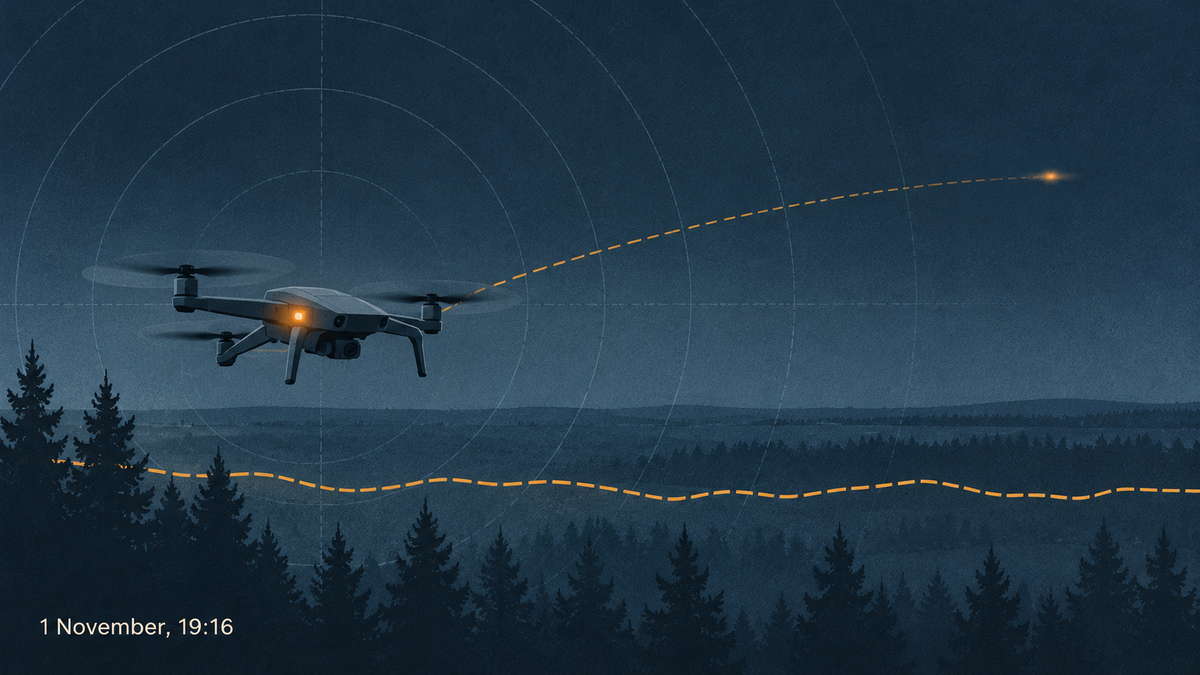
On the evening of 1 November, an unidentified flying object entered Latvian airspace near the Russian and Belarusian borders and left towards Russia less than half an hour after the alert was raised. Latvia launched a BLAZE interceptor drone, then destroyed it itself to avoid crossing into Russia…

Baltic Security Monitor | Material Update
Security Watch: 2 November 2026, 08:00 EET · Materiality: MODERATE · Domain: airspace / NATO's northeastern flank · Late capture (event of 1 November)
On the evening of 1 November, an unidentified flying object entered Latvian airspace near the Russian and Belarusian borders and left towards Russia less than half an hour after the alert was raised. Latvia launched a BLAZE interceptor drone, then destroyed it itself to avoid crossing into Russia. The whole episode lasted thirty minutes and showed exactly where NATO's response line now sits.
Timeline
18:57. Latvia's National Armed Forces (NBS) declared an air threat over Krāslava and Ludza municipalities in the country's southeast. Residents were told to stay indoors and keep away from suspicious low-flying objects.
19:16. The unidentified object left Latvian airspace, crossing the Latvia–Russia border.
19:19. Near the Russian border, the military triggered the self-destruct mechanism of a BLAZE interceptor drone to prevent a possible border violation. Residents reported hearing an explosion.
19:30. The threat was lifted.
The NBS said it monitors Latvian airspace around the clock together with NATO allies and has reinforced air defence on the eastern border with additional units. It also warned that foreign drones approaching or entering Latvian airspace may keep happening for as long as Russia's war against Ukraine continues.
The object's type and origin have not been officially established. International media describe it as most likely a drone, but no party (Russia, Ukraine or Belarus) has been named as its operator.
BSM analysis
The automated Security Watch report logged the entry and exit but missed the interceptor launch. Yet that is the most telling part of the story. Latvia did not just watch and warn. It used its own interception asset, then deliberately destroyed it the moment the target crossed the border.
Two signals follow. First, Latvia's counter-drone defence is moving from radar and sirens to active interception with systems already in service. BLAZE is built by the Latvian company Origin Robotics, and the armed forces of Latvia, Estonia and Belgium took delivery of the first units in early 2026. Second, the response line is tied tightly to the border. Even a brief overflight of Russian territory by the interceptor could have handed Moscow a pretext for diplomatic or information escalation, and Riga avoided that.
Why this is more than another alert
Unlike precautionary alerts where an object merely approached the border, this case involves a confirmed entry into NATO airspace and a recorded exit. It happened before the previous 20:00 BSM snapshot but was not captured at the time, so this is a late capture, not a second violation overnight.
The incident fits an autumn pattern. On 18 October, according to the Kyiv Independent, a probable drone entered Lithuanian airspace and exploded, damaging a civilian car, and NATO jets were scrambled. In March, a Russian drone came down on Latvian territory. A separate factor is Ukraine's strikes on Russian Baltic Sea terminals: some drones diverted by Russian electronic warfare end up crashing in the Baltic states and Finland. Without a radar track or debris, attributing any unidentified object in this area remains premature.
What to watch
Official identification of the object, including its type, route and operator. Whether Latvia releases radar data or investigation findings. Whether BLAZE launches become routine on the eastern border and whether similar procedures are aligned with Estonia and Lithuania. Any reaction from Moscow or Minsk.
Bottom line
The object left, the interceptor blew up on Latvia's side of the border, and nobody was hurt. But those thirty minutes reveal a new reality on NATO's northeastern flank. The alliance's air border is now guarded not only by fighter jets but by cheap, locally built autonomous interceptors, and the rules for using them are being written right now.
Baltic Security Monitor (osint-baltic.com) — an analytical publication on security on NATO's northeastern flank.
Based on automated open-source monitoring with independent verification of key facts.