A Fire With a Return Address: Brașov, Oleshky and Moldova
Romanian intelligence has linked a September fire next to a defence plant in Brașov to a sabotage network coordinated from Russia. Two suspects are in custody in Germany and a third is wanted in Poland. It is the second time in two months that an EU state has formally blamed Moscow for arson near…

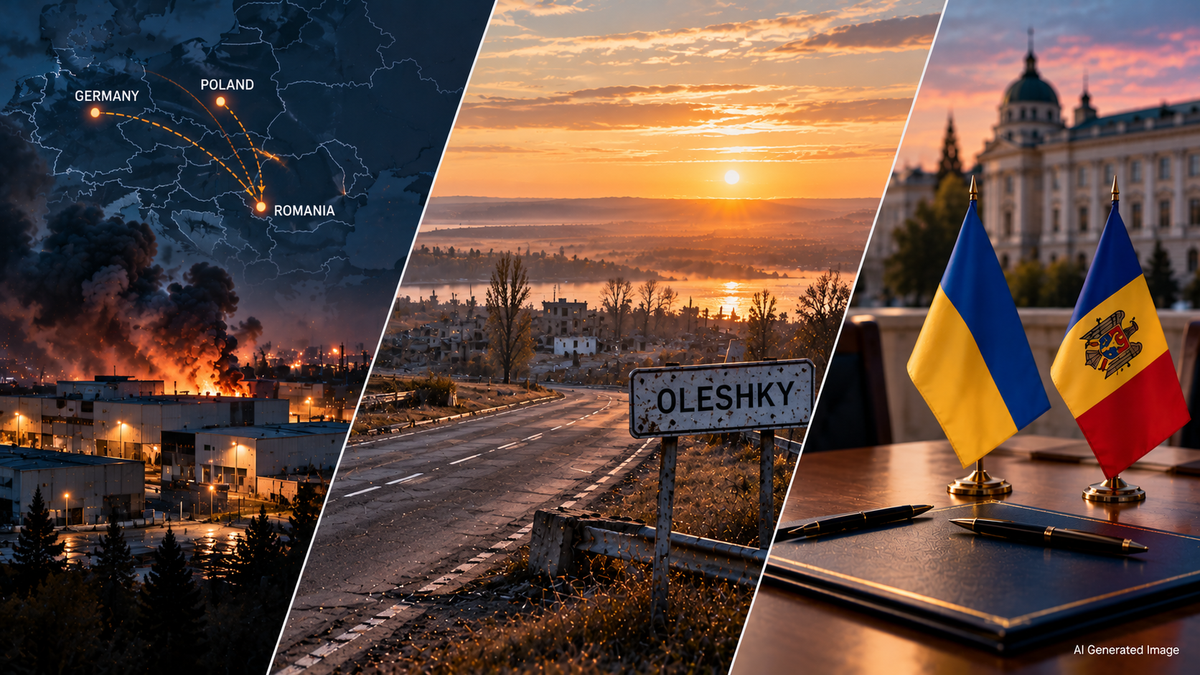
Romanian intelligence has linked a September fire next to a defence plant in Brașov to a sabotage network coordinated from Russia. Two suspects are in custody in Germany and a third is wanted in Poland. It is the second time in two months that an EU state has formally blamed Moscow for arson near a defence manufacturer, after Milrem Robotics in Tallinn. Also this cycle: the Oleshky ceasefire has begun, and Ukraine and Moldova have signed a military-technical cooperation agreement.
Baltic Security Monitor | Material Update — 1 HIGH · 2 MODERATE
Snapshot: 27 October 2026, 08:00 (EET)
Monitoring window: 26 October, 20:00 to 27 October, 08:00, with a 24-hour lookback. Next scheduled snapshot: 27 October, 14:00.
Romania: the Brașov fire gets a sponsor (MATERIAL, HIGH)
On 26 October Romania's intelligence service (SRI) and its organised crime and terrorism prosecutors (DIICOT) announced that the 14 September fire in Brașov had been set by a sabotage network coordinated from Russia. The fire hit the premises of several companies on the CARFIL industrial platform, next to CARFIL SA, a subsidiary of the state arms group ROMARM.
DIICOT is investigating three foreign nationals living in EU countries, two Belarusians and a Ukrainian, for attempted sabotage. Two were found and remanded in custody in Germany, where, according to DIICOT, they were preparing similar acts. The third was located in Poland, and a European arrest warrant for him was issued on 26 October. Romania is seeking the extradition of all three.
The SRI describes the case as part of "a wider campaign of sabotage operations coordinated by the Russian Federation in Europe." According to the service, the network had "an extended series of targets in the region": state and private arms factories and other military-industrial sites. The SRI also says that other attempts were recorded in Romania this year against international military facilities and sites used to train Ukrainian forces, but it does not directly link them to these three suspects.
According to the SRI, recruiters find people through social media and offer money for simple tasks such as photographing sites. The tasks later escalate to arson, and those who refuse are blackmailed.
What is confirmed. The official SRI and DIICOT attribution, the three suspects, the custody in Germany and the European warrant for the suspect in Poland. The Romanian findings were reported separately by Reuters, the Kyiv Independent and Romanian state media.
What is not established.
- 🟡 Whether CARFIL SA's own production was affected.
- 🟡 Which Russian service coordinated the network, and its full target list.
- 🟡 The date and place of the arrests in Germany and what exactly the suspects were preparing.
- The suspects have not been convicted; these are investigative findings, not a court verdict.
BSM analysis: Brașov repeats a pattern Estonia has already seen. On the night of 14–15 August a building used by Milrem Robotics in Tallinn's Lasnamäe district was set on fire. The company makes THeMIS unmanned ground vehicles for Ukraine. Three Latvian citizens were detained in Latvia and handed over to Estonia, and on 29 September the Estonian government called the fire sabotage commissioned by Russian special services. The Kremlin rejected the accusation. Both cases share the same profile: defence production tied to supplies for Ukraine, hired perpetrators from third countries, and several EU jurisdictions in one case. For the Baltic states the conclusion is practical. It is not only the border that needs protecting but the industrial sites of defence manufacturers, and investigators have to work as one team, because the perpetrators are recruited in one country and set fires in another. There is no evidence that this particular network operated in the Baltic states.
Oleshky: the ceasefire has begun (MATERIAL, MODERATE)
At 03:00 EET on 27 October, a local ceasefire around Russian-occupied Oleshky in Kherson Oblast took effect. Russia's Defence Ministry said on Telegram that it had stopped shelling towards Kherson from 04:00 Moscow time to prepare a humanitarian operation. Ukraine's parliamentary human rights commissioner Dmytro Lubinets confirmed the ceasefire began at the same time: "As head of the Ukrainian negotiating team, I confirm that the Ukrainian side is honoring its commitments." Reuters reported the start of the ceasefire; according to the White House, US First Lady Melania Trump helped secure it.
The aim is to allow humanitarian deliveries and the evacuation of civilians. Ukrainian officials estimate that about 2,000 people remain in Oleshky.
What changed. The agreement was classified MATERIAL on 23 October. The new stage is implementation: both sides say the ceasefire has started, not just that it is scheduled.
What is not established.
- 🟡 Whether the ceasefire is being observed in practice, whether aid has arrived and whether evacuations have begun: there is no independent confirmation from the ground yet.
BSM analysis: this is not a general ceasefire or a territorial settlement but a narrow humanitarian corridor. Still, it is a rare case of Moscow and Kyiv publicly confirming the implementation of a deal at the same moment. The test will not be statements but buses carrying people out.
Ukraine and Moldova: a military-technical cooperation agreement (MATERIAL, MODERATE)
On 26 October in Kyiv, Ukrainian Defence Minister Yevhenii Khmara and Moldovan Defence Minister Anatolie Nosatîi signed an intergovernmental agreement on military-technical cooperation in the presence of both prime ministers. Both defence ministries confirmed the signing.
The agreement runs for five years with automatic extension. It covers modernisation, repair and maintenance of equipment, training of specialists, testing of military products, transfer of knowledge and technology, joint defence R&D, and cyber defence, surveillance and airspace protection. "Ukraine has experience that cannot be gained through exercises," Khmara said.
Nosatîi pointed to more than 100 incidents of airspace violations in Moldova and said that the changing types of drones force the country to modernise its monitoring and defence capabilities. According to Ukraine's Defence Ministry, implementing the agreement does not affect Moldova's constitutional neutrality.
What is not established.
- 🟡 Specific projects, system deliveries or funding: so far there is only a framework.
BSM analysis: like the Baltic states, Moldova has for years dealt with drone debris and airspace violations spilling over from the war next door. The agreement formalises a model spreading along the eastern flank: Ukraine's combat experience in countering drones is becoming an export for its neighbours. Neutral Moldova gains access to that experience without joining any bloc.
Open lines
- Black Sea. Russian claims of strikes on two cargo ships near Chornomorsk and Odesa remain uncorroborated. 🟡 The ships have not been identified; repeating the same claim is not confirmation.
- Germany and Bars. The reported first delivery from the German-Ukrainian joint venture still needs official or documentary confirmation.
- Patriot / NASAMS / PURL. No new Pentagon approval or completed delivery was recorded this cycle.
- Latvia. The Resolute Reforger 2026 exercise continues until 8 November.
- Lithuania. No findings yet on the drone crash in Pasvalys district or the attempted arson at a Vilnius warehouse holding Starlink equipment.
- Zaporizhzhia nuclear plant. Restoration of the main 750 kV line is tracked separately.
Conclusion
The key point of this cycle is not the fire itself but that it now has a sponsor. Brașov and Tallinn show one pattern: hired perpetrators from third countries, targets in the defence industry working for Ukraine, and investigations that need three EU states for a single case. In Oleshky, both sides confirmed the ceasefire at the same time for the first time. And Moldova has signed an agreement that makes Ukrainian counter-drone experience part of its own defence.
Arson can be hired through social media. The response has to be built across borders.
Sources: Kyiv Independent via Yahoo — SRI/DIICOT attribution · Spotmedia — suspects and recruitment · Radio România Actualități — SRI and DIICOT · Defense News — Estonia on the Milrem arson · ERR — Milrem suspects extradited · Jerusalem Post / Reuters — Oleshky ceasefire begins · Ukrainian Defence Ministry — agreement with Moldova · Moldovan Defence Ministry — Nosatîi statement
Baltic Security Monitor (osint-baltic.com) — an analytical publication on security on NATO's northeastern flank.
MATERIAL / WATCH statuses are set by an automated open-source monitoring system and checked by the editors.