End of Cycle, Start of the Count: OSINT Digest — 19 June 2026

Baltic Security Monitor | Analytical Brief
Snapshot: 2026-06-19T11:37:39Z
OSINT Indices
| Indicator | Value | Delta 6h / 24h |
|---|---|---|
| Composite Threat Index | 0.12 | 0.00 / 0.00 |
| Force Posture | 0.17 | = stable |
| Logistics | 0.00 | = stable |
| Info/Cyber | 0.00 | — |
| Border/Air/Maritime | 0.24 | = second day at peak |
Events logged (24h): 10 · High-confidence: 0 · Quarantine: 0 · Source failures: 0
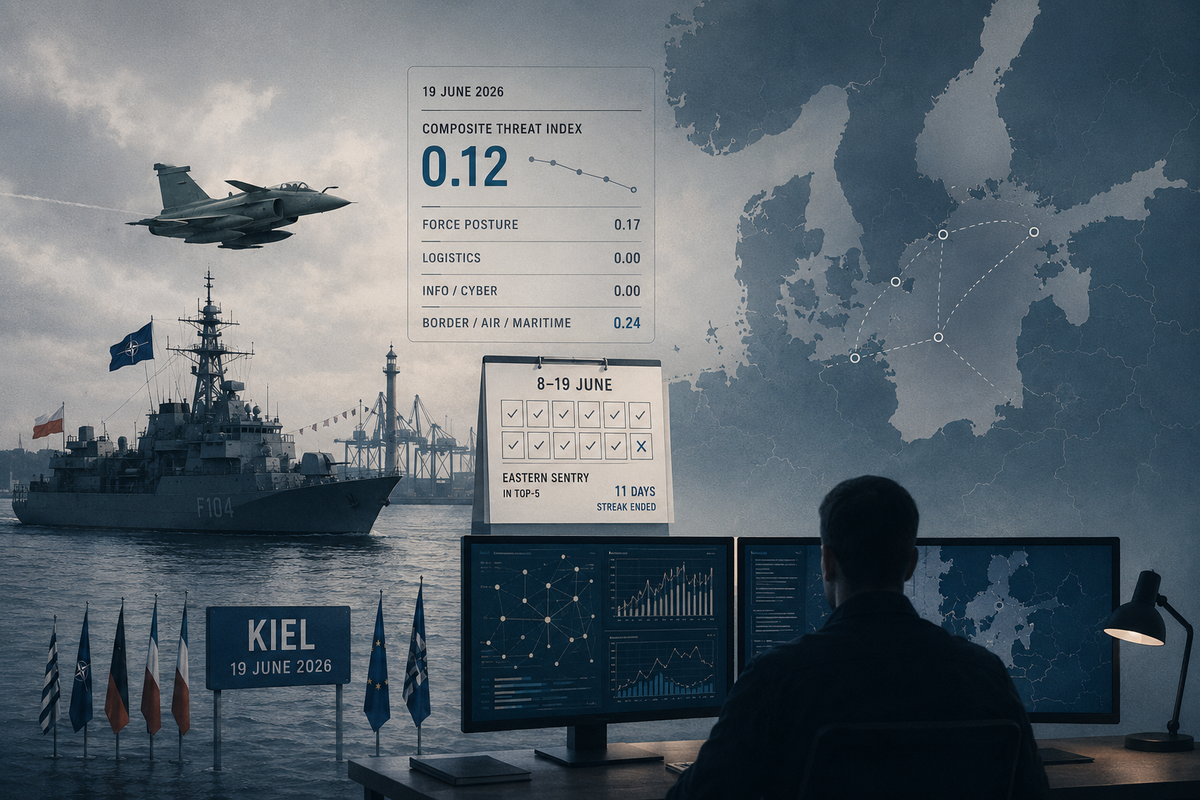
Composite at 0.12 — the lowest reading in twelve days of monitoring. But today's digest carries a structurally more important signal than any single number: Eastern Sentry (0.56 WARNING) has dropped out of the top five for the first time after eleven consecutive days of presence. This is not a system anomaly — it is confirmation that the active phase of the training cycle has concluded. Simultaneously, Border/Air/Maritime holds at its peak level of 0.24 for a second straight day, demonstrating that the air and maritime domains remain structurally loaded even without the exercise backdrop.
Two-Week OSINT Summary: 8–19 June
| Date | Composite | Force Posture | Logistics | B/A/M | WARNING in top-5? |
|---|---|---|---|---|---|
| 8 June | 0.17 | 0.37 | 0.00 | 0.18 | ✓ Eastern Sentry |
| 9 June | 0.14 | 0.30 | 0.00 | 0.16 | ✓ |
| 10 June | 0.16 | 0.27 | 0.04 | 0.23 | ✓ |
| 11 June | 0.13 | 0.13 | 0.24 | 0.16 | ✓ |
| 12 June | 0.15 | 0.17 | 0.15 | 0.23 | ✓ |
| 17 June | 0.17 | 0.36 | 0.00 | 0.20 | ✓ |
| 18 June | 0.07 | 0.05 | 0.00 | 0.24 | ✓ |
| 19 June | 0.12 | 0.17 | 0.00 | 0.24 | ✗ — first time |
Two-week conclusions:
- Eastern Sentry held at WARNING for 11 consecutive days (8–18 June) — monitoring record
- Border/Air/Maritime never dropped below 0.16 — structurally elevated regardless of exercise phase
- Logistics produced one sharp peak (0.24, 11 June) — signature of two parallel exercises at maximum tempo
- Composite oscillated in a narrow 0.07–0.17 range — background level in the absence of acute events
Top Events
🔵 1. SNMG1 and BALTOPS 2026: Final Day
OSINT score: 0.45 — WATCH
Today, 19 June, BALTOPS 2026 officially concludes in Kiel. The 55th iteration of NATO's flagship Baltic maritime exercise ran from 4 to 19 June, departing from Gdynia, Poland and ending at the heart of the German Baltic coast, coinciding with the opening of the traditional Kiel Week.
BALTOPS 2026 leaves behind several structural innovations. For the first time since 1972, command was exercised not by the U.S. directly but through Allied Joint Force Command Brunssum — a realistic simulation of the command structure that would activate in an actual conflict. USS Mount Whitney served as flagship. The exercise area stretched from Skagen to the Gulf of Riga, encompassing 15 Allied nations, approximately 20 vessels and 6,000 personnel.
Poland held a particularly prominent role: unlike previous years, BALTOPS 2026 launched from Gdynia in the Bay of Gdańsk — a symbolic recognition of Poland's role as a key participant and frontline NATO state.
What remains after BALTOPS. The decline of Force Posture (0.17) and zero Logistics confirm: the active phase is over. But all BALTOPS units increased NATO's presence in the Baltic and supported NATO's Baltic Sentry activity — and the sea area does not revert to a "normal" operational tempo once the exercise ends. It remains a space of continuous managed competition.
🔵 2. NATO Military Committee Visits Iceland — GIUK Gap
OSINT score: 0.45 — WATCH
(Full analysis in the 8 June digest.)
🔵 3. NATO Allies and Industry Test Counter-Drone Technologies
OSINT score: 0.44 — WATCH
(Full analysis in the 17 June digest: TIE 26, Latvia's Sēlija range, Eurosatory marketplace agreement.)
🔵 4. British Army AR3 Evolution Drone — Estonia
OSINT score: 0.44 — WATCH
(Full analysis in the 10 June digest.)
🔵 5. Canadian and Latvian Troops Sharpen Drone Skills — Crystal Arrow 2026
OSINT score: 0.39 — WATCH (returns to top five)
Crystal Arrow 2026 in Latvia: ground-drone operations rehearsed at scale for the first time alongside Canadian and Latvian units, with Ukrainian veterans as instructors. The return of this entry to the top five today is a direct consequence of Eastern Sentry's departure: with the highest-scoring entry removed, the monitoring system redistributes attention to other structurally significant events awaiting their turn in the ranking. (Full analysis in the 9 June digest.)
The Structural Signal: Why Eastern Sentry's Exit Matters
This is not a technical footnote. It marks a transition.
Eastern Sentry entered the top five on 8 June at WARNING (0.56) and held that position for eleven consecutive days. No other event in the digest showed comparable persistence. The reason was structural: Eastern Sentry is not a discrete exercise but an ongoing Enhanced Vigilance Activity (eVA) that continuously generates new iterations, intercepts and training scenarios. The real-world Rafale drone intercept over Latvia on 8 June only reinforced the score.
Today's exit means the monitoring system has assessed that the immediate Eastern Sentry training cycle has stabilised and is no longer generating new significant events to register. But the mechanism itself has not gone away — it has returned to background mode as a permanent, continuous operation.
Strategic Horizon: NATO Ankara Summit — 7–8 July
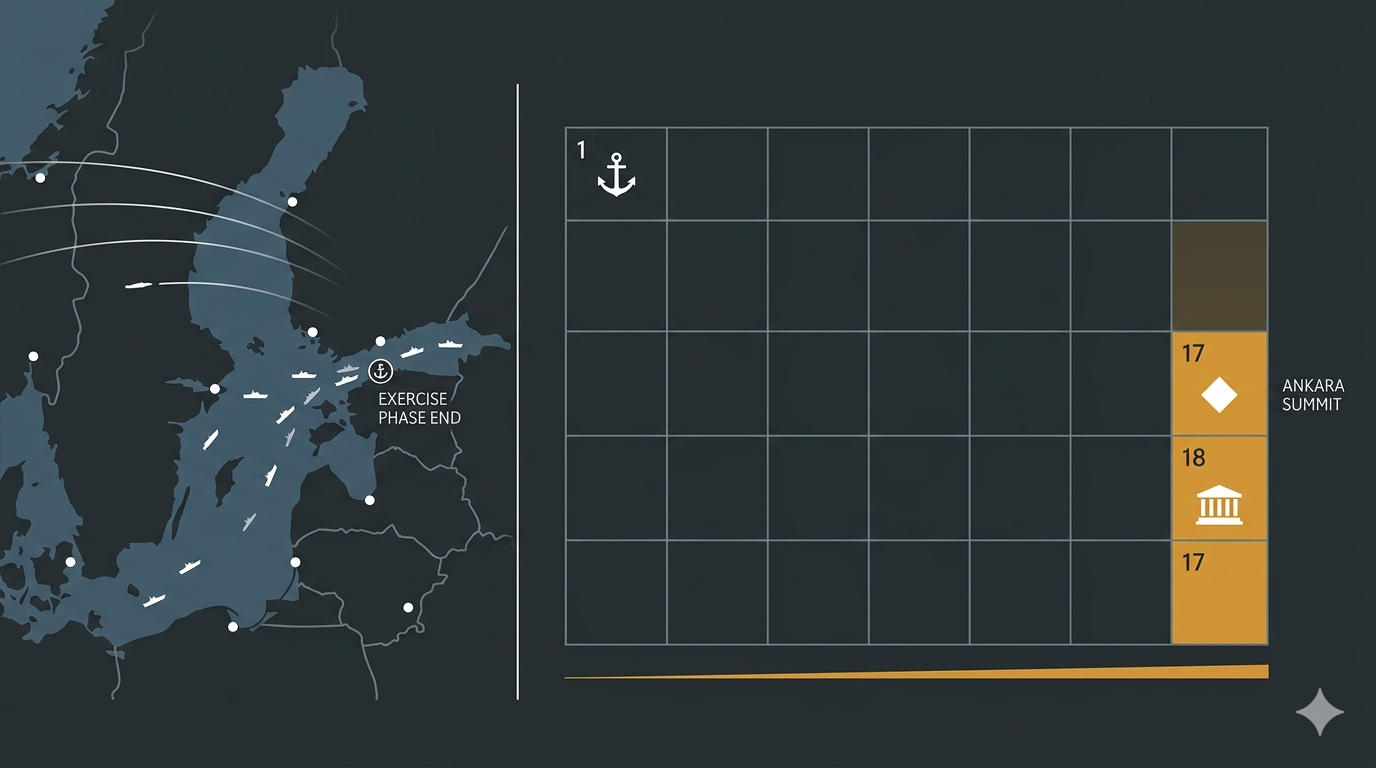
In 18 days, Ankara hosts the 36th NATO Leaders' Summit — the Alliance's first in Türkiye since Istanbul 2004.
The summit will focus on strengthening defence capabilities, military readiness and modernisation; preparing for "non-traditional threats" including cybersecurity and critical infrastructure defence; and revitalising transatlantic cooperation with burden-sharing on defence spending.
The most sensitive issue heading into the summit is the reshaping of the role of American troops in Europe. In Washington's view, Europeans must now take greater responsibility for their own security, and Marco Rubio has announced that the U.S. military presence in Europe will be "recalibrated."
The summit coincides with the 74th anniversary of Türkiye's NATO membership, giving the host nation a strong platform to position itself as indispensable to both the Alliance's eastern and southern flanks simultaneously.
The BSM indicator to watch. Ankara will be the first summit since The Hague 2025 where NATO formally assesses progress on 5% GDP defence spending targets, new battle groups on the Eastern Flank, and defence planning incorporating lessons from Ukraine. Members should get on with fulfilling their pledges to increase capabilities while continuing the tempo of NATO exercises and building out the eight battle groups along the eastern flank, according to the Atlantic Council. The Baltic states, already exceeding the threshold (Lithuania 5.38%, Latvia 4.9%), enter Ankara with strong negotiating leverage on what the rest of the Alliance owes.
What Twelve Days of Monitoring Showed
The 8–19 June cycle covered:
- The largest NATO maritime exercise in the Baltic (BALTOPS 2026, 15 nations, concluding today)
- The first drone shootdown over Latvia under Baltic Air Policing (8 June, French Rafale)
- NATO's largest air exercise of the year (Ramstein Flag 2026, 8–19 June)
- The first organic drone deployment in NATO artillery in the region (AR3 Evolution, Spring Storm)
- NATO's flagship counter-drone technology test (TIE 26, Netherlands) and the Eurosatory counter-UAS marketplace agreement (16 June)
- Russia's response — missile-strike practice drills near Kaliningrad on 8–9 June
- Baltic states' defence ministers demanding faster air defence procurement and Latvia's minister issuing the public statement: "We'll shoot them down"
Not one of these events triggered a high-confidence flag. But together they describe an Alliance that has moved from "preparing to deter" to "routinely executing deterrence" — with permanent exercises, live intercepts, new doctrine and a new technology base that did not exist twelve months ago.
The Ankara Summit will be the first formal opportunity for NATO leaders to take stock of that transition at heads-of-state level. What they decide in Ankara will shape the indices monitored in this digest for the next twelve months.
Baltic Security Monitor (osint-baltic.com) — analytical publication covering NATO's northeastern flank.
All OSINT coefficients are calculated by an automated indexing system from open sources.