Drones strike Moscow, but Baltic panic is overblown. Here's what actually matters

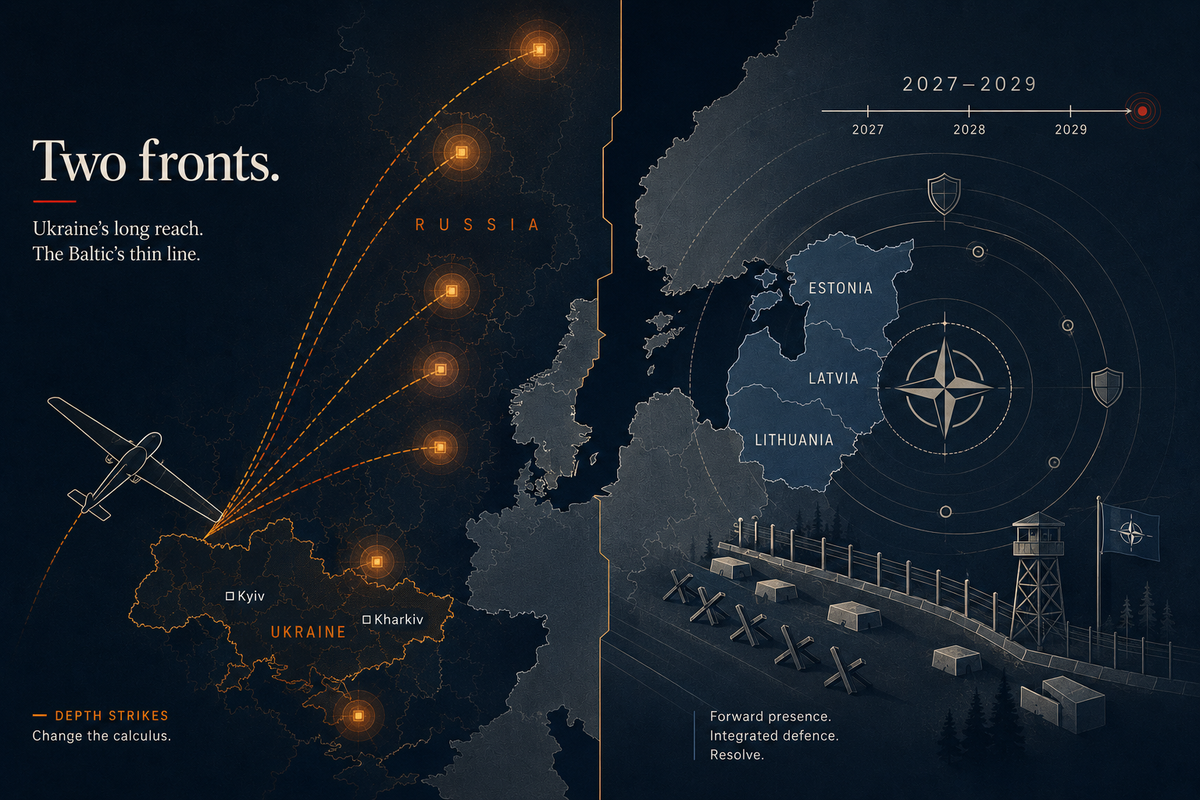
When Ukrainian drones strike targets in Moscow Oblast, social media erupts with apocalyptic predictions. The Russian army is collapsing. NATO has found its moment. Europe has won. Such narratives are convenient for engagement metrics, but they obscure a far more complex reality being written not in comment sections but on tactical maps stretching from Moscow to Tallinn.
Over the past weeks of May 2026, military operations across the Ukrainian theatre have unfolded much as they do in protracted conflicts: sufficient bloodshed for news cycles, but not enough seismic shift to rewrite textbooks. More importantly, what unfolds further along NATO's northern frontier demands geopolitical clarity rather than panicked extrapolation.
Deep strikes: tactics reshape perception
Ukrainian command has grasped something fundamental about asymmetric warfare against an adversary forced to defend a homeland larger than France. When one cannot overwhelm an opponent through numbers, one attacks where the opponent is thinnest: far from the front lines, in places where civilian economy bleeds into military logistics.
Over the closing days of May, Ukrainian drones struck 46 targets distributed across Donetsk, Luhansk, Zaporizhzhia, and occupied Crimea. But the more telling numbers lie further afield: long-range operations have reached Moscow Oblast at distances exceeding five hundred kilometres from Ukrainian soil. These strikes are not calibrated for tactical penetration—they are calibrated for psychological effect and economic erosion.
A pattern emerges from operations across recent months. In April and March 2026, Ukraine systematically struck Russian military and industrial objects at distances exceeding one thousand kilometres. The Kremlin cannot defend its entire territory simultaneously. This is not defence—it is control. This is not reaction—it is initiative.
The purpose of these operations is transparent and well understood in the Russian capital: while Russian command calculates strategic offensives on the Ukrainian axis, Ukrainian specialists dismantle the economics of Russian aggression. Fuel, ammunition, energy infrastructure—all are targets that can be hit without waiting for peace negotiations.
The front: Russian momentum exhausts itself
On the ground, the picture is less dramatic than social media suggests, but sufficiently clear to alter the conflict's vector. Russia is losing what it calls "strategic initiative"—the capacity to dictate operational tempo to its opponent.
Along the Kursk and northern Slobozhanshchyna axes, Ukrainian forces repelled five Russian assaults within a single week in late April. The fact that Ukraine now counts intercepted Russian attacks rather than tallying lost territory signals a shift in combat dynamics. Russia advances more slowly. Ukraine holds lines with less attrition.
Against this backdrop, President Zelenskyy announced on May first a sweeping reform of the Armed Forces, scheduled for June 2026. The initiative addresses a problem that has festered: manpower shortages and the absence of rotation for those mobilised since 2022. Four years of continuous operational stress exact a price even from the most resolute.
The practical details suggest pragmatism rather than capitulation. Infantrymen on the front line will be offered contracts ranging from 250,000 to 400,000 hryvnias monthly, tied to task completion. This is not a revolution in material support, but it represents a shift away from soldiers fighting month after month in a state of exhaustion and abandonment.
The Baltic and the "window of opportunity": geopolitical mathematics
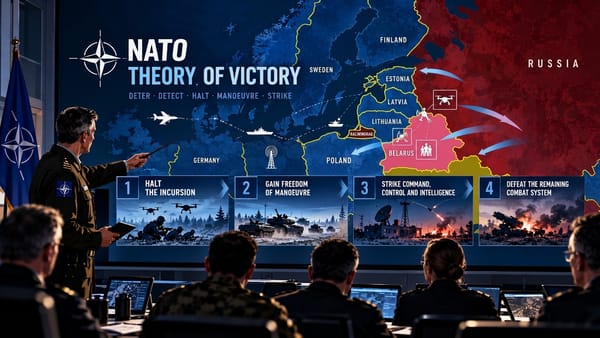
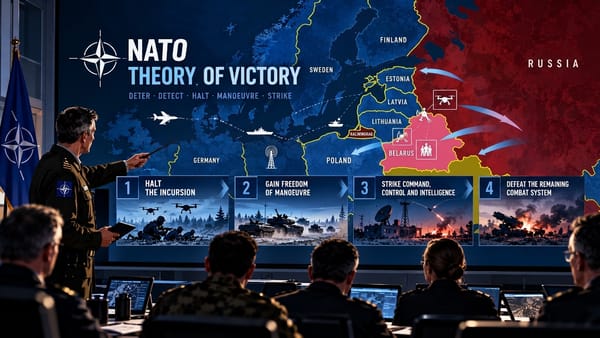
Here the map curves differently. On the Ukrainian theatre, the question concerns whether Ukraine holds positions. On the Baltic, the question concerns whether smaller alliance members are prepared for what comes after.
Christopher Smith, a senior American diplomat, expressed in closed Congressional session a pessimism that officials attempt to mute in formal communications: the moment Russia disengages from the Ukrainian front, it will redeploy forces along NATO's eastern flank, attempting to rebalance air and ground formations. Washington harbours no ambiguity on this point: a ceasefire in Ukraine will release Russian mobile units northward. The question is not "whether" but "when."
In early May, drones from Russian territory penetrated Latvian airspace. This was no spontaneous error—hybrid operations by Russian air command are calibrated precisely to probe NATO reaction times and trace how slowly warning signals propagate from regional capitals to Brussels.
Latvia's armed forces commander, addressing parliament, articulated with surgical precision what weighs on Baltic strategists. Russia will possess, he stated, a "window of opportunity" for large-scale aggression against NATO precisely during 2027–2029. Why is this window so critical? The answer lies in NATO's force expansion timeline. By 2030, the alliance must strengthen its northern positions so substantially that Russian calculations regarding the "window" become irrelevant. In other words, Russia possesses a narrow corridor of time when NATO's northern flank remains comparatively weaker.
Swedish defence officials speak hypothetically of operations on small Baltic islands. The discussion is not of full-scale invasion of Tallinn or Riga—that would constitute direct assault on NATO with predictable consequences. Rather, it concerns point operations calibrated to test: strike a small island target, observe how quickly the alliance responds, determine whether that response proves decisive, assess whether European unity fractures under elevated risk.
The truth buried beneath informational noise
Two distinct geopolitical questions frequently merge in public discourse but must be examined separately.
First: does Ukraine contain Russia within Ukrainian territory? Yes, and the evidence is sufficiently compelling. February 2026 became the first month since 2024 when Ukraine recaptured more territory than it lost. This does not mean the war approaches conclusion—it means only that momentum has shifted toward the defender. Russia attacks, but Ukraine attacks back, sometimes with greater effect.
Second: will Baltic security be guaranteed after the Ukrainian conflict ends? No guarantee exists here, and it would be naive to expect one. But something more valuable than guarantees exists: time.
Unlike 2016, scenarios of swift Estonian invasion or lightning occupation of Tallinn cannot succeed today. Russia, even unburdened from Ukraine, will lack forces for large-scale operations against three simultaneously resistant nations that will remain members of the world's most powerful military alliance. More realistic to anticipate a period of probing and temptation—hybrid warfare designed to test boundaries, measure resolve, exploit seams in unity.
But this also means the Baltic states possess five to ten years in which to construct defences that do not exist today. This interval must be deployed with maximum efficacy.
Conclusion: logic over panic
Even should negotiations conclude in peace, Ukraine has demonstrated to Europe a fundamental precept often forgotten by politicians and journalists: defence is possible, but it demands years, armament, resolve, and acceptance of losses. It is not elegant, but it is true.
The Baltic states must replicate Ukrainian experience. Drones, hybrid energy defence, logistical counter-strikes, trained civilian populations—all cost far less than economic capitulation to threat.
If Russia emerges from Ukraine with peace, it will confront a unified, armed, and prepared coalition along its northern flank. This provides no guarantee of steadfast impregnability, but it alters calculations. And calculations in Moscow account for this.
Panic in social media generates clicks. Geopolitical clarity generates survival.