Drones Near Neptun Deep: The War Edges Up to Europe's Newest Gas Hub in the Black Sea

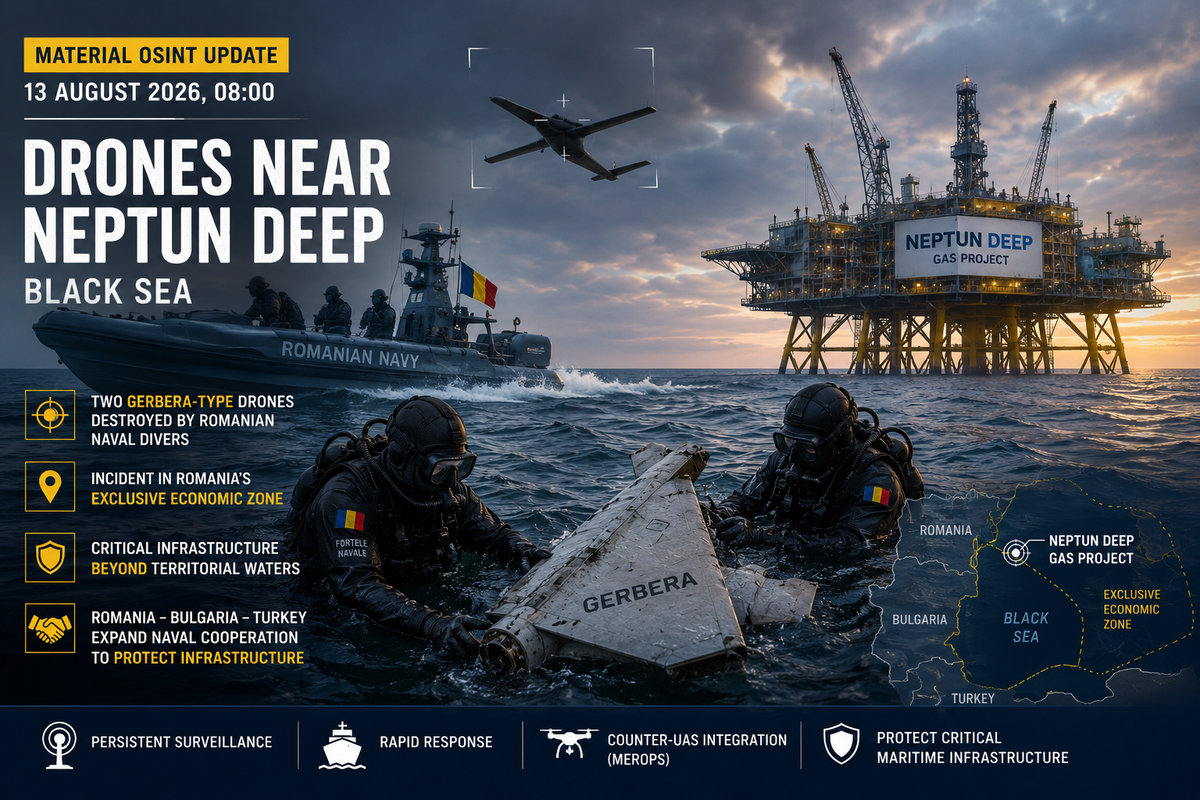
Baltic Security Monitor | Analytical Brief Snapshot: 13 August 2026, 08:00
What happened
Romanian military divers destroyed two Gerbera-type unmanned aircraft found drifting in the Black Sea near the Neptun Deep offshore gas project, Defence Minister Radu Miruță said. A civilian vessel operating near the platform detected the objects, after which Romanian forces carried out controlled detonations. The incident took place in Romania's exclusive economic zone, not its territorial waters. (Reuters, 11 Aug 2026)
The drones' origin has not been established. Ukraine told Romania the aircraft were not Ukrainian, according to Reuters, but there is no public forensic confirmation yet identifying the operator or the circumstances of launch. 🟡 They were described as Gerbera-type — a platform associated with Russia's long-range drone campaign — but platform identification alone doesn't amount to attribution. (Reuters, 11 Aug 2026)
The event occurred on 11 August and enters this cycle as a previously missed, late-indexed development rather than an overnight incident. Its significance is amplified by location: Neptun Deep is a strategic offshore gas development due to start production in 2027, and in July Romania, Bulgaria and Turkey agreed to expand their Black Sea naval cooperation beyond mine clearance to protection of critical maritime infrastructure. (Reuters, 8 Jul 2026)
This is the first concrete incident in this monitoring cycle near Neptun Deep, and it moves the drone-security problem out of coastal territory, ports and border airspace and into the offshore infrastructure environment. Attribution remains unresolved, and nothing reviewed here establishes deliberate targeting of Neptun Deep itself — but the mere presence of unidentified aircraft next to a strategic EU gas asset is already the story.
What changed
Romania has repeatedly dealt with Russian drones crossing or crashing inside its airspace, and with Ukrainian maritime drones drifting toward Romanian ports. This case is different: two unidentified aerial drones were physically neutralised close to a major offshore energy installation inside Romania's EEZ.
It is the first concrete incident identified near Neptun Deep since Romania, Bulgaria and Turkey formally expanded the Black Sea Mine Countermeasures Task Group (MCM Black Sea TG) in July to add protection of energy, telecommunications and subsea infrastructure — an amendment signed at the NATO Ankara summit, with Bulgaria taking command of the group from 9 July. (Reuters, 8 Jul 2026)
Attribution remains unresolved. 🟡 Nothing reviewed in this cycle establishes that Neptun Deep itself was deliberately targeted.
BSM analysis: Gerbera isn't a strike platform in its own right — it's a roughly $10,000 modular airframe Russia has used since July 2024 mainly as a decoy to saturate air defences during mass Geran-2 strikes, and increasingly as a reconnaissance or relay asset. Its appearance drifting inside a NATO member's EEZ, hundreds of kilometres from the typical trajectory of strikes on Ukraine, points to either a stray unit from a mass launch or a standalone reconnaissance/test flight. Both scenarios matter equally for defence planning, and neither requires confirmed intent to justify tighter monitoring.
Neptun Deep as a strategic asset
Neptun Deep is Romania's largest Black Sea gas project and the country's first deepwater offshore development, run by OMV Petrom with Romgaz. Recoverable resources are estimated at around 100 bcm, with peak output of roughly 8 bcm a year; the investment is estimated at around €4 billion. First gas is expected in 2027. (OMV Petrom, Romgaz)
Defence Minister Miruță has previously acknowledged publicly that Neptun Deep lies outside the area normally associated with Article 5 protections, while saying Romanian forces have contingency plans to protect national interests there. (tvrinfo.ro, 7 Apr 2026) In June 2026, Romania integrated the MEROPS counter-UAS system into its defence posture. (Romanian Ministry of National Defence, 24 Jun 2026)
Regional context: the Baltic parallel
The parallel with the Baltic Sea is direct: offshore cables, pipelines, energy terminals and shipping lanes operate in a similarly complex legal and geographic space spanning territorial waters, exclusive economic zones and international shipping corridors. The Romanian incident is another practical case for integrating military surveillance, civilian operators and infrastructure protection specifically outside territorial waters, where Article 5 coverage isn't automatic.
Likely implications
Romania is likely to step up surveillance and rapid-response arrangements around Neptun Deep as construction advances toward production. 🟡
The incident may accelerate operational implementation of the July Romania–Bulgaria–Turkey decision to expand their Black Sea naval task force toward infrastructure protection rather than mine clearance alone. 🟡
For Baltic planners, the incident reinforces the case for persistent unmanned-system detection around offshore energy and communications infrastructure, including areas outside territorial waters. 🟡
Attribution should remain open until Romanian investigators identify components, navigation data or other forensic indicators linking the drones to an operator. 🟡
Bottom line
13 August marks an extension of the drone-security problem from the coastline and ports into the offshore environment, where legal protection is thinner and detection harder. For Neptun Deep, due to become one of Europe's newest gas hubs in 2027, this is an early warning shot before production even starts. For the Baltic region, it's another argument that critical-infrastructure defence can no longer be bounded by territorial waters and sovereign airspace alone.
Baltic Security Monitor (osint-baltic.com) — an analytical outlet covering security on NATO's northeastern flank. All OSINT coefficients are calculated by an automated indexing system based on open sources.