Cyber Doesn't Go Away: OSINT Digest — 30 June 2026

Baltic Security Monitor | Analytical Brief
Snapshot: 2026-06-30T16:36:38Z
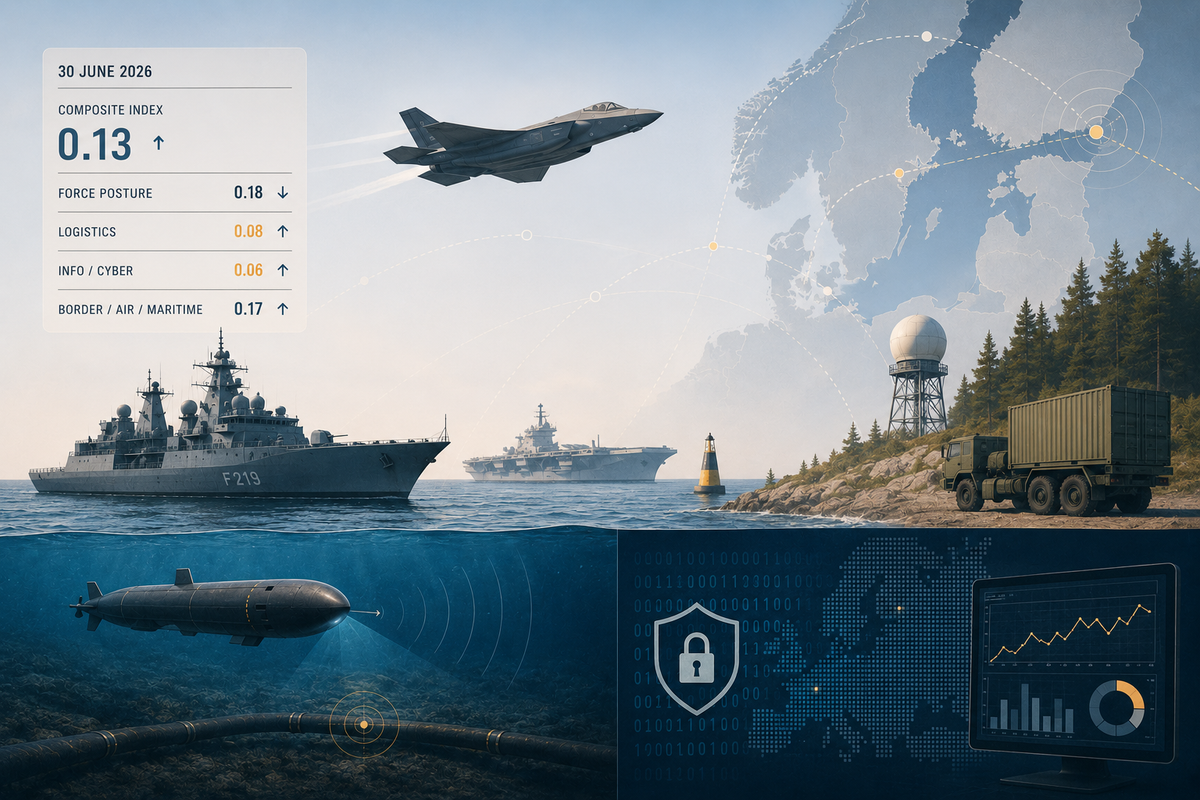
OSINT Indices
| Indicator | Value | Delta (24h) |
|---|---|---|
| Composite Threat Index | 0.13 | ↑ from 0.11 |
| Force Posture | 0.18 | ↓ from 0.35 |
| Logistics | 0.08 | ↑ from 0.07 |
| Info/Cyber | 0.06 | ↑ from 0.05 — second consecutive day |
| Border/Air/Maritime | 0.17 | ↑ from 0.10 |
Events logged (24h): 10 · High-confidence: 0
Quarantine: 0 · Source failures: 0
Composite at 0.13 returns to the cycle's mid-range. Force Posture has retreated from yesterday's three-week high (0.35) to 0.18 — confirming yesterday's hypothesis that the spike reflected pre-summit positioning activity now subsiding. Border/Air/Maritime recovers to 0.17 from the cycle's minimum. But the day's most significant detail is this: Info/Cyber holds at a non-zero level for a second consecutive day (0.05→0.06). What might have looked yesterday like a one-off artefact now reads as a persistent trend: the cyber domain is settling into the OSINT system's regular monitoring profile ahead of the Ankara Summit.
Top Events: A Complete Turnover
Today's top five shares no overlap with yesterday's — all five entries are new or substantially reprocessed. This is unusual for the cycle and reflects an active phase of processing accumulated material from the full span of Ramstein Flag 26.
🔵 1. NATO Allies and Industry Test Counter-Drone Technologies
OSINT score: 0.44 — WATCH
(Full analysis in the 17 June digest: TIE 26, Latvia's Sēlija range, Eurosatory marketplace agreement.)
🔵 2. UK Carrier Strike Group and Ramstein Flag 2026
OSINT score: 0.39 — WATCH
(Full analysis in the 25 June digest: HMS Prince of Wales, F-35Bs over Finland.)
🔵 3. NATO Invests in Future Maritime Technology and Experimentation — CMRE
OSINT score: 0.39 — WATCH
(Full analysis in the 26 June digest: TFX-Arctic, acoustic sensors near Gotland, MAINSAIL.)
🟠 4. The Chair of the NATO Military Committee Visits Ramstein Flag 2026
OSINT score: 0.36 — WATCH (new entry)
On 15–16 June 2026, Admiral Giuseppe Cavo Dragone, Chair of the NATO Military Committee, travelled to Norway, Sweden and Finland for a two-day visit to observe Exercise Ramstein Flag 2026 firsthand. The visiting delegation included up to 13 members of the NATO Military Committee, 17 national air chiefs or representatives, and five ambassadors — led by NATO's most senior military officer.
The visit route covered three operational hubs across the High North: Bodø (Norway), Kallax (Sweden) and Rovaniemi (Finland). At Kallax, the delegation observed Swedish Gripen fighters performing a "quick turnaround" — landing, rearming, refuelling and returning to flight within minutes under simulated combat conditions — a core demonstration of the Agile Combat Employment (ACE) concept.
On 15 June 2026, a NATO E-3A airborne early warning aircraft landed at Kallax for the first time, immediately following a surveillance mission over Poland. During the transit flight to Rovaniemi, the delegation observed a simulated interception mission ("Alpha Scramble") between Swedish and Finnish airspace.
Admiral Cavo Dragone's statement: "In the air domain, deterrence and defence require the integration of science, operational art, engineering, computing and human performance. Together, these allow NATO to detect, understand, decide and act across 360 degrees, from every direction and against every threat. This is what our societies expect from us."
Ramstein Flag 26 was conducted under the framework of enhanced Vigilance Activity (eVA) Eastern Sentry — the same continuous high-alert operation that held a WARNING flag in BSM digests for 11 consecutive days at the start of this monitoring cycle. This confirms the structural connection: Eastern Sentry is not a discrete exercise series but an umbrella concept under which NATO runs multiple training events throughout 2026.
BSM assessment: A personal visit by NATO's most senior military officer to a High North exercise is not a routine occurrence. Cavo Dragone is selective about which operational exercises he attends in person; his route through Bodø, Kallax and Rovaniemi underscores that the Arctic and Scandinavia are regarded by the Alliance not as a periphery but as one of the central theatres of its current deterrence doctrine.
🟣 5. NATO Education and Training Opportunities Catalogue — ETOC
OSINT score: 0.35 — WATCH (a new type of entry)
This is the first entry of its kind in the entire BSM monitoring cycle — not an operational event or an exercise, but institutional infrastructure.
The Education and Training Opportunities Catalogue (ETOC) is NATO's electronic system cataloguing all approved and listed training courses for personnel from member and partner nations. It operates as part of the e-ITEP (electronic Individual Training and Education Programme) system, managed by Allied Command Transformation (ACT).
ETOC encompasses courses from dozens of NATO Centres of Excellence and training institutions — from the Naval Maritime Interdiction Operational Training Centre (NMIOTC) to the Counter-IED Centre of Excellence (C-IED COE). Each course carries a unique discipline code, depth-of-knowledge rating, duration and status (NATO Approved or NATO Listed).
Why this appears now. NATO's Global Programming process synchronises the annual Education, Training, Exercise and Evaluation (ETEE) cycle across the Alliance's entire command and force structure. The annual planning cycle typically concludes with the Annual Disciplines Forum early in the calendar year, while updated catalogues and course revisions traditionally publish mid-year — precisely the period when NATO transitions from concluding one exercise cycle (BALTOPS, Ramstein Flag) to planning the next.
BSM assessment: ETOC's appearance in the top five should not be read as an indicator of rising threat — it is an institutional, not operational, signal. Its timing, however, immediately after Ramstein Flag 26 and ahead of the Ankara Summit, reflects a systemic process: NATO is simultaneously closing one training cycle and beginning to shape the next — codifying accumulated lessons, including those from Hedgehog 2025, Flytrap 5.0, and Crystal Arrow, into formal curricula for the next generation of personnel.
Today's Theme: Cyberspace as a Permanent Dimension
For two consecutive days, Info/Cyber has held above zero after three full weeks of complete absence. Yesterday's identified drivers — CCDCOE CyCon, a pre-summit cyber agenda, the documented "physical sabotage plus cyber strike" attack chain — are reinforced today by an additional structural element: NATO's official position, repeatedly articulated by Admiral Cavo Dragone and Alliance leadership, holds that modern deterrence requires integrating air, maritime, land, cyber and space domains into a single operational picture.
The admiral's own phrase — "360 degrees against every threat" — explicitly places cyberspace on equal footing with the physical domains. This is not rhetoric. It is the doctrinal foundation now consistently surfacing in the monitoring data.
Pre-Ankara Trajectory: 7 Days Out
| Date | Composite | Force Posture | Logistics | Info/Cyber | B/A/M |
|---|---|---|---|---|---|
| 25 June | 0.14 | 0.23 | 0.00 | 0.00 | 0.23 |
| 26 June | 0.11 | 0.11 | 0.07 | 0.00 | 0.21 |
| 29 June | 0.17 | 0.35 | 0.07 | 0.05 | 0.10 |
| 30 June | 0.13 | 0.18 | 0.08 | 0.06 | 0.17 |
Today's Force Posture retreat from 0.35 to 0.18 confirms the hypothesis: yesterday's spike was a short-lived data-processing peak rather than a new sustained trend. Info/Cyber, by contrast, continues a slow but steady rise — behaviour typical of a newly emergent structural indicator that has just entered the system's focus.
Seven days remain until the NATO Ankara Summit (7–8 July).
Baltic Security Monitor (osint-baltic.com) — analytical publication covering NATO's northeastern flank.
All OSINT coefficients are calculated by an automated indexing system from open sources.