Below the Surface: OSINT Digest — 26 June 2026

Baltic Security Monitor | Analytical Brief
Snapshot: 2026-06-26T17:14:27Z
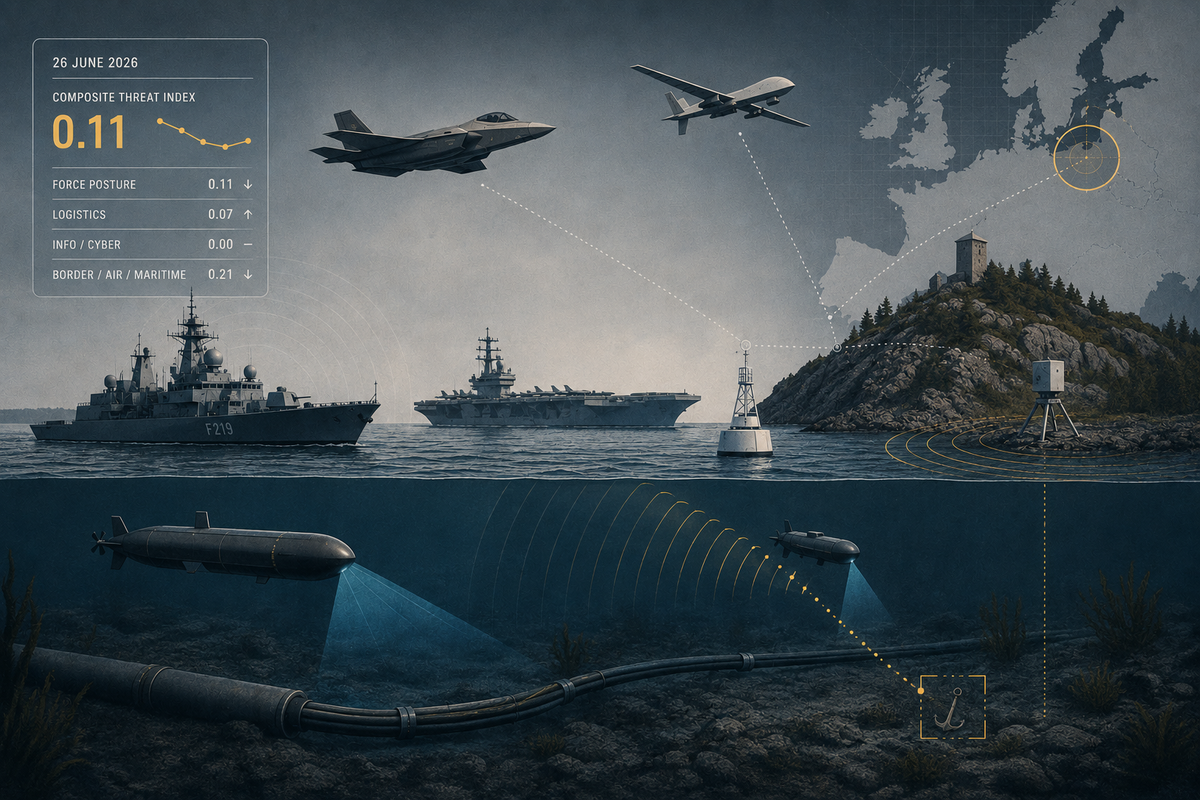
OSINT Indices
| Indicator | Value | Delta 6h / 24h |
|---|---|---|
| Composite Threat Index | 0.11 | 0.00 / 0.00 |
| Force Posture | 0.11 | ↓ from 0.23 |
| Logistics | 0.07 | ↑ from 0.00 |
| Info/Cyber | 0.00 | — |
| Border/Air/Maritime | 0.21 | ↓ from 0.24 |
Events logged (24h): 10 · High-confidence: 0
Quarantine: 0 · Source failures: 0
Composite at 0.11 is the new cycle minimum. Force Posture has fallen to match it — both at 0.11 — meaning force deployment as a category is generating almost no new signal. But the day's structure carries a more interesting message: Logistics has returned from zero to 0.07, a quiet but persistent indicator of background operational support. Border/Air/Maritime, while easing from 0.24 to 0.21, remains structurally elevated. The day's key qualitative development: CMRE enters the top five for the first time in the entire monitoring cycle — the underwater dimension of NATO security finally has its own entry.
Top-Five Structure: A Qualitative Shift Toward the Sea
| Position | Event | Score | Domain |
|---|---|---|---|
| 1 | SNMG1 | 0.45 | Surface maritime |
| 2 | TIE 26 (counter-drone tech) | 0.44 | Air/ground |
| 3 | AR3 Evolution, Estonia | 0.44 | Ground UAS |
| 4 | HMS Prince of Wales / Ramstein Flag | 0.39 | Carrier air-maritime |
| 5 | CMRE — maritime future tech | 0.39 | Undersea autonomous |
For the first time in the monitoring cycle, all five top-five entries are linked to the maritime or air-maritime dimension. The ground component (Eastern Sentry, Flytrap, Crystal Arrow) has entirely receded. This is not coincidence — it reflects the actual operational emphasis of the week.
Top Events
🔵 1. Standing NATO Maritime Group 1 (SNMG1)
OSINT score: 0.45 — WATCH
Following BALTOPS 2026's conclusion (19 June), SNMG1 maintains operational presence in the Baltic Sea. Today's Logistics signal (0.07) is partly linked to sustaining this post-BALTOPS maritime posture: fuel, maintenance, and personnel rotations across the group's vessels. (Full analysis in the 10–12 June digests.)
🔵 2. NATO Allies and Industry Test Counter-Drone Technologies
OSINT score: 0.44 — WATCH
(Full analysis in the 17 June digest: TIE 26, Latvia's Sēlija range, Eurosatory marketplace agreement.)
🔵 3. British Army AR3 Evolution Drone — Estonia
OSINT score: 0.44 — WATCH
(Full analysis in the 10 June digest.)
🔵 4. UK Carrier Strike Group and Ramstein Flag 2026
OSINT score: 0.39 — WATCH
(Full analysis in the 25 June digest: HMS Prince of Wales, F-35Bs over Finland, 1,000+ sorties.)
🟠 5. NATO Invests in Future Maritime Technology and Experimentation — CMRE
OSINT score: 0.39 — WATCH (new entry)
This is the day's most significant qualitative development — and it concerns the underwater dimension of regional security, which remains the least visible but operationally most consequential.
What CMRE is. The NATO Centre for Maritime Research and Experimentation, headquartered in La Spezia, Italy, is the Alliance's technical centre for underwater acoustics, autonomous maritime systems and undersea infrastructure protection. CMRE operates the NATO Research Vessel Alliance — the world's quietest and most capable underwater acoustic research vessel — and the coastal research vessel Leonardo. CMRE also operates NATO's first quantum computing laboratory.
TFX-Arctic — the new mission. On 6 June 2026, NRV Alliance departed La Spezia, marking the launch of Task Force X-Arctic — NATO's new initiative to strengthen awareness and presence in the Arctic and High North. CMRE holds technical leadership for the mission under Allied Command Transformation. TFX-Arctic builds on TFX-Baltic, launched in January 2025 to protect critical undersea infrastructure in the Baltic Sea.
Through TFX-Baltic, NATO has already tested more than 70 air, surface and underwater systems in persistent ISR patrols across the Baltic. TFX-Arctic applies the same model — a networked mix of crewed and uncrewed platforms under ultimate human control — to a far larger, harsher and geopolitically more complex operational environment. The Baltic is the prototype; the Arctic is the scale-up.
Gotland — acoustic sensors against sabotage. A separate CMRE strand directly concerns the region: scientists have been deploying advanced acoustic sensors off the coast of Gotland, Sweden, to detect and track potential sabotage of underwater pipelines and data cables. One key trial replicates the acoustic signature of an anchor drop — the suspected method in several recent seabed interference incidents. This research operates in newly accessible waters alongside NATO's newest members, Sweden and Finland.
Underwater drones during BALTOPS 2026. On 8 June, the U.S. Navy's Unmanned Undersea Vehicle Group 1 (UUVGRU-1) conducted UUV operations — including the Iver3 underwater drone — near Liepāja, Latvia, as part of BALTOPS 2026. The exercise demonstrated search, identification and monitoring capabilities beneath the surface while reducing risk to crewed platforms, and marked an expanding operational role for autonomous underwater systems in Alliance exercises.
MAINSAIL — AI for undersea infrastructure protection. The MAINSAIL system, developed through NATO's Innovation Continuum, fuses data from sonar, radar, satellites and open sources using AI algorithms to produce a maritime picture focused on critical underwater infrastructure. The system generates alerts for anomalous activity — such as unusual vessel loitering near undersea cables — and provides long-term analytical insights for planning. MAINSAIL has already completed operational trials in both the Baltic and Arctic seas.
BSM assessment. CMRE's appearance in the top five is not coincidental — it reflects the convergence of several interlinked developments: TFX-Baltic's operational conclusion and TFX-Arctic's launch, MAINSAIL deployment, UUV operations during BALTOPS 2026, and acoustic sensor testing near Gotland. Together they describe an Alliance systematically building persistent undersea situational awareness as a standing capability — not a reaction to individual cable or pipeline incidents. Border/Air/Maritime (0.21) remains elevated precisely because the maritime sub-index now incorporates autonomous systems operating beneath the surface alongside surface ships.
Regional Context: The Undersea Threat in the Baltic
Timeline of undersea incidents and concerns (2023–2026):
- October 2023 — Balticconnector gas pipeline between Finland and Estonia damaged; anchor drag suspected
- December 2023 — Estlink cable between Estonia and Finland damaged
- 2024–2025 — Series of suspicious incidents involving "shadow fleet" vessels in the Baltic; NATO launches Baltic Sentry
- January 2025 — TFX-Baltic launched; 70+ systems tested
- February 2026 — CMRE deploys acoustic sensors near Gotland
- June 2026 — NRV Alliance departs for TFX-Arctic; UUVGRU-1 operates near Liepāja during BALTOPS 2026
Scale of the threat. The Baltic Sea hosts the densest undersea network in Northern Europe: gas pipelines (Balticconnector, the Estonia–Sweden link), power cables (Estlink 1 and 2), and dozens of fibre-optic communication lines. Damage to any of these assets can isolate Estonia, Latvia or Lithuania from critical networks. This is why Baltic Sentry, TFX and MAINSAIL are not research projects — they are operational necessities. Baltic Sentry is the prototype: a concentrated experiment in using autonomous maritime systems to protect underwater infrastructure and deter hybrid threats in a constrained sea. Arctic Sentry is the scaling effort, applying the same model to a far larger, harsher region.
Pre-Ankara Summary: 11 Days Out
| Date | Composite | Force Posture | Logistics | B/A/M |
|---|---|---|---|---|
| 8 June | 0.17 | 0.37 | 0.00 | 0.18 |
| 12 June | 0.15 | 0.17 | 0.15 | 0.23 |
| 17 June | 0.17 | 0.36 | 0.00 | 0.20 |
| 19 June | 0.12 | 0.17 | 0.00 | 0.24 |
| 25 June | 0.14 | 0.23 | 0.00 | 0.23 |
| 26 June | 0.11 | 0.11 | 0.07 | 0.21 |
Three weeks of monitoring establish a clear pattern: the composite oscillates between 0.07 and 0.17 in the inter-exercise period; Force Posture tracks exercise peaks and troughs; Border/Air/Maritime never drops below 0.16 — a structural floor, not a temporary anomaly. Logistics returning to 0.07 today is a quiet but meaningful signal: background support for maritime operations continues even without a major exercise underway.
Eleven days remain until the NATO Ankara Summit (7–8 July). Expected decisions with direct northeastern-flank implications include: revised defence spending targets, command architecture for Estonia and Latvia under German-Netherlands Corps, Ukraine funding arrangements, and — for the first time — formal establishment of Arctic Sentry as a standing operation alongside Baltic Sentry. If that last decision is confirmed in Ankara, the CMRE / TFX-Arctic entry appearing in today's top five will be retrospectively readable as the operational precursor that made it possible.
Baltic Security Monitor (osint-baltic.com) — analytical publication covering NATO's northeastern flank.
All OSINT coefficients are calculated by an automated indexing system from open sources.