America withdraws from Europe quietly. NATO understands but says nothing

Buried beneath bureaucratic memoranda and Pentagon reorganisation directives lies a fact with implications deeper than most strategic documents convey. The American military has cancelled the deployment of the Army's "Black Jack" tanker brigade to Europe. This is not a scheduling delay or a technical reshuffling. It is a signal that after two decades in Afghanistan and repositioning in the South China Sea, Washington is reconsidering its commitment to an ageing continent.
Approximately four thousand soldiers who were to be stationed in Poland and across NATO's eastern flank remain in American barracks. The brigade's expeditionary equipment is already en route to Europe, but the personnel stay behind. It is a paradox that tells a story: material logistics persist independently, but political will begins to corrode.
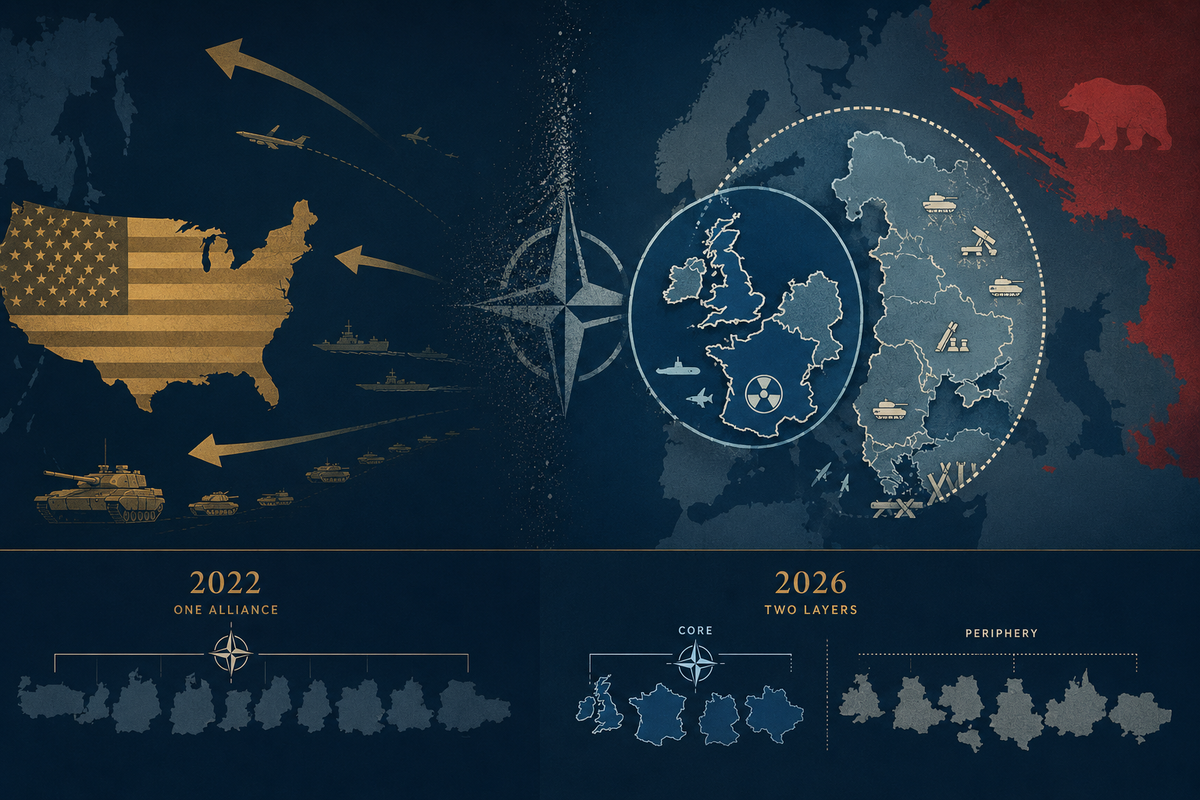
Simultaneously, the Pentagon announced plans to withdraw roughly five thousand troops from Germany—a decision that would return American military presence in Europe to pre-2022 levels, before Russia's full-scale invasion. On the surface, this appears sensible resource optimisation. In substance, it represents a reordering of priorities.
The 2026 National Defence Strategy: Europe shrinks on the page
In April 2026, the Trump administration released a National Defence Strategy that speaks more plainly than any official statement. At the apex of the geopolitical pyramid: defence of American territory and the containment of China. Descending through the hierarchy: the Indo-Pacific region, then the Western Hemisphere, then everything else.
Europe, once the centrepiece of American thinking on alliances and mutual guarantee, has become a secondary concern. Not boycotted, not adversarial—simply less critical. The logic is transparent: China represents a strategic threat demanding resource concentration. Russia is a regional irritant that Europe should learn to manage independently.
The new National Defence Strategy shifts overtly from "partnership" to "conditional partnership." Terminology alters, but substance persists: Europe is no longer a partner in global competition—it is a region entrusted to manage its own affairs.
Burden-sharing, when it was an American proposal in the 1990s, became a condition in the 2020s. Now it becomes a requirement. NATO must increase defence spending, must develop indigenous weapons production, must cease relying on American security underwriting as the foundation of its architecture.
Congress attempts to hold ground. The White House moves forward.
Even within a Republican-controlled Congress, word of America's wholesale recalibration of its NATO role proved loud enough to force a small cohort of legislators to defy leadership.
In April, the House of Representatives debated legislation that gained support from both Republicans and Democrats, aimed at strengthening military aid to Ukraine and imposing severe sanctions against Russia. This was not a routine vote. It was a vote that exposed a fissure within the Republican caucus—a fissure deeper than even some sceptics had acknowledged.
Defence Secretary Pete Hegset, on a day when he was to announce the release of four hundred million dollars in Ukraine support, capitulated to pressure. Senator Mitch McConnell, a veteran of the transatlantic strategic school, published a critical essay on how freezing funding weakens America and destabilises NATO. The funds were released—but not through administrative volition. They were released because Congress left the White House with no alternative.
The 2026 National Defence Authorisation Act, the sweeping defence bill passed annually, plainly reflects disagreement between Congress and the White House on European security. Congress seeks to preserve American commitment. The administration acts as though the United States can afford selectivity in its relationships.
But the mere fact that legislation was required to compel the White House to release Ukraine funding tells all that is necessary about how American power calculates European security.
Reality beneath words: symbolic presence, not operational
America formally remains in NATO. It has signed force posture agreements. It continues to proclaim steadfastness. Yet at the operational level, American presence in Europe contracts. Not abruptly, not overnight—gradually, under the rationale of deployment plan reassessment and the necessity of focusing resources on "genuinely important" theatres.
The Ukrainian conflict is classified as a European security problem—a problem Europeans must resolve with European resources. America will remain as a contingent precondition for success, not as foundation. The foundation must now be built by Europe itself.
This is not American capitulation. It is a transfer of responsibility.
The scenario of coming years: NATO stratifies
When you compound the reduction in American presence, the strategic reorientation toward the Indo-Pacific, and the evident political will of the White House to distance itself from European anxieties, a scenario emerges that European strategists have begun discussing privately but not publicly.
NATO will not fracture into members and non-members, but into two functionally distinct layers. One layer—the alliance's core—will remain bound together by the United States, Britain, and France. This layer will possess nuclear deterrence, genuinely global capabilities, and the will to project force across vast distances.
The second layer—Central and Eastern Europe, the Baltic states—will retain formal NATO membership but practical understanding that American guarantee is no longer automatic. These states will be compelled to mobilise their own defence potential, develop indigenous weapons production capacity, and most critically, reassess their geopolitical position in light of Washington's evident substitution of priorities.
This is not a new NATO. This is NATO under altered American stewardship.
What this means operationally
On the Baltic and in Central Europe, it means states must accelerate weapons production and defence expansion plans that they have deferred while expecting American underwriting. That expectation is dissolving.
For Ukraine, it means American military assistance will acquire a contingent character—dependent on whether Congress can override an administration that views the Ukrainian conflict as a European dilemma that Europeans must resolve.
For NATO as a whole, it means arrival at one of the most critical junctures in its history since founding: a period when American guarantee will remain nominal but practical security will depend on the resilience and weapons production of the European coalition itself.
Congress will attempt to preserve tomorrow. But the White House possesses leverage and intends to employ it.
This is not the end of NATO. But it is the end of the era when NATO could assume America would remain awake while Europe slept.