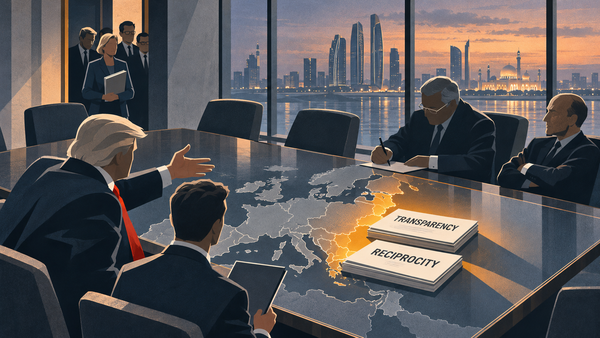
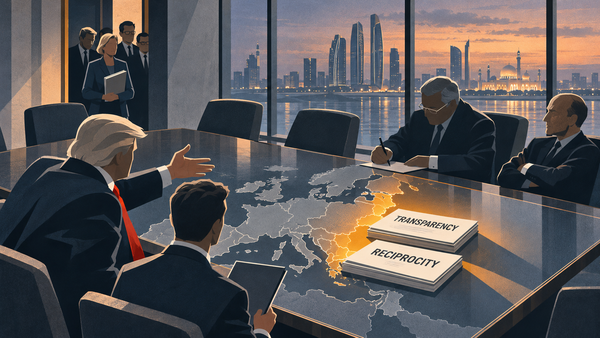
A Table in Abu Dhabi, a Chair in Brussels
Three days before US-mediated talks between Ukraine and Russia in Abu Dhabi, Washington is talking up a "big" security deal for the whole of Europe. Europeans will not sit at that table. They have been given a separate one in Brussels, while the Pentagon quietly asks allies on the eastern flank to…

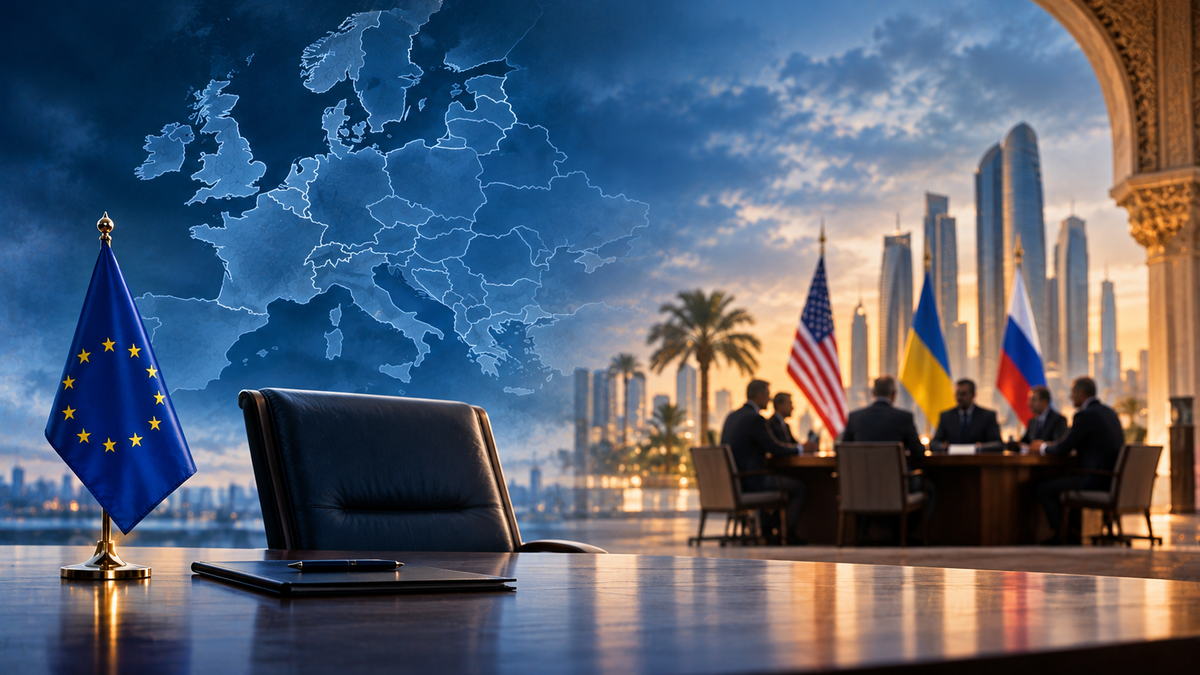
Three days before US-mediated talks between Ukraine and Russia in Abu Dhabi, Washington is talking up a "big" security deal for the whole of Europe. Europeans will not sit at that table. They have been given a separate one in Brussels, while the Pentagon quietly asks allies on the eastern flank to talk less about the Russian threat.
Baltic Security Monitor | Geopolitical Commentary
7 November 2026
Europe has not been shut out of the conversation about its own security. It has been seated elsewhere. Brussels discusses guarantees and reconstruction, Abu Dhabi discusses the war, and the White House talks about a deal "for all of Europe" whose terms nobody has seen. For the Baltic states the real question is not whether they get a seat. It is whether what gets decided at the different tables will fit together.
What is happening
Abu Dhabi, 10–11 November. US special envoy Steve Witkoff announced that Washington will mediate talks between Ukraine and Russia in Abu Dhabi, building on what he called progress in Kyiv, Oslo and St Petersburg. The format is trilateral. No European participants are named.
Brussels, 4 November. Europeans were included, but on a separate track. Representatives of Ukraine, the US, France, Germany, the UK, NATO and the World Bank met at the European Commission at national security adviser level. The stated focus was Ukraine's reconstruction and a "lasting, sustainable peace."
Washington, 5–6 November. After meeting Kremlin envoy Kirill Dmitriev, Trump said a major security agreement involving Ukraine and potentially all of Europe was under discussion. He gave no terms. Jared Kushner reportedly outlined a wider European security framework including military transparency and steps to lower Russia-Europe tensions. Zelensky warned that a Russia-Europe arrangement could be dangerous if it does not first resolve the war against Ukraine. Russia's demands, meanwhile, are unchanged: the Donbas, limits on Ukraine's army, and an end to its NATO ambitions.
Context older than "the last three days"
Several threads now being presented as fresh have been running for weeks. Taken together, though, they form a coherent picture.
"Don't poke Russia." In late October Reuters reported that Pentagon officials had privately asked Lithuania, Latvia and Estonia to tone down public warnings about Russia. Among them, according to sources, was Elbridge Colby, the under secretary of defense for policy, who advised a Baltic official against "poking" Moscow. Estonia's defence ministry said no such suggestions had reached it through official channels. The Pentagon declined to comment.
Russian diesel. On 9 October Trump announced an arrangement with Putin, and Treasury issued General License 135 authorising the sale and import of Russian-origin diesel. That came three weeks after Trump signed the Lindsey Graham Sanctioning Russia and Iran Act, which passed the Senate 86-11. Twenty-two House members from both parties want the license revoked, and Republican Senator Thom Tillis said there was a "legitimate case" that the president was not following the law.
USAI. A Pentagon inspector general report to Congress, cited by Militarnyi, shows zero dollars of military aid to Ukraine under USAI in the second quarter of 2026. Expired, uncommitted funds rose to $1.02 billion by the end of June. The report does not specify whether "zero" refers to new contracts, obligations or deliveries. Congress has kept the programme alive, with $400 million each for 2026 and 2027.
BSM analysis: three levels
Washington. The American logic is consistent, however uncomfortable for allies. Colby has long pushed what he calls "NATO 3.0": Europe takes primary responsibility for its own defence while the US runs the negotiation with Moscow. In that frame, asking allies to lower their voices and licensing Russian diesel are not contradictions but preparation of the negotiating ground. The problem is that a "big European deal" with no published terms hands Moscow what it wants most: a conversation about Europe's security architecture that does not start with Ukraine.
Europe and the Baltic states. The Brussels track is real, but it covers guarantees and reconstruction, the things that come after a deal. The deal itself is being shaped elsewhere. For Estonia, Latvia and Lithuania the risk is specific. Any "military transparency" or "de-escalation" between Russia and Europe would in practice mean limits on deployments, exercises or infrastructure on exactly the stretch of NATO's border that Moscow calls a threat. That is why a Pentagon request to speak more quietly reads in the region less as diplomatic etiquette and more as a signal of priorities.
Moscow. The Kremlin gets a full package: a direct line to the White House through Dmitriev, talks with no Europeans at the main table, the first carve-out from new sanctions, and a debate about "European security" in place of a debate about occupation. Its own demands have not moved. The Donbas, a capped army, no NATO.
What BSM does not confirm
Material circulating around this story contains several overstatements. The Pentagon did not tell "NATO" to go quiet; the reports concern private conversations with a few allies, and Estonia has officially denied receiving such requests. Trump did not "hand out permits" for Russian trade; Treasury issued one general license for diesel. Congress as an institution has not "pledged to block" sanctions relief; the opposition is bipartisan, but so far it consists of letters, statements and bills, not enacted measures. And Europeans have not been entirely "excluded from talks about Europe"; they are on a parallel track.
Bottom line
On 10 November three delegations will sit down in Abu Dhabi. Europe will be watching from Brussels, and the Baltic states will be watching while being asked to keep their voices down. You can have a chair without having a place at the table. Three days to go.
Baltic Security Monitor (osint-baltic.com) — an analytical publication on security along NATO's northeastern flank.
Prepared from open sources, with key claims independently verified.