Power at Zaporizhzhia, Fire at Kirishi
Zaporizhzhia NPP spent ten hours on diesel before power returned through a single line; the same night drones set Russia's Kirishi refinery ablaze — on the eve of the Abu Dhabi talks.

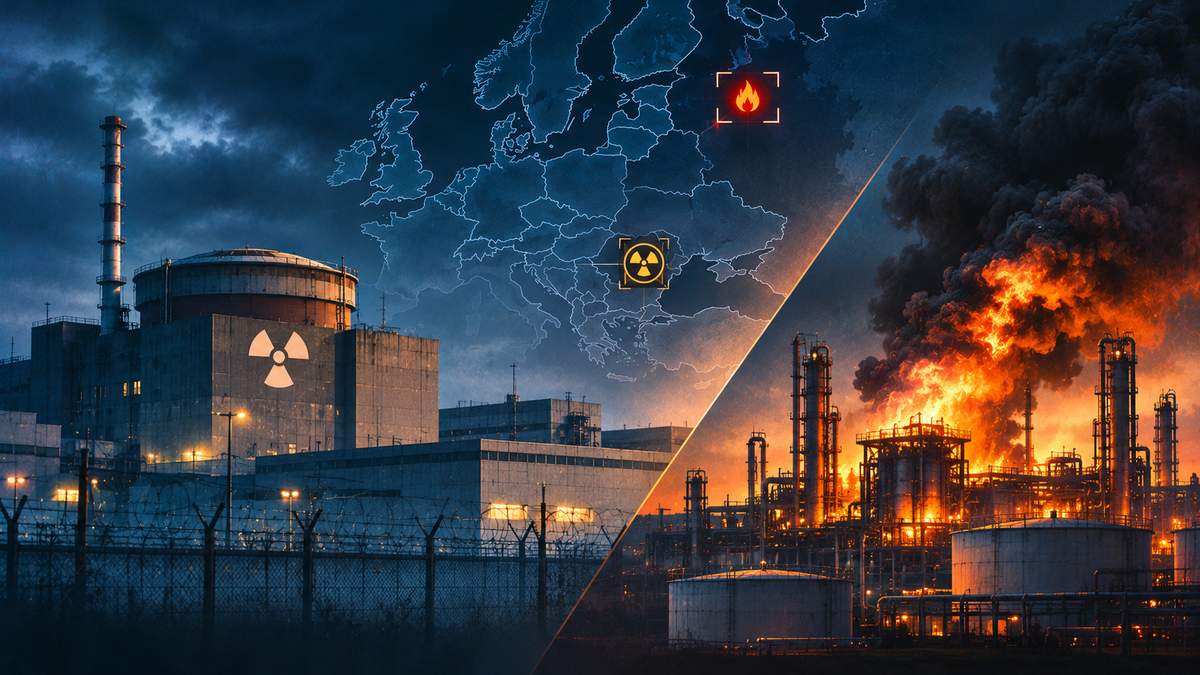
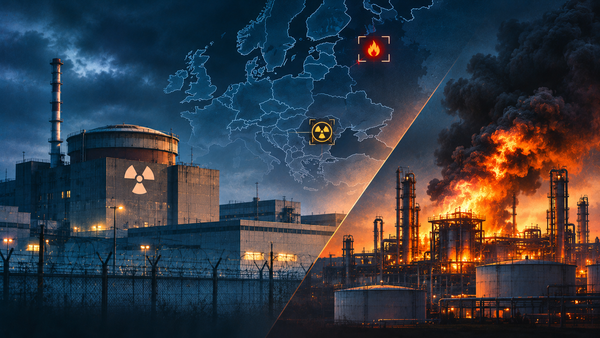
Europe's largest nuclear plant lost all off-site power for the 27th time in the war and spent ten hours on diesel before the grid came back — through a single line. The same night, drones set Russia's Kirishi refinery ablaze, 100 km from St Petersburg. Both stories point the same way: energy is the front line on the eve of the Abu Dhabi talks.
Baltic Security Monitor | Security Watch
Cycle: 9 November 2026, 08:00 EET · window 8 November 20:00 — 9 November 08:00
Cycle status
- Classification: 1 MATERIAL UPDATE — MODERATE (nuclear safety)
- Open WATCH lines: 10
- Uncertainty: 🟡 5 · 🔴 0
- Top new WATCH: strike on Kirishi's industrial zone, Leningrad Oblast
This cycle produced one risk-reducing change and one risk-raising event. Zaporizhzhia is back on the grid after emergency diesel operation — a verified operational delta. Yet nothing in the plant's safety architecture has improved: one line, an unexplained disconnection, no redundancy. Meanwhile the Kirishi strike shows that neither side is pausing its energy campaign a day before negotiations. If anything, the strikes are writing the agenda.
⚛️ Zaporizhzhia: ten hours on diesel
MATERIAL UPDATE — MODERATE · Nuclear safety / critical infrastructure
On 8 November the Russian-occupied Zaporizhzhia nuclear power plant lost its only working external connection, the 330-kV Ferosplavna line. The IAEA reported the outage around midday local time, with cooling and safety systems switched to emergency diesel generators. Roughly ten hours later, the agency confirmed that power had been restored.
IAEA Director General Rafael Grossi called it the 27th such event of the war. The exact cause and location of the disconnection have not been established. Russian-installed management reported normal radiation levels, which is not the same as independent verification of every safety parameter.
The main 750-kV Dniprovska line remains unavailable, according to the latest IAEA information. The plant has its lights back, not its backup.
Recent weeks show a pattern rather than an isolated fault. On 29 October a drone attack reportedly killed a welder from the plant's repair workshop. On 3 October the IAEA logged a series of drone strikes that damaged transformers at the neighbouring Zaporizhzhia thermal power plant. A comparable blackout in June lasted 15 hours.
BSM analysis: BSM rated the full loss of off-site power as HIGH in its 14:00 report on 8 November. The return to grid supply lowers immediate risk, but every outage draws down the safety margin — diesel stocks, generator wear, staff endurance. Six reactors in cold shutdown still need electricity to cool their fuel. For the Baltic states, which are weighing nuclear power as part of their own energy security, Zaporizhzhia is the clearest illustration of how a nuclear plant inside a war zone becomes a standing source of cross-border risk.
🟡 Cause of the disconnection unknown; no confirmed lasting restoration of redundant supply.
🔥 Kirishi: fire confirmed, damage not
WATCH — potentially HIGH
Overnight into 9 November, drones struck the industrial zone of Kirishi. Leningrad Oblast Governor Alexander Drozdenko confirmed impacts there and debris damage to an apartment in town, from which a family was evacuated; no injuries were reported in Kirishi. His count of downed drones rose during the morning from 81 to 113, as the attack was still under way at the time of his first statement.
Verification has moved beyond the digest snapshot. Independent Russian outlet ASTRA, after OSINT analysis of local video, confirmed that the fire is at the KINEF refinery (Kirishinefteorgsintez) itself. NASA's FIRMS satellite fire-monitoring system detected multiple thermal hotspots at the site, Kyiv Independent reported.
Still unconfirmed by independent sources: damage to primary crude distillation units (flagged as preliminary by Ukrainian monitoring channels), any halt in processing and its duration. The operator has not commented.
KINEF, owned by Surgutneftegas and under US sanctions, is one of Russia's three largest refineries, with capacity of roughly 20 million tonnes a year. It has repeatedly gone offline after strikes in 2026: in March, in May (when Reuters industry sources reported three of its four crude units damaged) and after the 30 August attack. This is the first strike since August.
BSM analysis: Kirishi is not a peripheral target. The plant supplies northwest Russia's domestic market and exports fuel through Baltic ports. Every extended KINEF outage reshapes product flows across the Gulf of Finland — the same waters where Estonia and Finland track the shadow fleet. The attack also underlines reach: some 800 km from Ukraine's border, with more than a hundred drones in a single wave over a region that borders Estonia.
🟡 Damage extent and any production halt not independently confirmed. Next checks: operator statement, geolocated imagery, Reuters industry sources.
Key signal: energy sets the negotiating agenda
US-mediated working-level talks between Ukraine and Russia are due in Abu Dhabi on 10–11 November. Reuters reports that Steve Witkoff and Jared Kushner will lead the US side. French Foreign Minister Jean-Noël Barrot said on 8 November that Europeans will be represented.
The 48 hours before the meeting brought a massive Russian strike on Ukraine's power system on 8 November and Ukrainian strikes on Kirishi and Rostov Oblast in return. Zaporizhzhia belongs in the same frame: the plant's power supply and safety will be part of any conversation about an energy ceasefire. Both delegations arrive having shown that the other side's energy infrastructure remains within reach.
Other open lines
- Black Sea 🟡 — Russia's 8 November claim of strikes on three vessels remains independently unverified; vessel names, port statements and AIS data are needed.
- Ukraine's power grid — the 8 November outages are already covered; next check is restoration and confirmed generation losses.
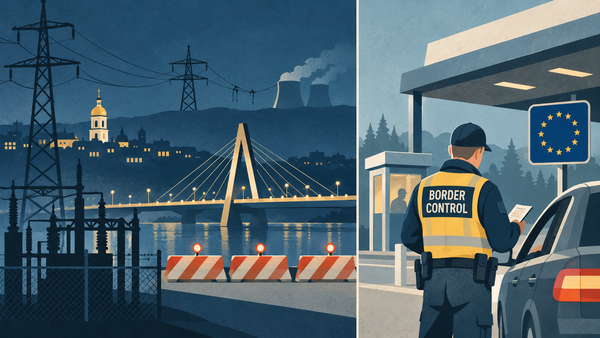
- Kyiv Northern Bridge — damage covered on 7 November; engineering assessment pending.
- Rassvet 🟡 — Ukrainian intelligence's claim of satellite connectivity for Russian drones still lacks independent technical corroboration.
- Latvian airspace violations 🟡 — preliminary identification of two drones, no conclusive forensic attribution.
- Rzeszów–Jasionka — the French air-defence mission was covered earlier; actual deployment is not yet confirmed.
- Threats to European aviation — perpetrators and links between incidents remain unestablished.
- Exercise Koalicja — 9–22 November in Poland with an Estonian company; a scheduled exercise announced on 3 November, not a new delta.
Conclusion
The night of 9 November delivered two events of opposite sign and the same logic. At Zaporizhzhia, risk fell but did not go away: power returned through the same single line that has now failed 27 times. At Kirishi, risk to Russian refining rose, though the scale is not yet confirmed. Together they say one thing — energy remains the field on which the sides negotiate before they reach the table.
One line stands between Europe's largest nuclear plant and its next switch to diesel. Abu Dhabi is one day away.
Baltic Security Monitor (osint-baltic.com) — analytical coverage of security on NATO's northeastern flank.
Cycle status and event classification are generated by an automated open-source monitoring system.