The Eastern Flank Between the Lines
Kushner's plan rejects a Russian veto over NATO membership. But "transparency" and "reciprocal measures" are where limits on the eastern flank could hide.

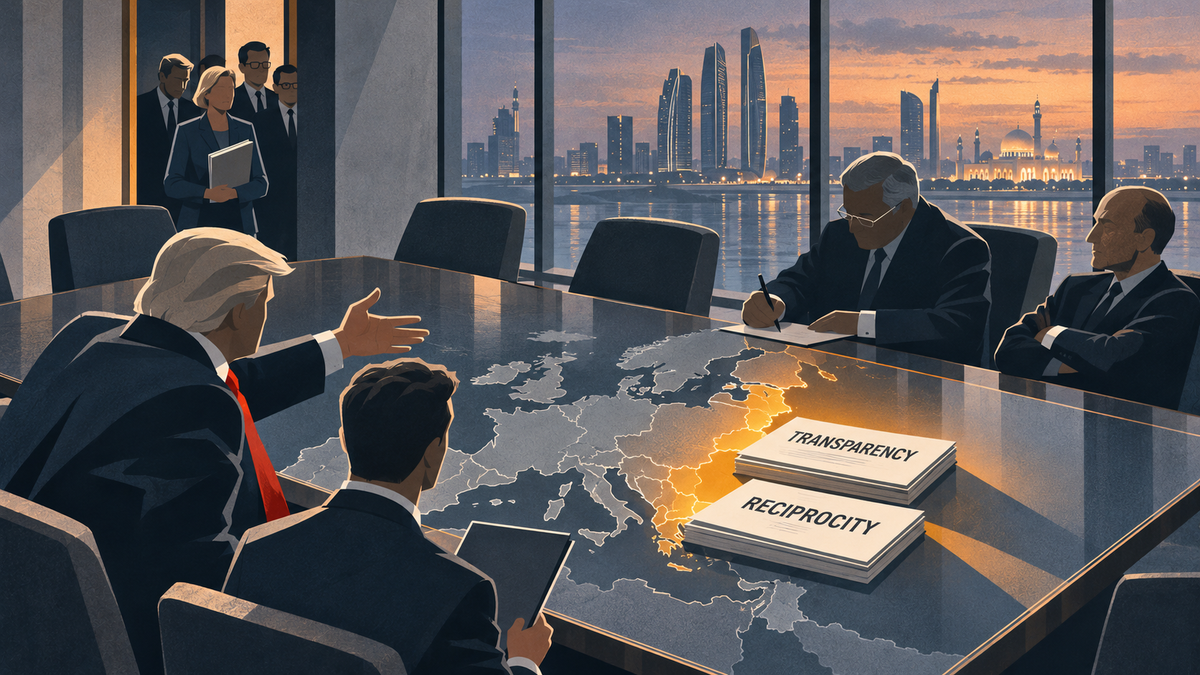
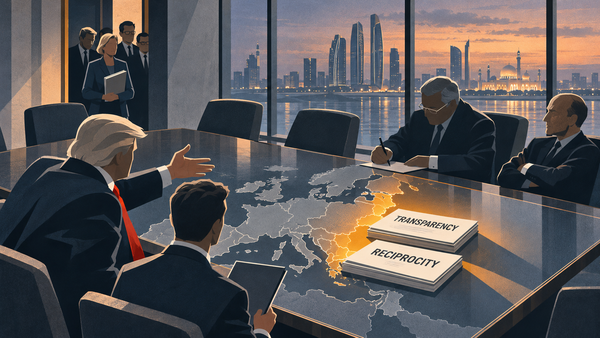
Talks on ending the war in Ukraine open in Abu Dhabi tomorrow. Yet the plan Washington is bringing speaks about all of Europe — "military transparency" and "reciprocal measures to reduce escalation risks". For the Baltic states and Poland, the question is not whether a ceasefire gets signed, but what ends up between the lines.
Baltic Security Monitor | Analysis
9 November 2026
Where things stand
US-mediated working-level talks between Ukraine and Russia are scheduled for 10–11 November in Abu Dhabi. Reuters reports that special envoy Steve Witkoff and Jared Kushner will lead the US side. It is the first US-brokered round since February, when talks stalled after the US and Israel went to war with Iran.
Russia's line-up is a signal in itself. According to TASS, presidential aide Vladimir Medinsky will head the delegation. Kyiv Independent reports that Deputy Foreign Minister Sergei Ryabkov, who handles relations with Washington and arms control, will join the talks for the first time. Nobody brings the arms-control file to a conversation that is only about the front line.
On 5 November Donald Trump called the possible deal "very big" and said it might involve "all of Europe". The same day he spoke with European leaders, after which Kushner set out five goals for a new European security framework.
Kushner's five goals
- permanent security consultations;
- reliable crisis communication;
- greater military transparency;
- reciprocal measures to reduce escalation risks;
- a durable framework for long-term European security and stability.
Kushner attached safeguards. Any arrangement must respect sovereignty and territorial integrity, every state chooses its own alliances, and no country will hold a veto over the sovereign decisions of others. NATO, he said, remains the central pillar of collective defence in Europe.
BSM analysis: as principles, this is good news for the eastern flank. Freedom of alliance and no Russian veto directly reject Moscow's core demand of 2021. But principles are not mechanisms. "Transparency" and "reciprocal measures" are the vocabulary of conventional arms control, from the CFE Treaty to the Vienna Document — and that is exactly where limits on force levels and deployments in border zones tend to appear.
A country can remain a full NATO member and still be bound by "reciprocal measures" on what it hosts and where. Sovereignty stays intact on paper while deterrence erodes in practice.
The red line is symmetry
For Estonia, Latvia, Lithuania and Poland, the word "reciprocity" matters less than its geography.
If limits apply only to allied territory along Russia's border, the asymmetry favours Moscow. Rotational battalions, the US presence in Poland and reinforcement plans all rest on the ability to build up forces quickly. The symmetry test is simple: do the same measures cover Kaliningrad, Belarus and Russia's western military districts?
The risk is not hypothetical. Before the 2022 invasion, Russia demanded that NATO pull forces out of every country that joined after 1997 — the entire eastern flank. In October The Telegraph reported that the Kremlin could revive that demand in the current negotiations. 🟡 There is no confirmation that it is on the table in Abu Dhabi.
Europe in the doorway
As late as 3 November, Europeans were not expected at the table in Abu Dhabi. A week later the picture changed: on 8 November French Foreign Minister Jean-Noël Barrot said Europeans would be represented.
The reaction to Trump's remarks was sharp. EU foreign policy chief Kaja Kallas said in Warsaw that Europe already has a security architecture, which Russia keeps violating, that Putin has no veto over European security, and that no deal can be implemented without the EU. Polish Foreign Minister Radosław Sikorski called any arrangement made without Europeans politically unacceptable and practically impossible. German Chancellor Friedrich Merz said on 3 November that he saw no serious Russian engagement so far.
BSM analysis: being in the room is not the same as shaping the text. But the fact that Europe had to be invited after the format was announced shows how the agenda was built.
Signals from the region
BSM's automated indices at 09:06 UTC show calm on the ground:
- Composite: 0.16, unchanged over 6 and 24 hours
- Force Posture: 0.46 — the only non-zero sub-index
- Logistics, Info/Cyber, Border/Air/Maritime: 0.00
A quiet border coincides with movement at the table. This week the risk to the eastern flank lies in wording, not incidents.
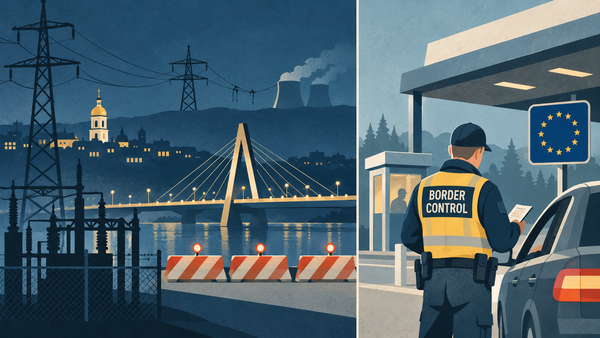
Northern Europe, meanwhile, is acting as if the threat is long-term. On 5 November Sweden announced internal border controls from 12 November to 11 May, citing the security situation and Russian hybrid threats. It is an extension rather than a first-time measure, but the framing stands out: while Abu Dhabi discusses "reducing escalation risks", Estonia's neighbour across the Baltic is locking in protection for six months ahead.
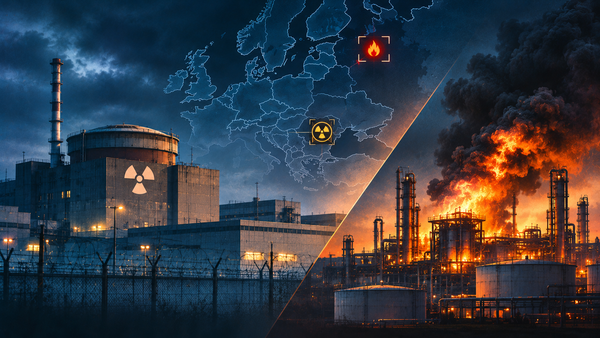
And overnight into 9 November, according to the regional governor, 113 drones were shot down over Leningrad Oblast, which borders Estonia, and the Kirishi refinery caught fire. The energy war is not pausing for talks. (Full analysis — Security Watch, 9 November, 08:00.)
What to watch on 10–11 November
1. Text. Whether a document or at least a list of provisions is published. Statements of progress without a text are WATCH, not a MATERIAL UPDATE.
2. Symmetry. Any concrete wording on deployments, exercises or infrastructure near borders — and whether it also covers Kaliningrad and Belarus.
3. The region's voice. How Warsaw, Tallinn, Riga, Vilnius and Helsinki respond after day one. The states expected to underwrite any guarantees need a say in defining them.
Conclusion
There are no grounds to claim that Washington is trading away the eastern flank: Kushner's published principles say the opposite. Nor are there grounds for comfort, because what matters in such deals is never in the principles but in the mechanisms. The Baltic states and Poland will be reading not the headlines from Abu Dhabi, but the annexes.
The right to choose NATO without the right to host NATO is not sovereignty. It is scenery.
Baltic Security Monitor (osint-baltic.com) — analytical coverage of security on NATO's northeastern flank.
OSINT indices are calculated by an automated indexing system based on open sources.