A Carrier Instead of an Airbase: OSINT Digest — 25 June 2026

Baltic Security Monitor | Analytical Brief
Snapshot: 2026-06-25T10:05:01Z
OSINT Indices
| Indicator | Value | Delta 6h / 24h |
|---|---|---|
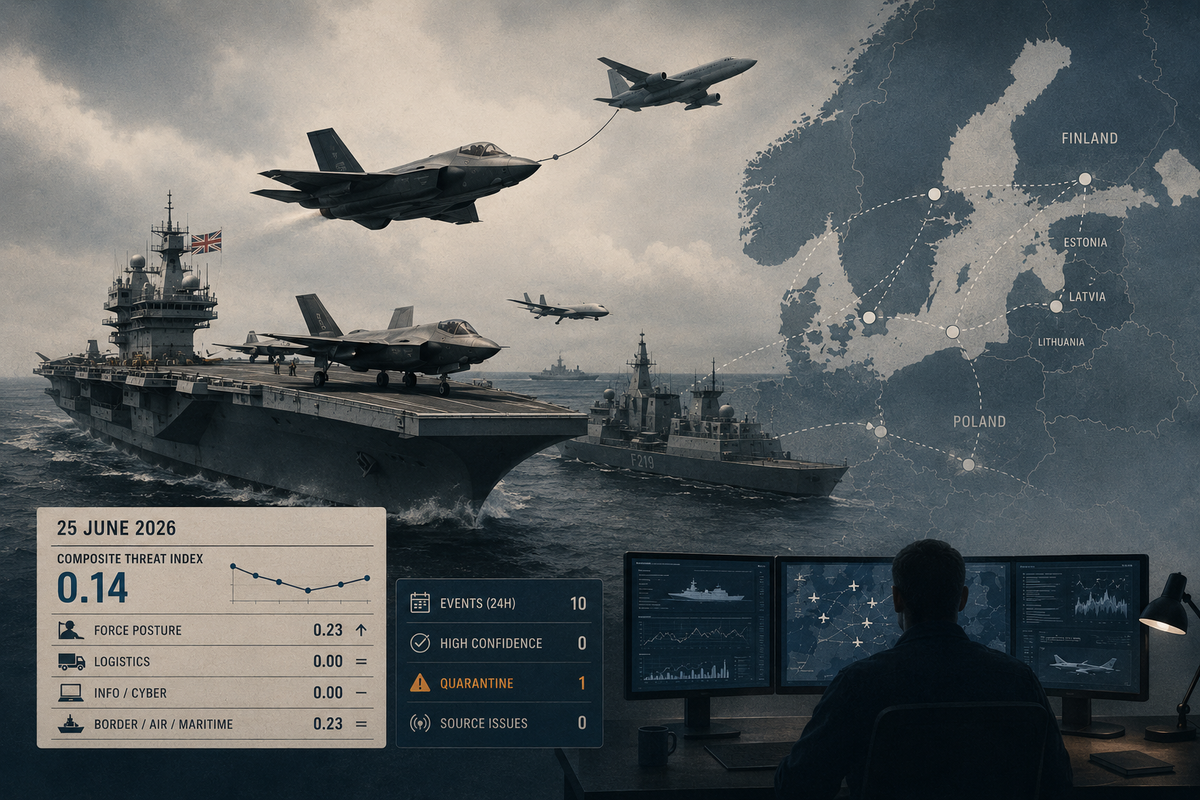
| Composite Threat Index | 0.14 | 0.00 / 0.00 |
| Force Posture | 0.23 | ↑ from 0.17 |
| Logistics | 0.00 | = |
| Info/Cyber | 0.00 | — |
| Border/Air/Maritime | 0.23 | = stable |
Events logged (24h): 10 · High-confidence: 0
Quarantine: 1 (reason: low-information-density) · Source failures: 0
Composite at 0.14 — a return to the mid-range after last week's low of 0.12. The notable movement: Force Posture rises from 0.17 to 0.23, aligning with Border/Air/Maritime — the first day in the entire monitoring cycle where both sub-indices show identical readings. The first quarantine in the cycle (low-information-density) signals that the system has caught a low-quality event for the first time in two weeks — consistent with the transition from peak exercise tempo to the inter-cycle interval.
What the Low-Information-Density Quarantine Means
For the first time in the two-week monitoring cycle, the OSINT system quarantined one event for low information density. This means the source or event passed initial filtering but proved insufficiently informative for analysis — most likely a publication with minimal operational detail, a duplicate, or a press release without concrete data. The quarantine is a quality-of-flow indicator: even on a "quiet" day, the system maintains its filtering discipline.
Top Events
🔵 1. Standing NATO Maritime Group 1 (SNMG1)
OSINT score: 0.45 — WATCH
BALTOPS 2026 concluded in Kiel on 19 June, but SNMG1 maintains operational presence in the Baltic Sea. The stable score of 0.45 and elevated Border/Air/Maritime (0.23) confirm that the Baltic does not revert to a "neutral" operational tempo after BALTOPS — it remains a space of constant fleet positioning under Baltic Sentry.
Notably, during Ramstein Flag 26, HMS Prince of Wales operated alongside FGS Sachsen — the SNMG1 command flagship — and also participated in Dynamic Mongoose 26, the parallel anti-submarine exercise. This illustrates how SNMG1 functions not as an isolated maritime structure but as a node connecting the Alliance's naval and air components. (Full analysis in the 10–12 June digests.)
🔵 2. NATO Military Committee Visits Iceland — GIUK Gap
OSINT score: 0.45 — WATCH
(Full analysis in the 8 June digest.)
🔵 3. NATO Allies and Industry Test Counter-Drone Technologies
OSINT score: 0.44 — WATCH
(Full analysis in the 17 June digest: TIE 26, Latvia's Sēlija range, Eurosatory marketplace agreement.)
🔵 4. British Army AR3 Evolution Drone — Estonia
OSINT score: 0.44 — WATCH
(Full analysis in the 10 June digest.)
🟠 5. UK Carrier Strike Group Joins Ramstein Flag 2026
OSINT score: 0.39 — WATCH (new entry)
This is the week's most significant new item. The participation of the UK Carrier Strike Group (CSG), centred on HMS Prince of Wales, in Ramstein Flag 26 (8–19 June) was one of the most doctrinally significant events of the entire exercise cycle — but it has entered the digest only now, as the monitoring system processes the accumulated reporting.
What happened. F-35B Lightning II aircraft of the Royal Navy's 809 Naval Air Squadron, embarked on HMS Prince of Wales, launched missions from the North Sea and executed sorties at ranges exceeding 700 miles from the carrier — sustained by air-to-air refuelling. Together with destroyer HMS Duncan and tanker RFA Tidespring, the CSG operated in full integration with forces from 18 Allied nations across three Joint Operations Areas from Norway to Spain.
Firsts and records. During Ramstein Flag 26:
- Royal Navy F-35 Lightnings flew in Finnish skies for the first time
- US Marine Corps F-35Bs of VMFA-224 performed the first-ever carrier-variant fighter landing and take-off from a Finnish highway strip, at Tervo
- F-35Bs conducted hot-pit refuelling at Pirkkala Air Base near Tampere — landing, refuelling with engines running, and departing immediately
- The exercise generated more than 1,000 sorties, supported by over 75 tanker sorties and more than 2 million litres of aviation fuel across 11 days
Scenario and scale. Ramstein Flag 26 modelled a full Article 5 scenario — an attack on an Ally requiring a collective response. Aircraft types operating simultaneously included F-35s from the UK, US, Denmark, Norway, the Netherlands and Italy; Eurofighter Typhoons; Spanish F-18s; Swedish Gripens; French Rafales and Mirages; tankers, transport aircraft and Reaper drones. A deployed Deployable Air Command and Control Centre (DACCC) operated from Kallax, Sweden. NATO's Intelligence, Surveillance and Reconnaissance Force provided RQ-4D Phoenix coverage from Pirkkala Air Base.
Command integration. HMS Prince of Wales also contributed to Dynamic Mongoose 26 alongside FGS Sachsen, the SNMG1 command flagship — directly linking the carrier strike group to the Baltic maritime posture in the same exercise period. By operating simultaneously across NATO's northern and southern JOAs, Ramstein Flag 26 demonstrated the Alliance's ability to connect command and control, combat aircraft, ISR, air defence, tanker support, maritime forces and synthetic training into one coherent air operation.
Commander UK CSG: Commodore Richard Hewitt stated: "The UK Carrier Strike Group is fully integrated into NATO's frontline defence. Operating under NATO command, the fifth-generation capability we are generating from HMS Prince of Wales delivers a deliberate message to any potential adversary: together, the Royal Navy and our allies provide the precise, synchronised combat power required to secure the Northern Flank."
BSM assessment: The involvement of a carrier strike group in an air command exercise is structurally significant. NATO traditionally separates air and maritime operational frameworks; Ramstein Flag 26 demonstrated the capacity to fuse them into a single operational arc from the North Sea to the Mediterranean. HMS Prince of Wales simultaneously supporting sorties over Finland and coordinating with SNMG1 in the Baltic is not a symbolic gesture — it is a test of real cross-domain capability at alliance scale. Today's Force Posture rise to 0.23 is partly explained by the delayed processing of this material.
Strategic Horizon: 12 Days to the Ankara Summit
The NATO Ankara Summit (7–8 July) remains on the horizon. The balanced composite (0.14), matching Force Posture and Border/Air/Maritime (both 0.23) and zero Logistics describe an Alliance in an inter-cycle pause — between the conclusion of BALTOPS and Ramstein Flag and the resumption of autumn exercises.
Ankara's northeastern flank agenda:
- Progress report on 5% GDP defence spending targets (Lithuania 5.38%, Latvia 4.9% — already at or above; Estonia 3.38% with a plan to reach 5.4% by 2029)
- Decisions on new Eastern Flank battle groups, including the German-Netherlands Corps command structure for Estonia and Latvia
- Ukraine funding arrangements after current Ramstein-format packages expire
- Formalisation of Arctic Sentry as a permanent NATO operation alongside Baltic Sentry
The Atlantic Council has noted that Alliance members should focus on fulfilling capability pledges and maintaining exercise tempo rather than seeking headline "deliverables" at a summit whose communiqué will not satisfy Trump's transactional calculus regardless of content. The northeastern flank's position is that the content of the communiqué matters less than whether the new battle group and command structures it endorses are actually funded and staffed.
Week-in-Review: 19–25 June
| Signal | Reading |
|---|---|
| Eastern Sentry | Absent from top five since 19 June — sixth consecutive day |
| HMS Prince of Wales | First appearance in digest, with delayed processing |
| Quarantine (1) | First in the entire cycle — system caught a low-quality event |
| Force Posture 0.23 | ↑ from minimum 0.05 — returning to background level |
| Border/Air/Maritime 0.23 | Stable at elevated level for three consecutive weeks |
The post-BALTOPS / post-Ramstein Flag week is characterised not by new escalation but by post-exercise review: the system processes events that occurred, refines rankings, identifies previously underweighted significant material (HMS Prince of Wales), and filters noise (first quarantine). This is normal OSINT monitoring behaviour after a peak exercise cycle.
The window between now and the Ankara Summit is structurally similar to what the Baltic Security Monitor recorded in the ten days before BALTOPS: Force Posture gradually building, Logistics at zero, Border/Air/Maritime providing the floor. The next spike, when it comes, will likely be summit-driven rather than exercise-driven.
Baltic Security Monitor (osint-baltic.com) — analytical publication covering NATO's northeastern flank.
All OSINT coefficients are calculated by an automated indexing system from open sources.