White nights over Ukraine: how Telegram conveys a war it does not understand. May 2026

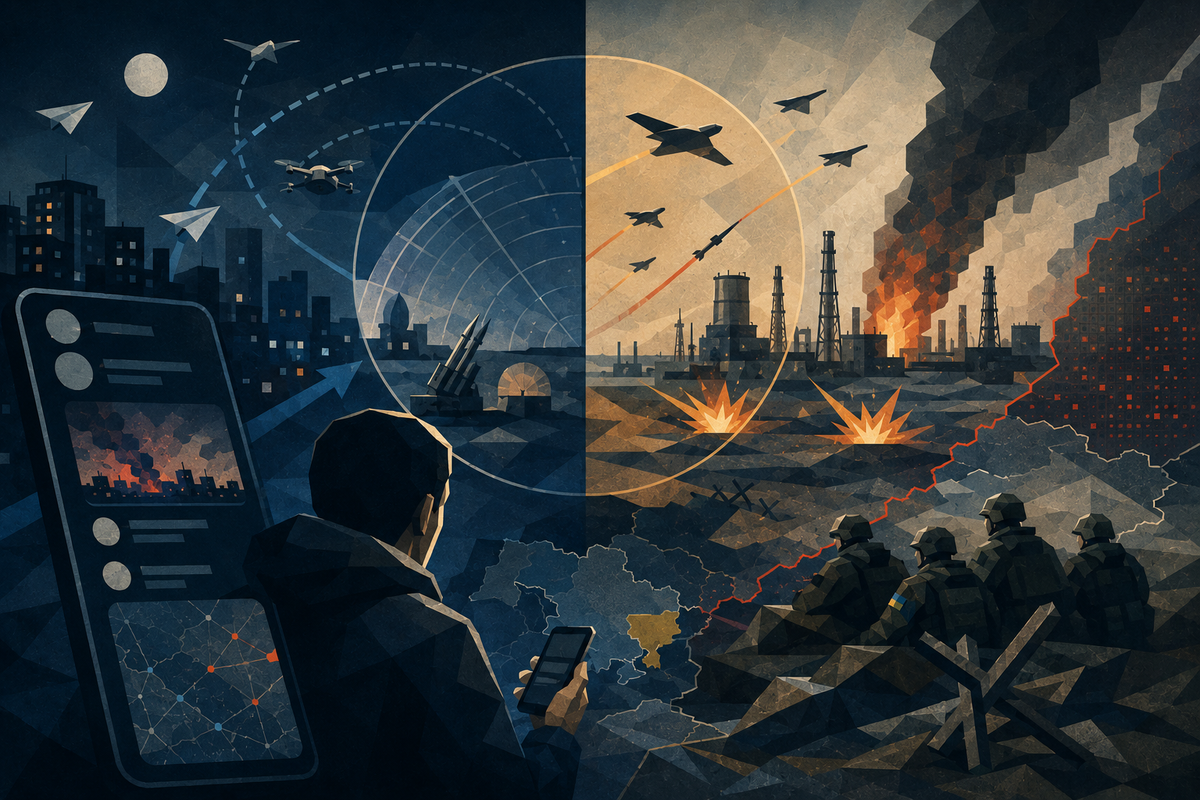
When recounting how war unfolds, there often emerges a gap between the narrative transmitted by chatbots and military channels and the reality understood by commanders on the ground. The past four days of May 2026 have provided a stark demonstration of this gap. What occurs along the front line is something more complex than merely a sequence of strike statistics and casualty figures.
Material reality under massed assault
The night of May 22 brought a massive Russian attack that struck the entire territory of Ukraine. Russia launched between 116 and 287 drones per night depending on the day—a number that Telegram channels transmitted as proof of Moscow's military desperation. But material reality contradicts this interpretation: Ukrainian air defense intercepted 90 to 93 percent of these drones. This is not collapse. This is exhaustion.
On the night of May 22, Russian drones reached northern, eastern, and southern regions of Ukraine. Ukrainian air defence intercepted 109 of 116 launched drones. Several ballistic missiles and five drones reached targets across five locations, but no systemic catastrophe occurred. Telegram conveyed the figures. Official sources confirmed them. But between "several drones landed" and "the air defence system is collapsing" lies an enormous distance of understanding.
The strategy Russia chose became transparent through analysis of intensity. Moscow did not attempt a knockout strike against a single target. It dispersed the attack across the entire territory. The objective was geometric: to overwhelm the air defence system, to force Ukrainians to expend ammunition in response to millions of drones rather than intelligent missiles. In practice, this means Russia is prepared to expend cheap unmanned aircraft to exhaust expensive Western ammunition.
Counteroffensive through energy infrastructure, not territory
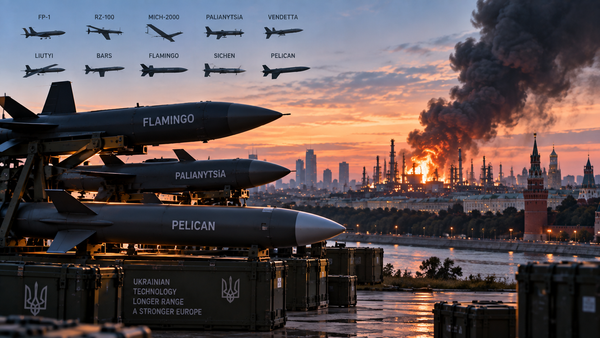
Meanwhile, Kyiv chose a different strategy. Rather than fighting for every metre on the front, Ukraine strikes Russian energy and petroleum networks.
On the night of May 17, Ukrainian drones executed the largest operation in the Moscow region since the beginning of full-scale war. Nearly 600 Ukrainian strike drones attacked Russian military-industrial facilities. Target data arrived minutes before official announcements: Angstrem in Zelenograd—microelectronics manufacturing microchips for Russian military-industrial systems. Raduga MKB in Dubna—a design bureau known for developing missile systems.
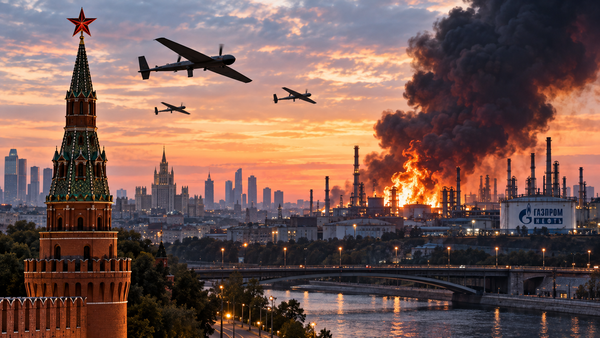
Telegram reported explosions. OSINT groups identified targets and coordinates. Monitoring showed scale. But context often vanished in the sequence of real-time transmissions. These strikes were not about territory. They were about money and industry. Each strike on a petroleum refinery is a strike on financing of Russia's war machine.
Over recent months, Ukrainian drones and missiles have deprived Russia of approximately 10 percent of its refining capacity, according to President Zelenskyy's assessment of May 19. In the period from April through mid-May 2026, Ukrainian weapons struck 20 petroleum transhipment points and export terminals in Russia. This is not an assault on the army. This is an attack on exports, on fuel, on the cash flows that finance the war machine.
The front: exhaustion rather than advance
On the front line, the numbers tell a story more complex than Telegram chatbots convey. During May 12-19, Ukrainian armed forces liberated one settlement and cleared territory in another. Simultaneously, Russian forces advanced on eight Ukrainian settlements. On paper this appears as Russian victory. In reality it is expensive victory.
The commander of Ukrainian drone systems reported that Ukrainian drone strikes wounded or killed 19,203 Russian military personnel over 19 days in May—a record level of combat activity. This means that the number of Russian killed and wounded over one month approached 35,203, according to General Staff estimates for April. The tempo has not slowed. But tempo is not the same as territorial gain.
Russia moves forward, but loudly and expensively. It attacks in numbers—advances through casualty counts. It expends personnel faster than it can replace them. Ukraine, in turn, holds the material line through rotation and technical strikes into depth. In practice, this means the front does not collapse, but both sides exist in a state of chronic exhaustion.
Mobilisation as critical juncture
But behind the figures on the front lurks a crisis that Telegram channels understand only partially. Ukraine is preparing "key changes" in its mobilisation system. The defence minister conducted meetings with infantry on the front and heard what official statistics do not convey: desertion is rising, rotations are lacking, personnel are insufficient for replacement.
Commanders complain that Russian drones block logistical withdrawal and that infantry are insufficient for rotation. This is not a figure that will appear on an OSINT map by night. This is a problem visible only to those standing on the front line.
Independence through indigenous production
On May 18, Ukraine announced successful testing of its first domestically produced guided aerial bomb with a 250-kilogram warhead capable of striking targets dozens of kilometres distant. Telegram published the official statement. DeepState analysed this as an operational shift: now Ukraine can expand strike range without Western missiles, which are expensive and constrained by American and NATO control.
In practice, this means Kyiv has effectively become its own weapons factory. In 2022, Ukraine depended on imports for 54 percent of its weapons. By 2025 this figure had fallen to 18 percent. This represents change of strategic significance. Cheap to produce and free from donor constraints, new bombs allow Ukraine to operate at medium range while preserving rare longer-range Western missiles for deeper targets. But the engine stalls under energy exhaustion caused by Russian strikes on infrastructure.
What NATO awaits
At an alliance meeting, members heard NATO Secretary General Rutte's proposal: commit 0.25 percent of GDP annually to military assistance for Ukraine. This would raise annual funding to 143 billion dollars across the entire alliance. In practice: the United States under Trump is stepping back. Europe must bear the greater weight. Priorities are clear: air defence, drones, long-range ammunition.
But money is only part of the equation. The real problem is the pace at which Ukraine must replace materials on the front. Every casualty is a person who will not be replaced. Every strike on a petroleum refinery is money that will not finance the next generation of Russian drones.
Conclusion: war of exhaustion
The past days of May have shown that neither side can achieve victory within 30 days. What awaits is a grinding, exhausting war of attrition. Telegram conveys the figures. OSINT analyses the targets. The General Staff counts the losses. But between figures and understanding lies still a vast distance.
Ukrainian society, like Russian, desperately awaits a ceasefire that seems far from possible under current conditions. But on the front line, people understand: before them is not a swift conflict but a material battle over who wears down the adversary first. And in this battle, every casualty is squandered potential, every strike on a petroleum refinery is money that will not return. Telegram conveys this. But understanding will come later, when nothing remains of the numbers but silence.