The Blind Spot at 11:13: OSINT Digest, 26 July 2026

Baltic Security Monitor | Analytical Review Snapshot: 2026-07-26T11:13:55.005Z
Today's OSINT Indices
| Indicator | Value | Change (vs 25 July snapshot) |
|---|---|---|
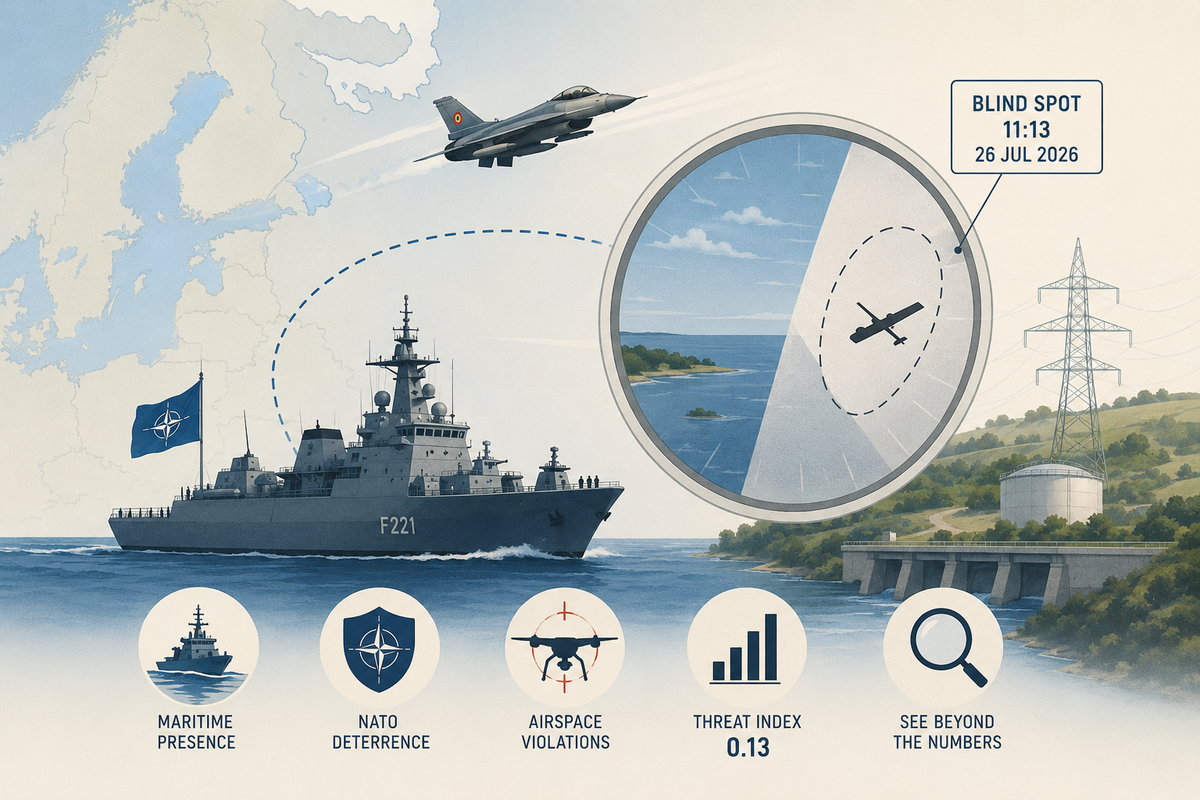
| Composite threat index | 0.13 | ↑ from 0.11 (+0.02) |
| Force Posture | 0.14 | ↑ from 0.06 — more than doubled, the day's largest move |
| Logistics | 0.06 | ↑ from 0.00 — first reading after a day at zero |
| Info/Cyber | 0.00 | ↓ from 0.06 — zeroed out |
| Border/Air/Maritime | 0.27 | ↓ from 0.30 — still dominant, but falling for the first time this cycle |
Events logged in 24h: 10 · High-confidence: 0 (second consecutive day) Quarantine: 0 · Source failures: 0
System-reported deltas: Δ6h 0.00, Δ24h 0.00.
A methodological note is needed immediately. The system reports zero deltas over six and twenty-four hours, while a comparison of the two published snapshots shows +0.02 on the composite and +0.08 on Force Posture. The explanation is most likely technical: today's snapshot was taken at 11:13 and the previous one at 13:32, so the interval between them is roughly 21 hours 40 minutes and does not align with the 24-hour delta window. This is not an error, but it does mean that on days like this the internal Δ24h figure does not describe the day-over-day change, and the movement is more accurately read by comparing snapshots directly.
Today's digest should be read less for what it contains than for what it omits. Yesterday morning a Romanian F-16 shot down a second drone in two days — the region's principal material fact of the past 24 hours, confirmed by Romania's defence ministry, its president, and Allied Air Command. It does not appear in today's top five: entry three still describes the first engagement of 24 July. Meanwhile SNMG1 has appeared from nowhere in second place at 0.40. This is not a data defect. It is the visible edge of the system's field of view, and today it is more informative than any index.
Top Five Events
🔵 1. Sea Breeze: Ukraine's mine countermeasures readiness
OSINT score: 0.41 — WATCH (second consecutive day, score unchanged)
The entry holds first place for a second day at an unchanged score. Its substance is the NATO Evaluation Level 2 certification of the Ukrainian Navy's 1st Minesweeper Division mine countermeasures staff, and the first-ever integration of a Ukrainian unit into NATO's maritime mine countermeasures command structure.
(Detailed analysis — digest of 25 July.)
🟠 2. Standing NATO Maritime Group One (SNMG1)
OSINT score: 0.40 — WATCH (new entry, straight into second place)
The principal change in the top five. The entry appeared from nothing and took second place, pushing the NATO defence-factories feature (0.24) out of the ranking entirely.
The character of the entry is worth registering up front: this is the indexing of a standing formation's page on mc.nato.int, not a dated news item about a specific event. The system priced not an incident at 0.40 but the activity footprint of a structural unit. For the reader, that means the entry reflects a formation's aggregate weight in the information stream rather than an event of the day.
What the formation is. SNMG1 is NATO's standing maritime group responsible for Northern European waters. Under Spanish Rear Admiral Joaquín Ruiz Escagedo, the group conducted sustained operations within Baltic Sentry, maintaining a persistent maritime presence focused on monitoring critical sea lanes and protecting critical undersea infrastructure, including pipelines and cables. On 10 April 2026 command passed to Royal Navy Commodore Maryla Ingham, who leads the group from the German flagship FGS Sachsen. The group has participated in exercises Dynamic Mariner 2026, Steadfast Dart 2026, Cold Response and Arctic Dolphin.
BSM analysis: this entry explains today's jump in Force Posture from 0.06 to 0.14 and the first Logistics reading in a day (0.06). A maritime task group is simultaneously force deployment and sustainment: fuel, rotations, port visits. The configuration "Force Posture doubled, Logistics off zero, B/A/M down" describes a shift in the day's weight from the border line to maritime presence. For the Baltic states this is the digest's most directly relevant entry: Baltic Sentry is the mission launched in January 2025 specifically to protect Baltic Sea undersea infrastructure after a series of cable damage incidents, and SNMG1 is its principal instrument. The command chain also deserves note: the group sits under CTF-Atlantic, headed since July by a Spanish vice admiral (entry 4). Entries 2 and 4 in today's digest are two floors of the same structure.
🔵 3. NATO fighters shoot down a drone in Romanian airspace
OSINT score: 0.39 — WATCH (second day in the ranking, score unchanged)
The entry describes the first engagement, on 24 July: a pair of Romanian F-16s from Fetești and a pair of Italian Eurofighters from Mihail Kogălniceanu, the decision taken in the NATO chain of command, a Shahed-type target, debris in a wheat field.
(Detailed analysis — digest of 25 July.)
Why this entry still does not include the second engagement is addressed in its own section below.
🔵 4. Spain leads NATO's North Atlantic naval forces
OSINT score: 0.39 — WATCH (second consecutive day)
Vice Admiral Juan Bautista Pérez Puig as Commander Task Force Atlantic through June 2027, more than 3,000 personnel from 14 nations, with SNMG1 and SNMCMG1 subordinated to him.
(Detailed analysis — digest of 25 July.)
For today specifically: SNMG1 appearing as a separate entry while the CTF-AT entry persists is a rare case of the system seeing both levels of a single command chain at once. The combined weight of purely maritime entries in today's top five is 1.20 (Sea Breeze 0.41 + SNMG1 0.40 + CTF-AT 0.39), against 0.80 yesterday (0.41 + 0.39).
🔵 5. Task Force X–Central Mediterranean
OSINT score: 0.27 — WATCH (second consecutive day)
The first nationally led Task Force X, the first fully multi-domain iteration, more than 100 uncrewed systems, with Latvia the only Baltic state among five contributors.
(Detailed analysis — digest of 25 July.)
Signal of the day: the event that is not in the digest
The region's most significant material change in the 24 hours before this snapshot did not make the top five.
At 08:22 on 25 July, Romanian radars registered an airspace violation near the border with Ukraine; at 08:30 the target was destroyed 10 km west of Sfântu Gheorghe in the Danube Delta. The engagement was flown by the same F-16 pilot as the day before. The second shootdown was announced publicly by Romania's defence ministry and by President Nicușor Dan; Allied Air Command confirmed the joint character of the operation, in which Italian Eurofighter Typhoons supported the Romanian F-16s. Both drones came down over unpopulated ground, with no casualties or damage. Prosecutors stated that the drone downed on 24 July was Russian; the origin of the 25 July aircraft has not been officially established.
So this is not a case of an event going unrecorded by open sources or by NATO's own channels. It was recorded. Yet as of 11:13 on 26 July it has no separate entry in the top five, and the existing entry still dates to the first engagement.
BSM analysis: there are two plausible explanations, both technical. The first is latency: the event occurred on the morning of 25 July, releases followed through the day, and the indexing cycle may not have caught it before the 11:13 snapshot the following morning. The second is deduplication: the system may have collapsed both episodes into a single record as same-type events from a single source, in which case the second engagement merged into the first without receiving its own score.
The practical conclusion matters more than the cause. The digest measures the information stream, not reality. For a second consecutive day the top five consists entirely of NATO's own channels, and for a second consecutive day the count of high-confidence events is zero. Under those conditions, an event first reported by a national government and the global wires — with NATO commenting only confirmatively — has a structurally lower chance of reaching the top than a scheduled Alliance publication about its own structures. Today SNMG1 at 0.40 ranks above an actual combat use of weapons that appears nowhere in the list.
This is not a reason to distrust the index. It is a reason to read it alongside an inventory of what it does not contain.
Two-day index tracker
| Date | Composite | Force Posture | Logistics | Info/Cyber | B/A/M | High-conf. |
|---|---|---|---|---|---|---|
| 25 July (13:32) | 0.11 | 0.06 | 0.00 | 0.06 | 0.30 | 0 |
| 26 July (11:13) | 0.13 | 0.14 | 0.06 | 0.00 | 0.27 | 0 |
The two-day pattern reads as follows. The overall level remains low — 0.13 is still far from any alert threshold. But the internal distribution has shifted substantially: weight has moved from border and air toward force deployment and sustainment. This is the classic signature of "maritime presence instead of border incident."
The zeroing of Info/Cyber is a separate signal. Yesterday the sub-index held at a minimal 0.06; today it fell to zero. Combined with a high-confidence count of zero, this points more toward an absence of cyber-profile material in the indexed stream than to reduced activity in that domain. Cyber events are rarely published by official military channels on a daily cycle, and those channels are what constitute today's top five.
The fall in B/A/M from 0.30 to 0.27 should be read against the previous section: the border sub-index declined on precisely the day that weapons were used for a second time on NATO's border. It is the sharpest illustration of the gap between the indexed stream and the event record in the observed cycle so far.
Regional context
The backdrop against which today's shift toward the maritime domain sits.
Lithuanian President Gitanas Nausėda gave specifics to the July warning: intelligence assessments indicate that planning of strikes on energy and transport infrastructure in the Baltic states or Poland is taking place "at the highest level, effectively in Moscow," with potential consequences capable of "disrupting the functioning of the entire energy system." The caveat from yesterday's review still stands: Baltic intelligence sources and Latvia's foreign and security policy establishment stated in parallel that no date, concrete plan or designated organiser of a provocation has been identified. Both assessments remain valid simultaneously.
Giuseppe Cavo Dragone, chair of the NATO Military Committee, said at the Ankara summit on 7 July that the Alliance is prepared for any Russian move against the eastern flank, and that Moscow "would lose a lot, much more than what they could gain, just by touching Poland or the Baltic states."
A report by the International Institute for Strategic Studies assesses that Russia likely used shadow-fleet vessels to launch drones over Europe, repeatedly disrupting civil aviation between 2024 and 2026.
That last point connects directly to today's entry two. If the shadow fleet is a launch platform, then maritime patrolling under Baltic Sentry ceases to be a purely infrastructure mission and becomes an element of air defence. In that frame, SNMG1 guards not only the cables beneath the water but the airspace above it.
Conclusion
For two consecutive days the composite has held in the 0.11–0.13 band, high-confidence events number zero, and the top five is composed entirely of NATO's own channels. Within that frame, today produced one substantive change: SNMG1's arrival in second place, with the attendant doubling of Force Posture and the first Logistics reading. The maritime domain has become the day's principal carrier of weight.
The main development, though, sits outside the table. The second kinetic engagement of an aerial target over Alliance territory in two days — the event we described two days ago as a precedent turning into a procedure — had not entered the digest as of this snapshot. The cause is most likely technical: latency or deduplication. The consequence is no smaller for that: an index assembled largely from the Alliance's scheduled publications will lag systematically on exactly those events where the Alliance is not the primary source.
The most useful thing to do with a digest like this is to read it as a map with its field of view drawn in. The next checkpoint is simple: whether the second Romanian shootdown appears as a separate entry in the 27 July snapshot. If it does, latency is roughly one day and that is a normal operating parameter. If it does not, deduplication is at work — and repeated same-type regional events will systematically fail to acquire their own weight. The difference between those two outcomes determines how every subsequent digest should be read.
Baltic Security Monitor (osint-baltic.com) — an analytical publication on security along NATO's north-eastern flank. All OSINT coefficients are produced by an automated indexing system based on open sources.
Sources
- Allied Maritime Command — Standing NATO Maritime Group One (SNMG1)
- Royal Navy — Royal Navy takes charge of NATO's premier Northern European task force
- Allied Maritime Command — UK takes the helm of NATO task group as Spain hands over command
- USNI News — NATO Launches Baltic Sentry Mission in Baltic Sea
- NBC News — Romania says it shot down a second drone breaching its airspace
- Kyiv Post — Romania Shoots Down Second Intruding Drone in 2 Days
- NATO Allied Air Command — the 24 July engagement
- Euronews — Lithuanian president's infrastructure warning
- CNBC — NATO Military Committee chair on the eastern flank
- LRT — intelligence assessment: "no concrete plan"