Thirty Thousand, Single-Sourced: how to read Ukraine's assessment on North Korea

Baltic Security Monitor | Analysis Updated: 25 July 2026
What was stated
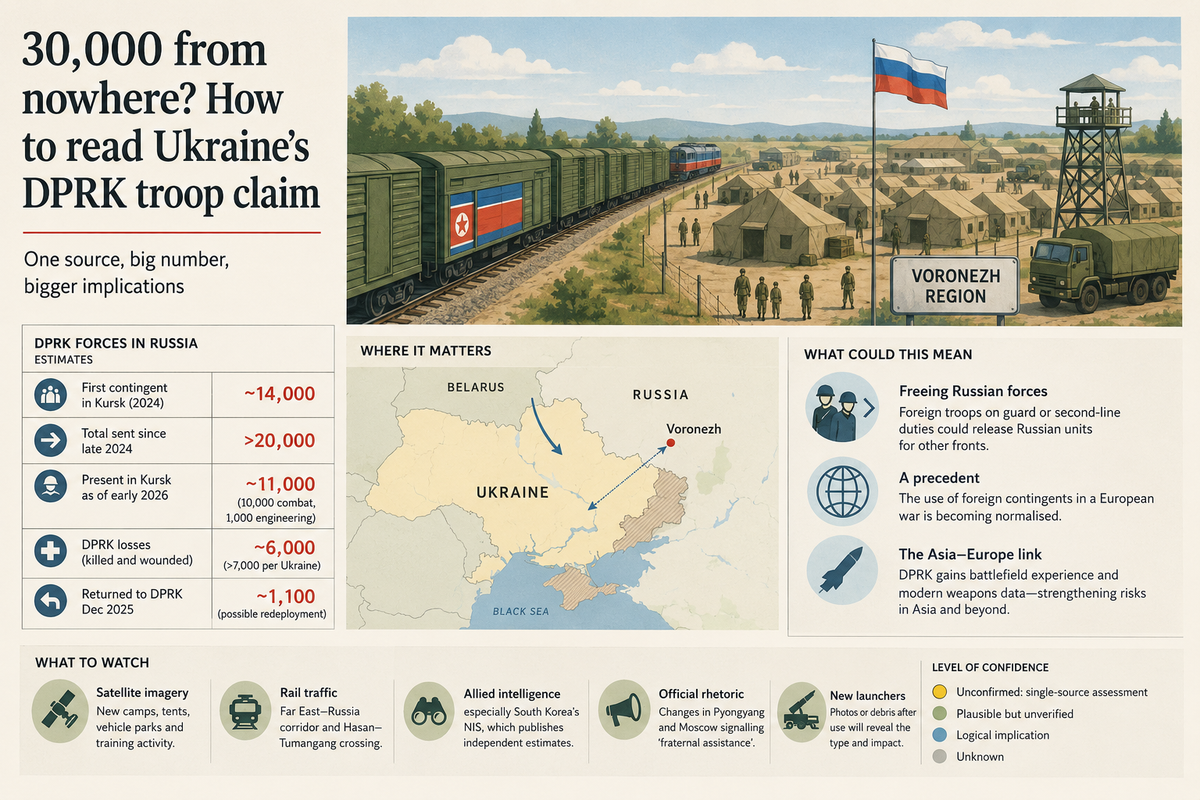
On 25 July, President Volodymyr Zelenskyy, citing Ukrainian intelligence, said Russia is preparing to receive around 30,000 more North Korean troops, with infrastructure to accommodate them under preparation in Voronezh Oblast since June. He added that North Korea is also preparing to supply Russia with new launchers for ballistic missiles.
Zelenskyy framed it as a threat "not only to Ukraine," saying that "Russia is helping North Korea learn how to wage war, improve its weapons and gain real combat experience in using them."
There is no independent confirmation of the size, timing or composition of the new contingent. The type of launcher has not been officially identified.
That is the defining feature of today's report, and any serious reading has to begin there.
The single-source problem
The assessment comes from a belligerent's intelligence service and was released in a political address. That does not make it false, but it sets the frame.
The case for caution. Statements of this kind serve an intelligence function and a diplomatic one simultaneously: a figure of 30,000 works as leverage in negotiations over air defence supplies and as a signal to partners about the scale of the problem. The phrasing "preparing to receive" describes infrastructure work, not the arrival of troops — two different confidence levels. Camp preparation could support rotation of the existing contingent, expansion to the stated scale, or never be realised at all.
The case against automatic scepticism. In 2024 the first reports of North Korean units in Russia came from precisely this channel — Ukrainian and South Korean intelligence — were denied by Moscow and Pyongyang, and were subsequently confirmed, including by both governments' own acknowledgements. The baseline reliability of this channel on the North Korea file is historically high. That does not automatically transfer to a specific number, but it forbids dismissing the report as an information operation.
BSM's working position: infrastructure preparation in Voronezh Oblast is plausible and verifiable by satellite. The figure of 30,000 is an assessment of intent, not an observed troop count. The two claims carry different status and should not be merged into a single sentence.
What is verifiable: the baseline
To weigh the stated figure, it has to be placed alongside what several intelligence services have already corroborated.
| Metric | Estimate | Source |
|---|---|---|
| First contingent in Kursk Oblast (2024) | around 14,000 | Reuters, under the mutual defence treaty |
| Total dispatched since late 2024 | more than 20,000 | South Korea's NIS |
| Present in Kursk Oblast at the start of 2026 | around 11,000 (10,000 combat, 1,000 engineers) | South Korea's NIS |
| North Korean losses (killed and wounded) | around 6,000 | South Korea's NIS |
| North Korean losses (alternative estimate) | over 7,000 | Ukraine's HUR |
| Returned to North Korea in December 2025 | around 1,100, possible redeployment | South Korea's NIS |
The table shows something the statement itself does not. The 30,000 figure exceeds everything North Korea has sent to Russia over the preceding eighteen months combined. Against the force actually present at the start of 2026 — roughly 11,000 — it is close to a fourfold increase; against the cumulative flow of more than 20,000, it is about half as much again as everything that has passed through this channel to date.
In other words, this is not the scaling of an existing practice but a qualitatively different level of involvement. Which is exactly why the number needs a second source before it can carry any operational conclusion.
If the assessment holds: the military arithmetic
A contingent of that size would give Russia reinforcement that is operationally significant rather than symbolic — for holding sectors of the front, border security, rotation of Russian units, or the generation of new reserves.
The key mechanism here is indirect and therefore routinely underrated. Foreign formations are rarely employed as a strike force. Their value lies in freeing up domestic units: every thousand North Korean personnel on border security or in the second echelon is a thousand Russian personnel available elsewhere. For Ukraine, this complicates the expectation that high Russian casualties will progressively constrain Moscow's ability to sustain offensive tempo.
The legal logic of employment is equally predictable: North Korean forces are most likely to be used on Russian territory or in occupied areas, which lowers the legal and political costs. The 2024 Kursk precedent worked on exactly that basis.
The missile dimension is separate. New launchers would potentially increase pressure on Ukrainian air defences, particularly if the systems are compatible with the ballistic missiles North Korea already supplies. The type has not been named, and without that detail the increment in threat cannot be assessed: the difference between a handful of additional launchers and a change in the architecture of the missile force is fundamental.
Finally, the most important caveat: preparation does not mean that all 30,000 will arrive, or be committed to combat simultaneously. Rail corridor throughput, the language barrier, retraining requirements and the experience of 2024–2025 losses all stretch any build-up over time.
The other side of the exchange: what North Korea gains
The best-documented part of this story is not the Russian gain but the North Korean one.
According to South Korea's National Intelligence Service, despite roughly 6,000 casualties the North Korean military has achieved results: absorption of modern combat tactics, accumulation of battlefield data, and modernisation of weapons systems with Russian technical assistance.
This is recorded by the intelligence service of a third country not party to the European theatre, and therefore carries a higher confidence level than any estimate of a future contingent's size. It is also the part of the story that will not end when the war in Ukraine does.
North Korean units are acquiring experience against Western weapons systems — artillery, ISR, uncrewed systems, precision munitions. That experience converts into doctrine, into indigenous development, and — through North Korea's defence export network — into third-party capability. Zelenskyy's framing of a threat "not only to Ukraine" is accurate here and, unlike the figure of 30,000, rests on independently corroborated assessment.
Relevance to the Baltic region
No new incident has been identified in Estonia, Latvia or Lithuania during the reporting period. The significance of this file for the region is indirect and should not be overstated. But it exists, and it runs in three directions.
First, the freeing of Russian formations. The more Russian units Moscow can release by substituting foreign personnel, the fewer constraints remain on reconstituting formations earmarked for the north-western direction and NATO's borders. This is a causal chain with several links, each individually hypothetical, so it is flagged as a working proposition rather than a forecast. The direction of the effect, however, is unambiguous: manpower acquired externally removes part of an internal constraint.
Second, the normalisation of foreign contingents. Four years ago, third-state troops fighting on Russia's side in a European war would have been treated as a discrete strategic event. Today it is a line in a daily update. For the Baltic states what matters is not North Korea specifically but the precedent: planning scenarios on the north-eastern flank now have to account for non-Russian personnel appearing in Russian order of battle.
Third, the coupling of the European and Asian theatres. North Korea is gaining combat experience against Western systems, which strengthens not only Russian capability but the future threat to US allies in Asia. The practical consequence for European capitals: in an Indo-Pacific crisis, the American resources on which the European flank depends would be competing against demand from another theatre. This is a long-recognised problem, but every episode of Russian–North Korean cooperation shortens the distance between the two theatres.
Indicators: what to watch
This is a case where the assessment can be tested with open sources within weeks. A practical list:
- Satellite imagery of Voronezh Oblast — camp expansion, new tent and modular accommodation, larger vehicle parks, increased density on training areas. The most direct indicator.
- Rail traffic from the Russian Far East to central Russia — throughput on the Trans-Siberian axis and activity at the Khasan–Tumangang border crossing.
- Corroboration by allied services — above all South Korea's NIS, which has historically published its own estimates of North Korean strength in Russia independently of Kyiv. An NIS figure of the same order would be the weightiest confirmation available.
- Official rhetoric in Pyongyang and Moscow — acknowledgement of "fraternal assistance" typically lags the fact by months, but a change in formulation is itself a signal.
- The type of the new launchers — imagery, or fragments recovered after use. Without it, the missile component of the assessment remains empty.
Until any of these indicators fires publicly, the correct formulation is "Ukrainian intelligence states," not "Russia is deploying."
What we still do not know
| Question | Status |
|---|---|
| Size of the new contingent | 🟡 single-source estimate, no independent confirmation |
| Deployment timelines | 🟡 not specified |
| Composition and intended role of the units | 🟡 unknown |
| Infrastructure preparation in Voronezh Oblast | 🟡 claimed; verifiable by satellite |
| Type of the new ballistic launchers | 🟡 not officially identified |
| Release of Russian formations for other axes | 🟡 a logical consequence, not an observed one |
| Consequences for NATO's north-eastern flank | 🟡 indirect, several hypothetical links in the chain |
Raising confidence requires: satellite imagery of the camps in Voronezh Oblast, data on movements from North Korea, corroboration by allied intelligence services, the type of the new launchers, and indicative deployment timelines.
No other new confirmed material changes have been identified in Estonia, Latvia or Lithuania since the previous update.
Conclusion
Today's report contains two components of unequal quality, and they are worth separating.
The first is the figure of 30,000. It comes from a single source, exceeds everything North Korea has sent to Russia in the preceding eighteen months, and describes an intention rather than an observed deployment. Until a second source appears, its place is on the watch list, not in the record of established fact.
The second component is sturdier and attracts less attention. The North Korean army has already extracted from this war something it could not have obtained in decades: experience of modern combat against Western weapons systems, battlefield data, and technical assistance in modernising its own equipment. That is corroborated by a third country's intelligence service and does not depend on whether the next 30,000 ever arrive.
For the north-eastern flank the conclusion is cautious but clear. What to watch is not the number but two things: whether independent confirmation of the Voronezh camps materialises, and whether released Russian units begin appearing where they were not before. The first is testable by satellite within weeks. The second is the signal that actually matters to Tallinn, Riga and Vilnius.
Baltic Security Monitor (osint-baltic.com) — an analytical publication on security along NATO's north-eastern flank. Prepared from open sources; confidence caveats marked 🟡 (requires confirmation).
Sources
- Reuters / U.S. News — Zelenskiy: Russia wants to bring in 30,000 North Korean troops
- The Korea Times — Russia preparing to receive another 30,000 North Korean troops
- The Japan Times — Russia wants 30,000 more North Korean troops
- Kyiv Independent — around 11,000 North Korean troops in Kursk Oblast at the start of 2026 (NIS assessment)
- Kyiv Independent — HUR assessment of North Korean casualties
- Defence Matters — Russia's manpower balance and North Korean casualties