Ukraine Strikes Rear, Russia Strikes Cities: June 2026 as Moment of Strategic Shift

Analysis: The June 2 massive attack revealed not Russian strength but Russian logistical panic
Breakthrough on the Front: May 2026 as Turning Point
Recent months have shown a fundamental change in war dynamics that had previously remained obscured by operational security concerns.
What happened in May:
DeepState, the most accurate frontline monitoring channel, reported that Russia occupied only 14 sq. km of territory in May. But this is incomplete.
More precisely: this became the first month since "Counteroffensive 2023" when Ukraine gained more territory than it lost
Simultaneously:
- Russian assault operations increased by 37.5% in May
- Yet zero territorial progress was achieved
- Russian casualties from these assaults increased accordingly
What this means:
This is a cycle of attrition without strategic compensation. Moscow expends human resources in exchange for nothing. Symptom of incapability disguised as activity.
Ukrainian Strategy Shift: From Defense to Operational Strikes
President Zelensky announced that Ukrainian forces already possess the capability to strike Russian military logistics across the entire depth of occupied territory.
Practical significance:
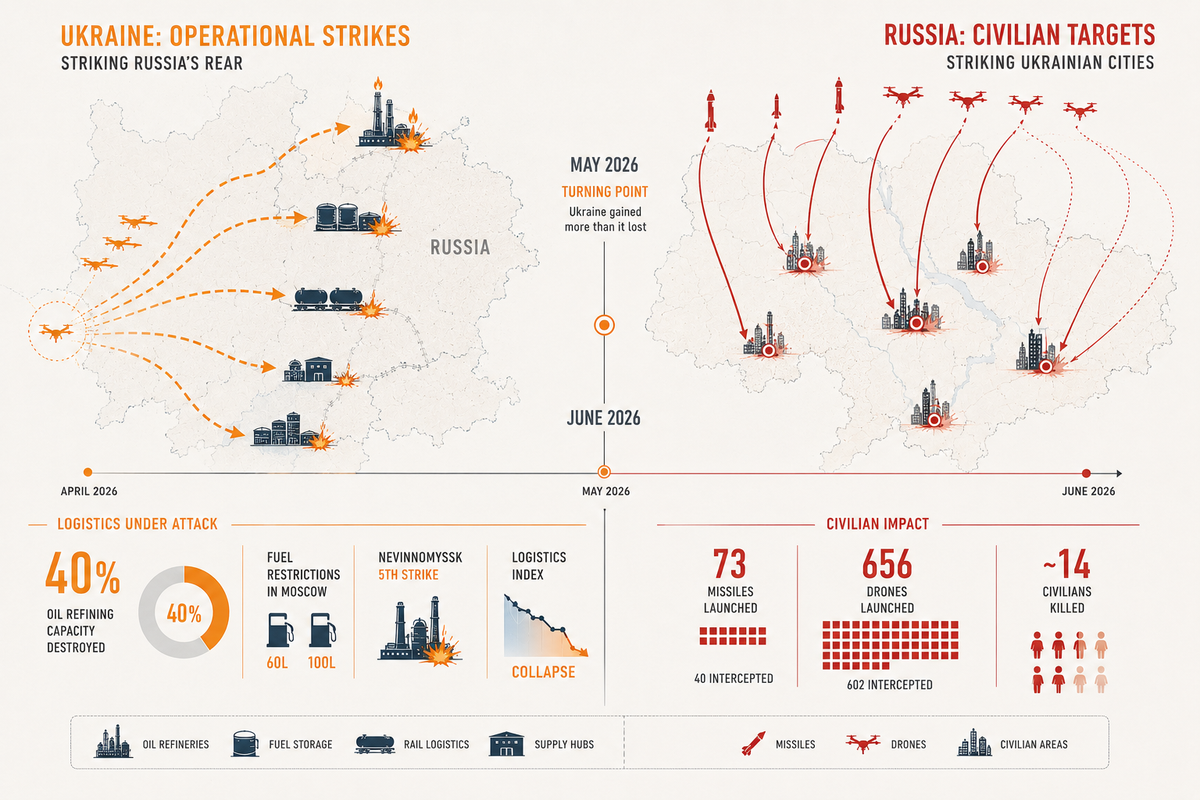
- Ukrainian drones recently set fire to the Nevinnomyssk Azot chemical plant in Stavropol region (producer of explosive components)
- This is the fifth strike against this facility since June 2025
- Moscow's defensive resources are not replenishing faster than they are being destroyed
Strategic meaning:
When rear bases are paralyzed, forward lines suffer from ammunition shortage, fuel shortage, lack of repairs. This is not conflict — it is cascade failure in the system.
This means what Zelensky stated is literal: "there are practically no safe roads for occupiers in the south and east" — not propaganda but tactical statement.
June 2 Massive Attack: Crisis as Response
During the night of June 2, Russia launched a large attack:
- 73 missiles (including 8 hypersonic Zirkons)
- 656 drones
- Intercepted: 40 missiles and 602 drones
Apparent reading: response to Ukrainian strikes on Russian rear areas.
Actually: this reveals several things about Russian condition.
What Was Hidden Behind June 2 Information Chaos
Telegram moved fast, official sources moved slow, analysts spent hours parsing data. Behind this chaos lay a changed Russian tactic.
Ballistic Missiles as Primary Weapon
Russia is using ballistic missiles massively instead of cruise missiles and drones.
Why this matters:
Ballistic missiles are most difficult to intercept with air defense systems. Ukraine expends more resources on them than on drones.
What this means strategically:
Previously Kremlin launched: 500 drones, several cruise missiles, exhausted air defense reserve. Now launches waves where ballistic missiles carry main burden — more expensive, more effective, harder to intercept.
For Ukraine this means: even with Patriot systems, their PAC-3 reserve will not be sufficient for such nights.
Fuel Crisis in Russia: From Periphery to Center
Telegram reported cessation of gasoline sales in occupied Crimea due to shortage, A-95 limited to 20 liters per day.
But official sources reported more:
In Moscow itself gas stations began limiting sales:
- Gasoline: 60 liters per person
- Diesel: 100 liters per person
This is not peripheral problem — this is center.
When Russia's capital is anxious about fuel, it means Ukrainian plan to destroy Russian oil refineries worked.
The figure: approximately 40% of primary oil refining capacity in RF was out of service as of May.
Change in Russian Tactic: From Positional to Attrition Strategy
Massive strikes on civilians on June 2 — this is not demonstration of strength but signal of panic.
What changed:
Previous Russian tactic: local assaults and territorial control. Now: mass strikes on civilian infrastructure, exhausting air defense resources, exhausting opponent.
Psychological component:
Russia cannot win on front. It cannot advance. Therefore it transitions to terror as pressure instrument.
But terror does not produce breakthrough. It reflects its absence.
Long-term Dynamics: Economic Bomb Exploding Slowly
Fuel shortage in Moscow, loss of 40% of oil refining — this is not bureaucratic problem. It means Kremlin is rotating through material reserves that could be exhausted.
Timeline:
- Not in June
- Not in July
- But the question of whether Kremlin can keep military alive is answered in Moscow's mind, though world does not yet know it
Political Consequence: Negotiation Window Becomes Real
Budanov stated that it is realistically possible to end this war by winter 2026.
Zelensky said the window for effective peace negotiations with Moscow remains open as long as Kyiv maintains initiative and intensifies strikes on Russian territory.
This is not fevered optimism. This is calculation.
- Russia can no longer afford to wait (logistics collapse)
- Ukraine can no longer afford lack of peace (people are exhausted)
- Their interests began to converge, only because Moscow understands: tomorrow will only be worse
Conclusion: Architecture of New War Becomes Visible
Telegram showed Ukrainians attacks on Kyiv. Experts dissected these strikes as pivot in Russian strategy. First needed calm; second needed structure of understanding.
What is actually happening:
Ukraine defends itself not against drones as such, but against architecture of new war — the one Kremlin constructed from missiles, attrition expenses, and long-term calculations.
But this architecture is beginning to crack:
- At front: Russia loses tempo (assaults without breakthrough)
- In rear: Logistics collapse (strikes on plants work)
- At home: Fuel crisis reaches capital (economy cracks)
What does this give Ukraine? Window of time. Window that Kremlin knows and understands is closing.
Date: June 2026
Source: DeepState, statements by Ukrainian leadership, intelligence materials, Kyiv Independent