The Intercept Line Moves Out to Sea: three days, three shootdowns over Romania

Baltic Security Monitor | Material Update As of 26 July 2026, 20:00
What changed
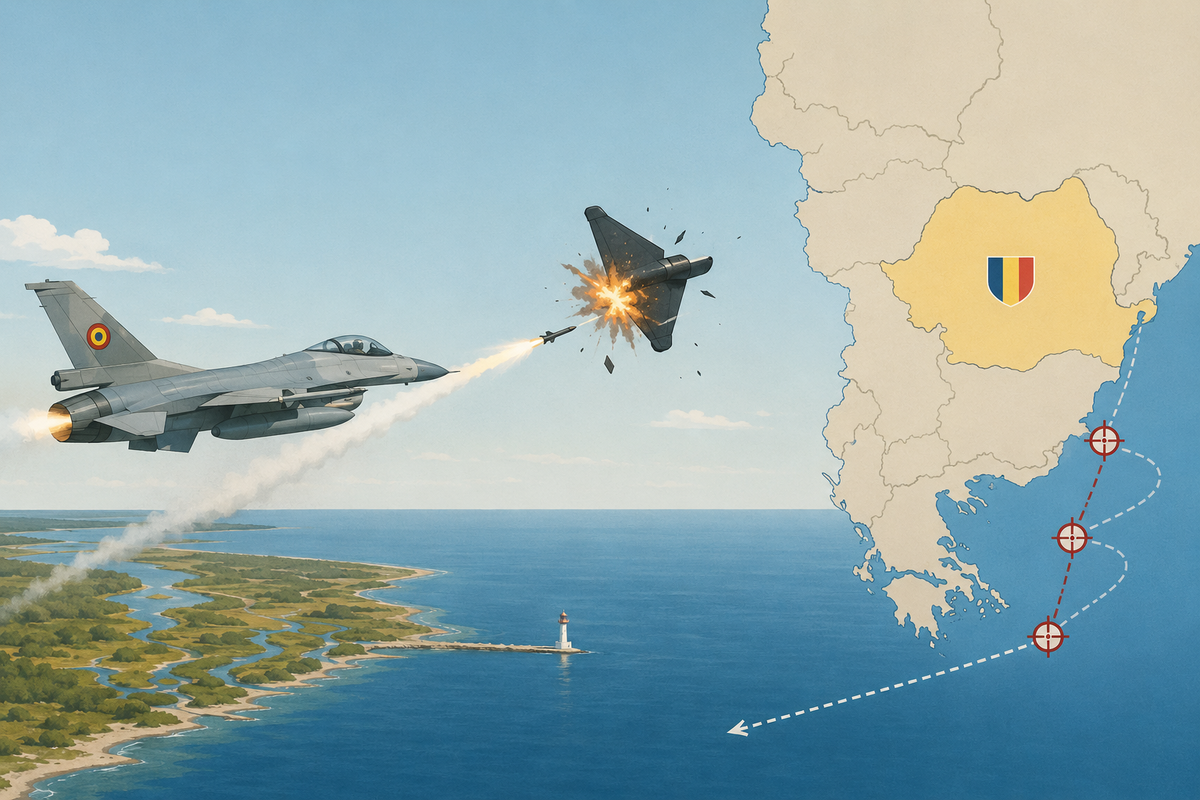
At 10:13 on 26 July a Romanian F-16 destroyed a drone that had entered national airspace without authorisation. According to Romania's Ministry of National Defence, the aircraft was safely shot down 12 km north-east of Sulina, within Romanian territorial waters. This is the third engagement in three consecutive days.
An investigation by the General Prosecutor's Office established that the drone downed on Friday morning was a Shahed type, used by Russia in its war against Ukraine. Investigations into the aircraft downed on Saturday and Sunday are ongoing.
Romanian President Nicușor Dan congratulated the pilots and described Russia's actions as "inadmissible and intolerable" in connection with the violations of Romanian airspace.
Romania's defence ministry links the incursions to Russian strikes on Ukrainian infrastructure along the Danube border.
The core finding: the geography of three days
The three episodes are best read not as a sequence of identical events but as the movement of a single line.
| Date | Time | Point of engagement | Terrain |
|---|---|---|---|
| 24 July | detection 09:30, 20 km east of Sulina | per several outlets, Buzău County | land, well inland |
| 25 July | detection 08:22, engagement 08:30 | 10 km west of Sfântu Gheorghe | land, Danube Delta |
| 26 July | 10:13 | 12 km north-east of Sulina | territorial waters |
The first engagement, on several accounts, took place deep over land. The second was over the delta, effectively the border strip. The third was over the sea — before the coastline was crossed.
BSM analysis: across three days the intercept line has moved steadily seaward. This is the most substantive fact in today's update, and it answers the caveat we registered yesterday: the more frequent interceptions become, the higher the risk that one will have to be conducted over inhabited terrain. Judging by the geography of the three episodes, Bucharest is solving precisely that problem by pushing the engagement point out to sea, where debris and any warhead fall into water. Technically this means earlier handover of the track to alert forces and an even shorter decision cycle. Politically, it means the risk to Romania's own population has been prioritised over the risk of a mistaken engagement.
A second detail of the same order: on 24 July the intercept was flown by Romanian and Italian pairs together; on 25 July Italian Eurofighters provided support; on 26 July the defence ministry reports Romanian F-16s. In three days the operation has moved from "allied reinforcement" to national routine — while remaining inside NATO's command loop.
Why this is material
This is no longer an isolated navigation failure but a recurring three-day pattern of drone penetration into NATO airspace.
Three consequences for the north-eastern flank.
First, regularity is now established rather than exceptional. For three consecutive days, strike waves aimed at Ukrainian infrastructure near the Danube have leaked into a member state's airspace. That is a property of the campaign itself, not a coincidence, and it will recur whenever strike intensity on that axis rises.
Second, the practice of weapons employment has consolidated. Three consecutive engagements are no longer a precedent or even a procedure but a standing norm of alert duty. We wrote on 25 July that a precedent had become a procedure in 23 hours; today the formulation can be sharpened: in three days the procedure became a standard, and it is in that form that it will be exported to the rest of the eastern flank.
Third, pressure to harmonise the rules. A situation in which one part of the flank exercises engagement authority three times in three days while another operates a "detect and track" model does not hold inside the Alliance for long. The likely direction is harmonisation of identification and engagement criteria across the whole eastern flank, including Estonia, Latvia and Lithuania.
An important caveat. This is not a deliberate attack on Romania. The officially published data confirm the violations and the interceptions but do not establish operator intent. The type has so far been confirmed only for the first aircraft — a Shahed; analysis of the second and third continues. Three consecutive incursions are harder to attribute to a single navigation error than one — but that is an argument about probability, not proof of intent.
What follows for the Baltic states
The Romanian experience becomes a direct operational precedent for Baltic Air Policing, and the practical content of that transfer comes in three parts.
The response model. Romania's shift from "detect and track" to "detect, identify and, if required, destroy" came about not through a change of documents but through three consecutive exercises of authority. For Tallinn, Riga and Vilnius that means the argument inside the Alliance now rests on demonstrated practice rather than on a request. Recall that the three Baltic presidents publicly asked on 21 May for Baltic Air Policing to be converted into a full air defence mission and for the region to be reinforced with counter-drone capabilities.
Geography matters. Pushing the intercept line out to sea is an option available to Romania because of the Black Sea and the delta. The Baltic region has maritime space too, but flight times are shorter and coastal population density is higher. Copying the Romanian scheme outright will not work: the shorter the route, the less scope there is to move the engagement beyond land. This is not an argument against the Romanian model but an argument for ground-based systems capable of operating where a fighter cannot arrive in time.
The cost of the exchange. For three days running, a pair of fighters and an air-to-air missile have been expended on a cheap strike drone. Expanding the employment zones of mobile counter-UAS systems is not an alternative to air power but a way of preserving air power for the tasks where it is irreplaceable.
An index footnote: the blind spot closes late
This morning's OSINT snapshot (26 July, 11:13) carried the 24 July shootdown in its top five at 0.39, and contained neither the second nor the third episode. The composite stood at 0.13 and Border/Air/Maritime at 0.27 — the border sub-index had in fact declined from 0.30 the previous day.
The timing deserves to be recorded precisely: at the moment the snapshot was taken, at 11:13, the third shootdown had already occurred — at 10:13, an hour earlier. The system was presenting a two-day-old event as current while two further engagements had taken place inside the same window.
This is not a reproach to the system but a measurement of its latency. The practical implication for anyone reading the indices: on days with rapidly repeating same-type events, the B/A/M value reflects the state of the information stream with a lag of roughly a day or more. The next snapshot will show whether the second and third episodes appear as separate entries or are collapsed into one. That determines how the border sub-index should be read in every subsequent digest.
Second thread: the air truce probe
Reuters reported that Ukrainian and U.S. officials had discussed a proposal for an air ceasefire to put to Russia as part of a new attempt to revive peace talks. Kremlin spokesman Dmitry Peskov said on Sunday that it was premature to comment on the reports. According to further reporting, both sides may have incentives to accept such a truce: Ukraine is running short of interceptors, while Russia is exposed to Ukrainian long-range strikes.
🟡 At this stage this is a diplomatic probe, not an agreed negotiating format. It becomes material only once a specific proposal is officially confirmed by Kyiv or Washington.
BSM analysis: the two threads in today's update are more tightly linked than they appear. The Romanian interceptions are a by-product of strike waves against Danube-area infrastructure; an air truce is the mechanism that would stop those waves. In other words, the single measure capable of removing the cause of incursions into NATO airspace is currently being discussed in a format that neither side has officially confirmed. The cautious conclusion for the Baltic states: plan air defence reinforcement on the basis of the current pattern, not on the expectation that diplomacy will cancel it. The probe may come to nothing; the intercept line over the Danube Delta has been working for three days.
What we still do not know
| Question | Status |
|---|---|
| Type of the aircraft downed on 25 and 26 July | analysis ongoing; Shahed confirmed for 24 July |
| Operator intent regarding Romania | 🟡 not established; the data confirm violation and interception, not intent |
| NATO's official position on the three-episode series | not published |
| De jure change to the rules of engagement | 🟡 practice observed; no documented decision announced |
| Content of the air truce proposal | 🟡 not officially confirmed by either side |
No other new confirmed material changes have been identified in Estonia, Latvia or Lithuania since the previous update.
Conclusion
Three days, three shootdowns, each one farther from shore. That movement, rather than the count of episodes, is the substance of today's update: Romania has not merely established the right to shoot but has begun optimising where to do it. Going from inland terrain to territorial waters in three days is the signature of a procedure that has passed the adoption stage and entered the tuning stage.
For the north-eastern flank this sharpens the task. The question is no longer whether engagement authority will be granted — Romanian practice has taken that off the agenda. The question is where and with what to engage, when flight times are measured in minutes and the coastline is densely populated. Romania answers with the sea. The Baltic region will have to answer with ground-based systems — and to do so now, before the next series begins over the Baltic Sea.
Baltic Security Monitor (osint-baltic.com) — an analytical publication on security along NATO's north-eastern flank. Prepared from open sources; confidence caveats marked 🟡 (requires confirmation).
Sources
- Euronews — Romanian forces shoot down third drone in three days
- Radio Romania International — Romanian Air Force shoots down new drone entering national airspace
- The Sofia Globe — Romanian F-16 shoots down third drone in three consecutive days
- The Moscow Times — Romania Shoots Down Third Russian Drone, as President Calls Breaches "Intolerable"
- Ukrainska Pravda — Three drones in three days
- NBC News — Romania says it shot down a second drone breaching its airspace
- NATO Allied Air Command — the 24 July engagement
- Reuters / U.S. News — Kremlin Says Too Early to Comment on Reported US-Ukraine Air Ceasefire Talks
- Kyiv Independent — Ukraine, US align on new peace push as officials hope Russia accepts air truce
- AeroTime — Baltic presidents' joint call for an air defence mission