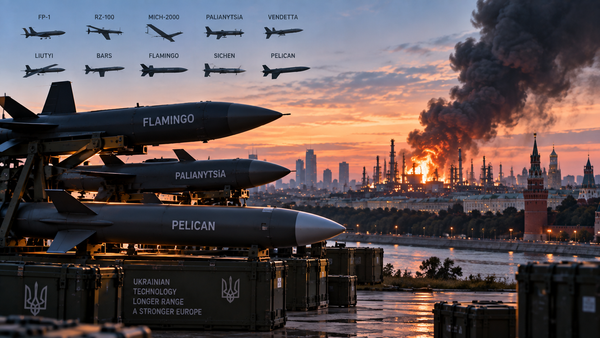
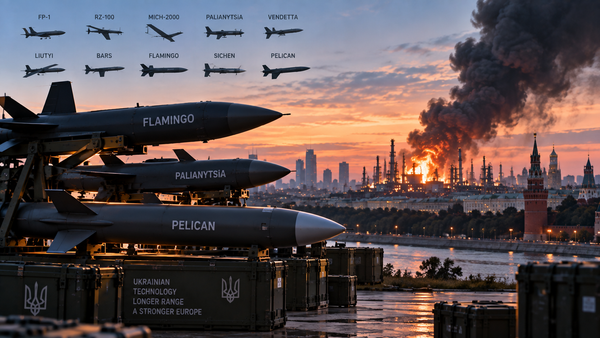
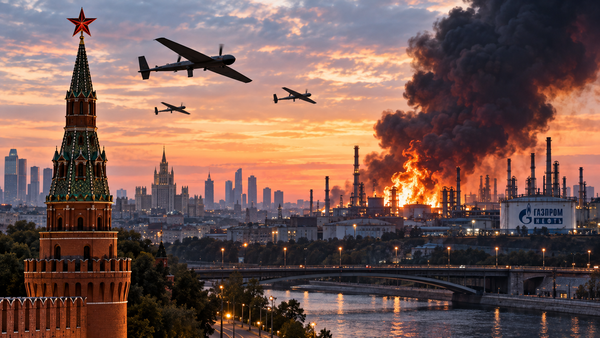
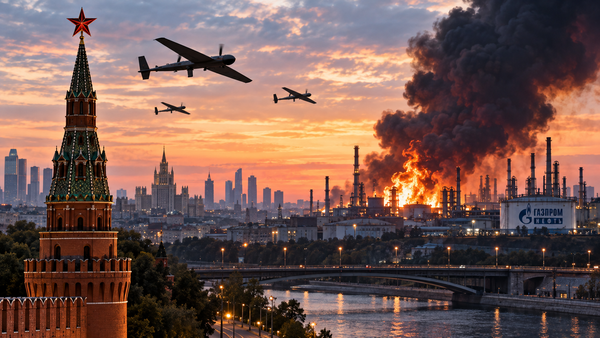
Ukraine delivers major strikes on Moscow and masterfully pivots the conflict. The Baltic, meanwhile, prepares for an assault it may recognize too late

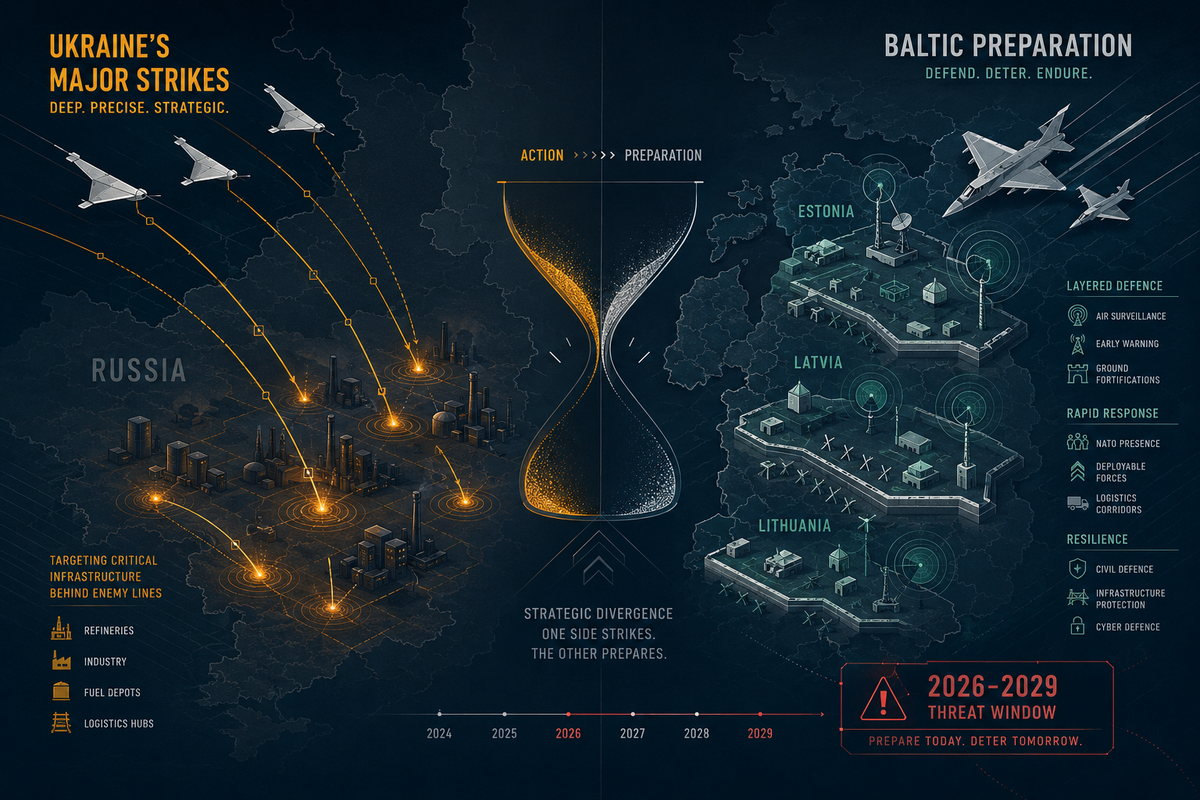
Over twelve months of conflict, Ukraine has transformed from a state that absorbs blows into a state that delivers them across distances exceeding one thousand kilometres. This is not merely material evolution in weaponry. This is psychological and geopolitical revolution rewriting calculations in Moscow and triggering anxiety in American intelligence services.
In early May 2026, Ukraine executed its largest sustained campaign of strikes against Russian territory in over a year. Long-range unmanned systems struck energy infrastructure, production complexes, strategic depots. But the numbers arriving from the battlefield tell a story the headlines do not. A single day yields 108 combat engagements. The adversary presses hardest toward Pokrovsk. Each day brings not the consequence of victory but the reality of attrition.
Yet beneath this reality lies something more fundamental. Through the sand and blood of the front, a development becomes visible: the evolution of drone technologies that have become critical to containing a larger Russian army and have attracted military interest worldwide.
The Moscow strike as message, not merely operation
When President Zelenskyy announces strikes on Moscow and Russian depths, Western audiences often interpret this as military success. In the Kremlin, it is read as something else. It reads as communication: Ukraine possesses the capacity to strike targets on Russian territory independent of Russia's distributed actions on the Ukrainian front.
In April, Russian forces renewed assaults on Kyiv, killing at least twenty-four people, including three children. This was intent to demonstrate force, an attempt to intimidate. Zelenskyy responded with orders to military command to prepare "possible formats of response" to further sustained attacks. But this order is not a cry of despair. It is realism and understanding that defence can be effective only through demonstration of capacity to strike back.
The drones Ukraine employs are not missiles retrieved from Soviet stockpiles. These are Ukrainian developments, often constructed from commercial components, oriented toward maximum efficacy at minimum cost. Ukrainian armed forces have learned to accomplish more with less—standard behaviour for a state under pressure, but rare for a state lacking the industrial capacity of its adversary.
At this juncture, one must pause and comprehend the value of achievement. When Western military experts examine Ukrainian drones, they see not simply weapons. They see a school of practical development yielding results even under constrained resources. This lesson has already attracted interest from military leadership worldwide.
The Baltic dilemma: allies prepare for American withdrawal
When Christopher Smith, a senior State Department official, addressed closed sessions in May 2026, his conversation was simple but grimly precise. The United States warns NATO: when the Ukrainian war concludes, Russia will redeploy approximately ninety percent of its combat power toward the northeast. Toward the Baltic.
This is not hypothesis. This is calculation built on analysis of Russian logistics and temporal matrices. The Baltic region is termed "particularly acute"—diplomatic language meaning this will be the first test.
But allies received another signal as well. The United States cancelled planning for deployment of four thousand troops to Poland. Simultaneously, announcement came of withdrawal of five thousand troops from Germany. These numbers are not statistics. They are demonstration of how the White House understands its obligations at the moment when allies require maximum assurance.
Estonia, Latvia, and Lithuania received a message in two layers. On one hand: the United States warns of Russian threat. On the other: the United States will reduce presence. Baltic leadership is left to construct an architecture of defence once calculated to rest on American guarantee.
Estonian air defence and drone warfare: who understands the new reality
In early May, Estonia demonstrated something important. Estonian air force showed that fighter aircraft can effectively intercept even small drones. This sounds like tactical achievement, but it conveys a story about how Baltic states comprehend the new reality of drone warfare.
If large drones can be intercepted by aircraft, then the problem shifts to mass and logistics. How does one defend a country against hundreds of drones simultaneous? How does one distribute limited resources for territorial defence if the adversary can launch attacks from multiple vectors?
These are questions confronting Estonia and its neighbours. Estonian demonstration showed technique. But the tactics of drone production and massed strikes—this is what Ukraine develops through a year of combat.
The Baltic states understand: they must learn from Ukraine while time remains. They must construct defence calibrated to hybrid threats, drones, massed assaults. They cannot calculate on America remaining as guarantor. America has already signalled it calculates otherwise.
Pause before the storm: why low threat numbers deceive
OSINT threat assessments for the Baltic region as of May 2026 register 0.13 on a scale of 1.0. This is a low number. For those who read it as mere statistics, it signals calm. For those who understand its context, it signals the quiet before strategic reorientation.
This is a period when Russia remains pinned to Ukraine and cannot redirect resources to the Baltic in the scale it would prefer. But this period is also the period when Baltic states possess maximum time for preparation. Low-risk periods are periods when one should construct fortifications, procure weapons, train personnel.
Low-risk period of 0.13 is not a period of security. It is a period of preparation for when the number rises.
The global geopolitical game: Ukraine as chess piece in larger match
What renders the situation more complex is recognition that Ukraine on the front lines plays a role transcending the Ukrainian conflict. When Ukraine strikes at Moscow's heart, it does not merely attack Russian resources. It also draws upon itself Russian resources that might otherwise concentrate on preparation for the next phase.
American diplomacy comprehends this well. America warns of the Baltic not because Russia will imminently attack at scale. America warns of the Baltic because it calculates on time. America calculates that Ukraine will endure long enough to grant Europe time for refinancing and rearmament without American guarantee.
This is cynical, but it is realism. Ukraine is combat-capable precisely because it has learned to anticipate Russian moves months in advance. The Baltic must learn to endure Russian moves years in advance.
Conclusion: pivotal moment demands clear strategy
Ukraine fights not merely for victories that alter this month's front. Ukraine fights for victories that alter outcomes across years. Each strike on Moscow is a strike against Russia's capacity to rearm and regroup for the next phase.
But this Ukrainian success possesses meaning only in context of allied readiness. If the Baltic is unprepared, if America does not sustain, if Europe does not comprehend the stakes, then Ukrainian success on the front becomes hollow victory in a larger conflict.
The time for the Baltic to prepare is time "now." Not tomorrow, not when the Ukrainian war ends, not when Russia decides to attack. The time is when threat level 0.13 still seems distant and serene. This is the finest time for construction, procurement, training, development of strategic defence depth.
Ukraine demonstrates that one can endure and even prevail under the highest pressure. The Baltic must master this during periods of calm, while time remains. Then must simply be endurance.