A Precedent Worth 0.39: OSINT Digest, 25 July 2026

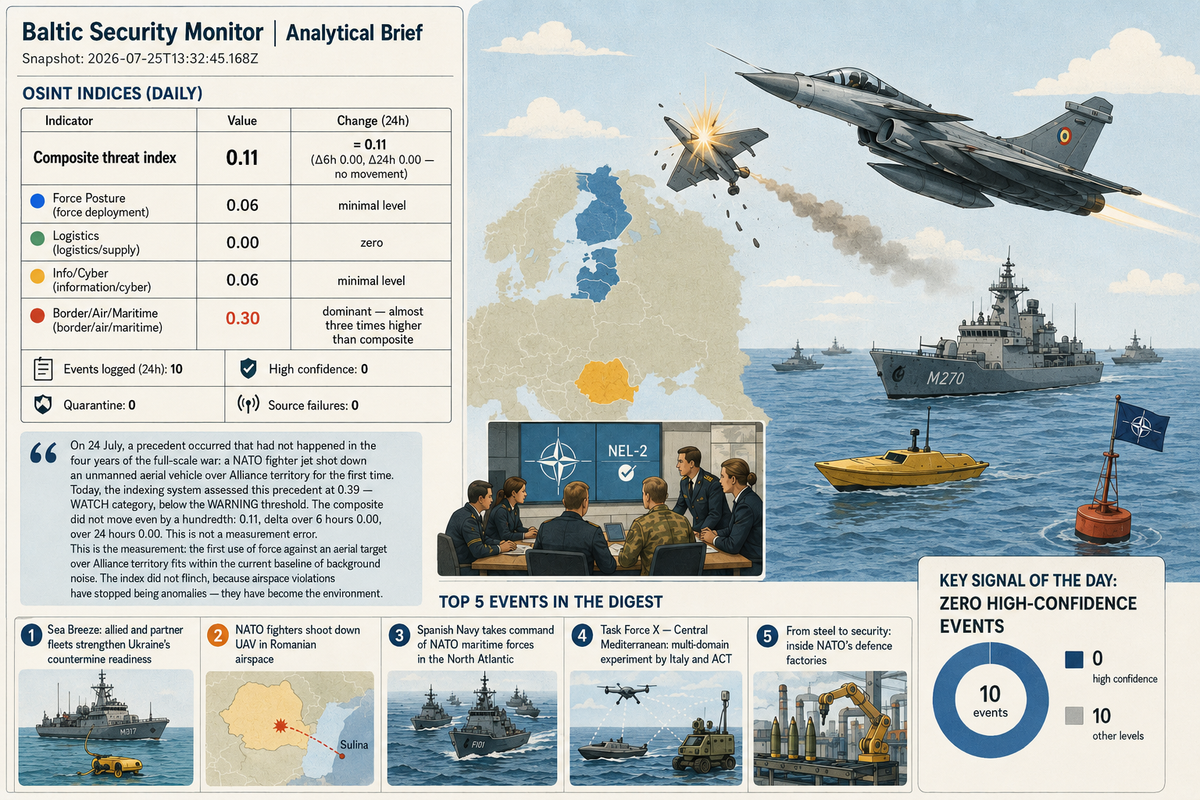
Baltic Security Monitor | Analytical Review Snapshot: 2026-07-25T13:32:45.168Z
Today's OSINT Indices
| Indicator | Value | 24h change |
|---|---|---|
| Composite threat index | 0.11 | = 0.11 (Δ6h 0.00, Δ24h 0.00 — completely static) |
| Force Posture | 0.06 | minimal |
| Logistics | 0.00 | zero |
| Info/Cyber | 0.06 | minimal |
| Border/Air/Maritime | 0.30 | dominant — nearly 3× the composite |
Events logged in 24h: 10 · High-confidence: 0 Quarantine: 0 · Source failures: 0
Yesterday, in the skies over Romania, something happened that had not happened in four years of full-scale war: a NATO member's fighter shot down a drone over Alliance territory for the first time. Today the indexing system scored that precedent at 0.39 — WATCH, below the WARNING threshold. The composite did not move by a hundredth: 0.11, six-hour delta 0.00, twenty-four-hour delta 0.00. This is not a measurement error. This is the measurement: the first use of weapons against an aerial target over Allied soil now fits inside the current band of background noise. The index did not flinch, because airspace violations have stopped being an anomaly. They have become the environment.
Top Five Events
🔵 1. Sea Breeze: Allied and partner navies build Ukraine's mine countermeasures readiness
OSINT score: 0.41 — WATCH (highest of the day)
Exercise Sea Breeze 26-2 concluded on 24 July after two weeks of intensive multinational mine countermeasures training off the southern coast of the United Kingdom, co-led by U.S. Sixth Fleet and Ukraine and hosted by the Royal Navy. <cite>Naval forces from Bulgaria, Denmark, Estonia, France, Georgia, Greece, Japan, Latvia, Lithuania, Poland, Spain, Sweden, Türkiye, Ukraine, the United Kingdom and the United States took part.</cite>
Ukraine deployed five minehunters — Chernihiv and Cherkasy, both donated by the Royal Navy; Mariupol, donated by Belgium; and Melitopol and Henichesk, both from the Netherlands.
The decisive development, though, took place in a headquarters rather than on the water. <cite>The Mine Countermeasures Staff of the Ukrainian Navy's 1st Minesweeper Division completed NATO Evaluation Level 2 (NEL-2) certification. For the first time in the history of Ukraine's modern navy, a Ukrainian unit has been formally integrated into NATO's command structure for maritime mine countermeasures.</cite> In practice, a Ukrainian staff is now cleared to command Allied — not only national — mine countermeasures forces.
BSM analysis: This is the most structurally significant item in the digest, and the system was right to rank it first. It is not another exercise; it is a change of status. Ukraine has moved from the category of "trained by NATO" to "commands NATO forces" — in a narrow and technical niche, but a critical one. Since 2022 the Black Sea has become one of the most heavily mined maritime areas in the world, and mine warfare is the one domain where Ukrainian experience objectively exceeds that of its Allies. The Baltic read-across is direct: Estonia, Latvia, Lithuania, Poland, Denmark and Sweden were all on the participant list, and SNMCMG1 — NATO's standing mine countermeasures group in northern waters — works to the same NEL standards. A certification earned in the Channel is convertible in the Baltic Sea.
🟠 2. NATO fighters shoot down a drone in Romanian airspace
OSINT score: 0.39 — WATCH (new entry, precedent)
<cite>On the morning of 24 July 2026, two Romanian F-16s from Fetești Air Base and two Italian Eurofighters from Mihail Kogălniceanu Air Base scrambled under NATO command and control to identify an unknown UAV flying close to Romanian airspace. Once it crossed into Romanian airspace, the Allied assets were cleared to engage and the target was shot down.</cite>
<cite>Radars first detected the track at 09:30, roughly 20 km east of Sulina on the Black Sea coast. Romania's army chief said pilots described the aircraft as resembling a Shahed-type drone — the Iranian design used at scale by Russia against Ukraine. Debris fell on a wheat field; there was no damage and no casualties.</cite> Romanian authorities have not officially established the drone's origin or purpose.
One discrepancy deserves flagging. The official Allied Air Command release describes the engagement as taking place in Romanian airspace without geographic detail, while several outlets place it over Buzău County — more than 150 km inland from the initial detection point near Sulina. If the latter is accurate, the drone was tracked over Romanian territory for a substantial period before the decision to engage was taken.
BSM analysis: Romania is not the Baltic region, and that is precisely why this entry matters for the north-eastern flank. Dozens of prior incursions and debris incidents were handled in Bucharest under a "track and record" protocol. Yesterday, for the first time, the protocol was "track and engage." The change is not in the threat but in the response — and it creates a precedent that Warsaw, Vilnius, Riga and Tallinn can now cite. The key detail for the flank: the decision ran through the NATO chain of command rather than a national one, and two nations flew the intercept, Romanian and Italian pairs together. That is a model the Baltic region — where national airspace is measured in minutes of flight time — can apply without renegotiating authorities first. A score of 0.39 against an unchanged composite is a precise measure of how far airspace violations have normalised: a precedent of this magnitude no longer shifts the shape of the day.
🔵 3. Spain takes command of NATO's North Atlantic naval forces
OSINT score: 0.39 — WATCH
<cite>From July 2026 through June 2027, Vice Admiral Juan Bautista Pérez Puig, commander of the Spanish Maritime Forces Headquarters (SPMARFOR), serves as Commander Task Force Atlantic (CTF-AT), leading 3,000 personnel including five Spanish ships, a Marine Corps landing force and eight Allied vessels.</cite> His command includes <cite>Standing NATO Maritime Group 1 and Standing NATO Mine Countermeasures Group 1 within JFC Norfolk's area of responsibility, spanning the waters from North America's east coast to Greenland, Iceland, the United Kingdom and Norway.</cite>
<cite>This is the first time the Spanish Navy has held the CTF-Atlantic mission since the construct was established in January 2026. The multinational force draws more than 3,000 personnel from Spain, Portugal, Latvia, Türkiye, the United States, Italy, France, the Netherlands, Belgium, Norway, Lithuania, Poland, the United Kingdom and Germany.</cite>
BSM analysis: Latvia, Lithuania and Poland appearing on the contributor list of an Atlantic task force is not boilerplate — it is an indicator of how NATO now wires the North Atlantic to the Baltic Sea. SNMCMG1, subordinate to CTF-AT, is the same mine countermeasures group that operates in Baltic waters and to whose NEL standard the Ukrainian staff certified this week (see item 1). Two entries in today's digest, geographically separate, converge on a single command chain. The rotational logic is worth noting on its own: a Mediterranean navy commands the Atlantic, Italian fighters cover Romania, Spanish ships patrol the north. NATO's southern flank is being systematically invested in the security of the northern one.
🔵 4. Task Force X–Central Mediterranean: Italy and ACT run multi-domain experimentation
OSINT score: 0.27 — WATCH
<cite>Task Force X–Central Mediterranean (TFX CentMed) was hosted and led by Italy from 22 June to 10 July 2026, the latest iteration of Allied Command Transformation's Task Force X framework.</cite> <cite>It was the first Task Force X led by an individual Ally rather than by NATO ACT directly, the first to be fully multi-domain, and the first on NATO's southern flank.</cite>
<cite>Five contributing nations — Croatia, Italy, Latvia, Slovenia and the United States — tested how emerging and dual-use technologies, under ultimate human control, can strengthen multi-domain awareness and presence. More than 100 uncrewed air, surface, subsurface and ground systems participated, alongside counter-uncrewed aircraft and radar capabilities.</cite>
BSM analysis: Latvia is the only Baltic state among the five contributors, and that is not incidental — Riga's working knowledge of uncrewed systems and counter-drone solutions has been accumulated on its own border. The programme's formula, over 100 uncrewed systems plus counter-UAS effectors inside a single digital backbone, is exactly the toolkit whose absence yesterday's Romanian episode exposed: four crewed fighters launched against one Shahed is a losing cost exchange, and everyone in the Alliance knows it. TFX is the attempt to change that arithmetic.
🔵 5. From steel to security: inside NATO's defence factories
OSINT score: 0.24 — WATCH
<cite>A NATO feature published on 9 July documents accelerating defence production: an armoured vehicle line in France, a helicopter assembly plant in Poland, an ammunition factory in Czechia. The manufacturer Sellier & Bellot is able to produce 1.5 billion rounds of ammunition.</cite>
BSM analysis: The lowest score in the top five — and the only entry whose horizon is measured in years rather than hours. It is instructive that Logistics reads 0.00 in the same digest that contains an industrial entry: the system separates industrial production from operational logistics, which is methodologically correct. The Polish plant is the element of that industrial map with the most direct bearing on the north-eastern flank: it shortens the supply leg from thousands of kilometres to hundreds.
The Signal of the Day: Zero High-Confidence Events
The most important number in this digest is not in the index table. It sits beside the event counter: 10 events in 24 hours, 0 of them high-confidence.
All five top entries originate from NATO's own channels — mc.nato.int, ac.nato.int, JFC Norfolk, ACT, nato.int. No independent confirmation, no national source, no neutral wire service in the day's top ranks. There is no quarantine and there are no source failures: the system is functioning correctly and seeing exactly what the Alliance publishes about itself.
That diagnoses two things at once. First, nothing occurred in the region on 24–25 July that independent sources logged with high confidence — the informational quiet is real, not an artefact. Second, and more consequentially: on days this quiet, the shape of the day is set by NATO's communications staff. A composite of 0.11 with 100% official sourcing in the top five does not mean "calm." It means "we are seeing what we are shown."
For the reader, that is the interpretive frame for this entire edition. The Ukrainian staff certification, the Atlantic change of command, the TFX results — all are real events, but all reached us through press releases, in a form the sender controls. Exactly one entry in today's digest was independently corroborated worldwide: the Romanian shootdown. And it is that entry which the system declined to rate as high-confidence.
Regional Context
The backdrop against which today's quiet sits looked rather different two weeks ago.
<cite>On 15 July, Lithuania's president said intelligence assessments indicate Russia may be preparing attacks on critical infrastructure in the Baltic states or Poland. The three Baltic states and Poland have stepped up protection of key transport and energy assets.</cite> <cite>The Kremlin dismissed the warning, with spokesman Dmitry Peskov calling it "a fresh batch of bugaboos."</cite>
The other half of that story should not be lost. <cite>A Baltic intelligence source clarified: "Today, there is no known date, no concrete plan, and no designated organizer for such a provocation." A Latvian foreign and security policy official stated there are no indications of a looming military provocation and no changes in Russian military presence or preparations aimed at the Baltic states.</cite> It is an unusual moment when public political rhetoric and working intelligence assessment diverge this openly — and BSM records both sides.
In the air and maritime domains the cycle has been dense. <cite>In mid-July Poland intercepted Russian aircraft over the Baltic Sea that were surveying Polish air defence systems while remaining outside territorial waters. Polish and Swedish fighters scrambled against Su-30SM2s out of Kaliningrad, forcing a course change; a day earlier Polish aircraft intercepted a Russian Il-20 over the Baltic Sea.</cite>
That series is what holds Border/Air/Maritime at 0.30 while the composite reads 0.11. The border sub-index runs at nearly three times the aggregate — the classic signature of structural load: the system is not registering new threats, but it is registering continuous contact along the perimeter.
Conclusion
Today's digest is a rare case of total stasis: Δ6h 0.00, Δ24h 0.00, three sub-indices at or near zero, no quarantine, no source failures. On days like this the temptation to write "nothing happened" is strongest — and on days like this it is most misleading.
Within the 24 hours the index priced at 0.11, a Ukrainian military staff was cleared for the first time to command NATO mine countermeasures forces, and a member state's fighter shot down an aerial target over Alliance territory for the first time. Both are precedents without parallel in four years of war. Neither moved the composite.
That is the day's real finding, and it is not about Romania or the English Channel. The thresholds by which the system distinguishes normal from anomalous are calibrated to the environment of 2026 — an environment that already treats routine airspace violations, routine intercepts over the Baltic Sea, and the incremental integration of Ukraine into Alliance command structures as ordinary. A composite of 0.11 does not mean tension is low. It means the current level of tension has become the baseline.
The next calibration point is the first day Border/Air/Maritime moves off 0.30. A rise will indicate a new event. A fall will indicate that what dropped was not the tension, but the attention.
Baltic Security Monitor (osint-baltic.com) — an analytical publication on security along NATO's north-eastern flank. All OSINT coefficients are produced by an automated indexing system based on open sources.