The Guest List, Not the Workshop? A ballistic strike on a Ukrainian defence event and what the north-eastern flank should take from it

Baltic Security Monitor | Analysis Updated: 25 July 2026
What happened
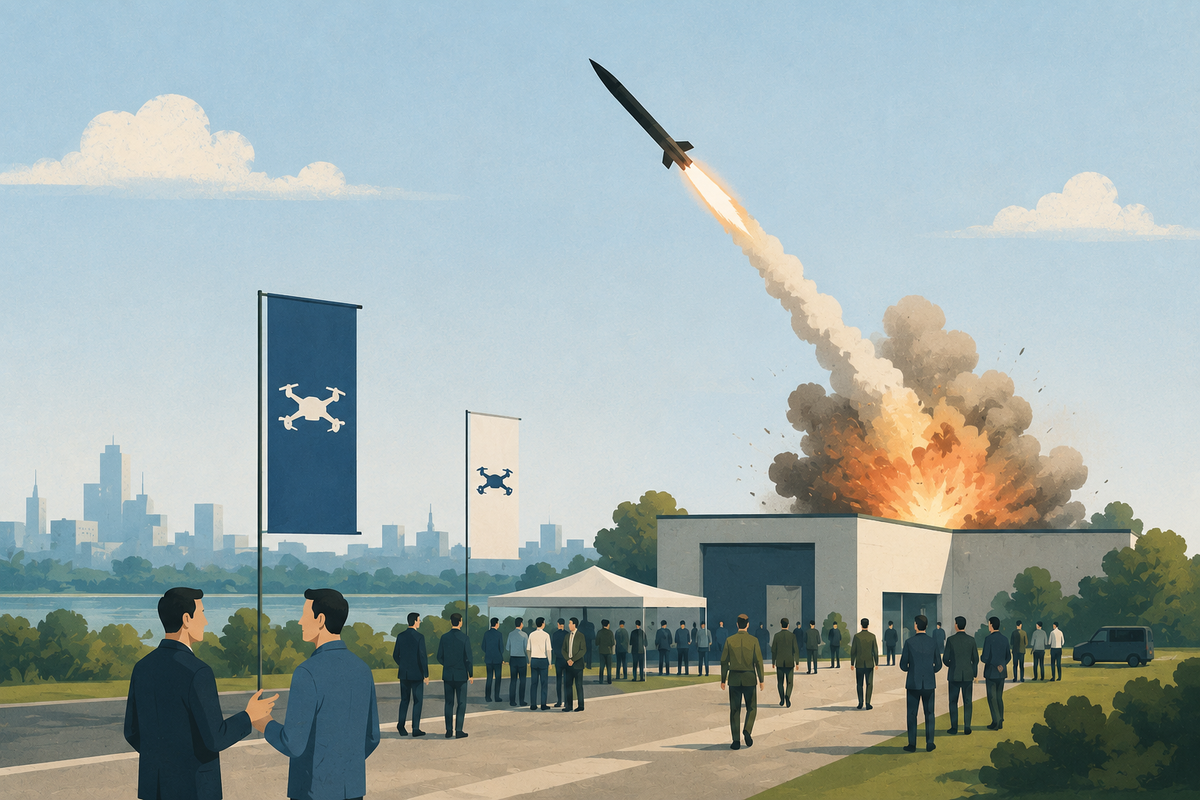
In daylight on 24 July, a Russian ballistic missile struck a private training range in the Bucha district of Kyiv Oblast, where an event bringing together representatives of Ukraine's defence industry and uncrewed-systems manufacturers was under way.
At least 10 people were killed and around 100 injured. Twenty-seven homes and 44 vehicles were damaged in the Bucha district. According to Euromaidan Press, two missiles hit the range, and the strike was unusual for taking place in daylight — the overwhelming majority of Russian ballistic attacks on Kyiv and the surrounding region are launched at night.
Ukraine's Prosecutor General Ruslan Kravchenko opened a war crimes investigation into the Russian strike and a separate criminal case into possible negligence in organising the event. Investigators are to establish who authorised the event, who approved its location, timing and format, what security measures were in place, and whether the risks under martial law were properly assessed.
Ukrainian prosecutors are examining why a defence exhibition was held and publicly promoted at all given the risk of a Russian strike — particularly since Ukraine's armed forces have long prohibited mass events and large gatherings because of the standing missile threat.
The context without which the episode cannot be read: late on the evening of 23 July, President Zelenskyy held talks in Kyiv with a delegation from Raytheon, the American manufacturer of the Patriot system, saying the company was ready to co-produce Patriot interceptors with Ukraine. The meeting came less than three weeks after President Trump pledged to grant Ukraine a licence to produce Patriots. Commenting on the strike, Zelenskyy wrote that "missiles for Patriot systems are the number one priority."
An official list of the dead, the identities of the participating companies, the missile type used, and any assessment of industrial damage had not been released at the time of publication.
Analysis on three levels
Level one — tactical: daylight ballistics and the arithmetic of interception
The defining tactical feature of this episode is the time of day. Night-time ballistic strikes on Kyiv Oblast have become routine, and with routine came a behavioural pattern: an alert at night means take shelter; an alert in daylight, for most people, means carry on working. The 24 July strike broke that pattern.
A ballistic missile leaves only minutes between detection and impact. Inside that window, shelter is reached by those already near shelter — not by people standing in the open on a demonstration ground. The ratio of 10 dead to roughly 100 wounded is consistent with casualties taken in the open, though it does not on its own establish it: the distribution of losses also depends on blast direction, warhead type, distance, the presence of vehicles, the posture of those present and the quality of available cover. Absent official data on the missile type and the circumstances of impact, this reading remains provisional.
From there the line to Patriot is direct. Intercepting a ballistic target is the only technical way to close that window, and it is interceptors — not launchers — that Ukraine lacks most acutely. Zelenskyy's "number one priority" statement was made after the strike, not the day before it, and that is where its political weight lies.
Implication: Kyiv's pressure on partners to accelerate Patriot and interceptor deliveries will intensify over the coming weeks, and this episode will be the argument. For European capitals that means returning to a question already raised last year: how many interceptors is each country prepared to release from its own stocks.
Level two — operational: indications of a shift in targeting logic
The most consequential thing about this strike is likely not what was destroyed but who was standing at the point of impact.
Russia has struck Ukraine's defence industry systematically since 2022, and the logic of those strikes has been largely facility-based: a workshop, a warehouse, a plant's power supply, an assembly line. The indicators around the 24 July strike — the choice of place, timing and moment — may point to a different category: a target that was not productive capacity but a concentration of the people who create it, namely engineers, uncrewed-systems developers, programme managers and executives of private defence firms. This remains a hypothesis. There is no official confirmation of Russian targeting intent, and the coincidence of the event with the strike could in principle admit other explanations, from a pre-planned strike on the range as such to an incidental target selection. The available evidence is, however, consistent with the hypothesis.
A comparable approach has already been used by Russia against Ukrainian power-sector workers, rescuers and repair crews, where follow-up strikes were delivered after personnel arrived on site. If this case confirms deliberate targeting of a concentration of engineers and developers, it would mark the extension of an already observed logic into the defence-industrial sector — an evolution of a known tactic rather than a wholly unique episode.
If the hypothesis holds, the difference between the two types of strike lies above all in the nature of the loss. A destroyed batch of equipment or a damaged workshop is recoverable in months, with money. An engineer with four years of wartime experience developing FPV platforms, or a programme manager who carries an entire component supply chain in his head, is recoverable in neither months nor money. Ukraine's drone industry grew out of small private teams in which critical competence often sits with a handful of individuals — and it is that structure which makes it vulnerable to targeting by human rather than material criteria.
A separate question remains unanswered: how the Russian side knew. Public promotion of the event is the simplest explanation and probably the correct one, but it is not the only one. Registration lists, participants' social media, geolocation from photo metadata, human intelligence, a leak from the organisers' logistics chain — all are live hypotheses, and closing them is exactly what the negligence investigation is for. Until the leak hypothesis is disproved, every subsequent Ukrainian defence-sector event must be planned on the assumption that the access channel may still be open.
Implication: rules for exhibitions, trials and industry gatherings in Ukraine will tighten sharply — closed vetted registration, dispersal of participants, a ban on publishing location and timing, mandatory shelter within seconds of walking distance. This is inevitable, and it carries a cost: an industry built on fast horizontal exchange between hundreds of small teams will pay for security in the currency of innovation tempo.
Level three — structural: why this is Baltic material
Formally the episode occurred more than a thousand kilometres from Tallinn, Riga and Vilnius and does not enter the north-eastern flank digest. Practically it is the most useful OSINT material of the week for Baltic and Polish defence establishments, for three reasons.
First, the target class is universal. A defence exhibition, a demonstration range, an industry conference, a factory open day, a trial of a new system in front of customers — these are the same formats in Kyiv, Vilnius, Riga and Warsaw. The only difference is that in Ukraine this target class has now been struck, and in the Baltic states it has not.
Second, regional flight times are shorter still. Iskander-M systems in Kaliningrad Oblast have a declared range of up to 500 km — enough to cover Vilnius, Riga and a substantial part of Polish territory; Vilnius sits roughly 250 km from the Kaliningrad border. The few-minute window that left people in the open near Kyiv with no options on 24 July is narrower in a Baltic scenario. No alerting procedure compensates for that difference. The only thing that does is participants being dispersed and close to shelter from the outset.
Third, and least comfortable: the intelligence work is happening now. If the Russian side has taken the chain "open source → identify the event → time and coordinates → launch" all the way to weapons release, that same chain applies to any announced defence event in the region — in peacetime without the launch, but with the data accumulating. A public announcement of an exhibition in Riga will not produce a strike tomorrow. It will produce an entry in someone else's database, and that entry is the product intelligence services spend years collecting before it is needed.
Practical conclusion for the region: defence events, ranges and concentrations of military and civilian technical specialists should be treated not as communications opportunities but as a category of site with its own security regime. The minimum set: no publication of precise location and timing before the event begins, closed and vetted registration, dispersal, shelter within a minute's reach, and a check on what participants themselves post on social media during the event. That last item is the hardest — an organiser controls the announcement, but not a hundred phones in the hands of guests.
What we still do not know
This analysis deliberately leaves open the positions where evidence is absent:
| Question | Status |
|---|---|
| Official list of the dead | not released |
| Missile type used | not officially confirmed |
| Participating companies and their losses | not disclosed |
| Intent to strike the concentration of specialists | 🟡 hypothesis; no official confirmation of targeting |
| Real damage to production capacity | 🟡 no public evidence of significant damage |
| Channel through which the event was identified | 🟡 under investigation, several hypotheses |
| Discrepancy in early reporting | some wires initially reported 6 killed; the figure was later revised to 10 |
Raising confidence requires: an official casualty list, confirmation of the missile type, an assessment of damage to specific companies, and the findings of the investigation into a possible leak of venue data.
No new confirmed major air, maritime, border or infrastructure incidents have been recorded in Estonia, Latvia or Lithuania since the previous update.
Conclusion
The 24 July strike should be read not only as an episode in an air campaign but as a possible change in target-selection criteria. For three years Russian long-range weapons treated Ukraine's defence industry largely as infrastructure — walls, lines, warehouses. This time the indicators point toward the industry being struck as a community of people, and if that is borne out, the most expensive thing lost will not be susceptible to inventory. The definitive answer will come from the investigation — which is why this analysis should be read as a working hypothesis rather than an established fact.
For the Baltic states and Poland, the useful part of this material is not sympathy but a list. Every announcement of a defence event, every published conference programme, every geotagged post from a range is a line item someone is collecting. In Kyiv that chain has just run to its end. On the north-eastern flank it is still near its beginning — which is exactly why now is the only convenient moment to break it.
Baltic Security Monitor (osint-baltic.com) — an analytical publication on security along NATO's north-eastern flank. Prepared from open sources; confidence caveats marked 🟡 (requires confirmation).
Sources
- Kyiv Independent — Russian ballistic missile strikes Kyiv arms exhibition
- Bloomberg — Russian Missile Strike Near Kyiv Kills 10, Probe Launched
- Euromaidan Press — rare daytime ballistic strike on Kyiv Oblast
- AP / CP24 — strike follows Zelenskyy's Raytheon meeting
- The Irish Times — probe into the defence event
- Kyiv Post — 10 killed, 100 injured
- UNN — 27 homes and 44 vehicles damaged