Three Statements, No Decisions
US Secretary of State Rubio denied that the White House ordered Ukraine's Starlink service slowed, Lithuania's prime minister called the drone that fell on his country Ukrainian after the National Security Commission met, and the Kremlin confirmed only that a summit with Trump and Xi is being…

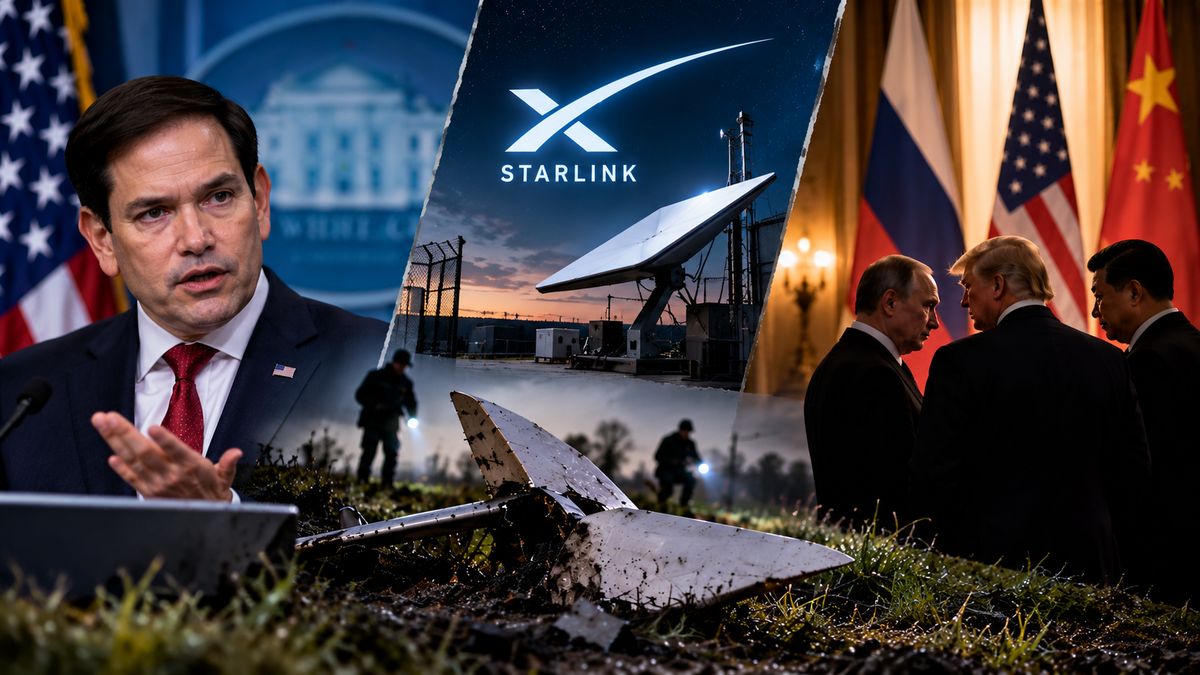
US Secretary of State Rubio denied that the White House ordered Ukraine's Starlink service slowed, Lithuania's prime minister called the drone that fell on his country Ukrainian after the National Security Commission met, and the Kremlin confirmed only that a summit with Trump and Xi is being "discussed". None of the three has yet changed anything on the ground.
1. What is confirmed
Rubio and Starshield
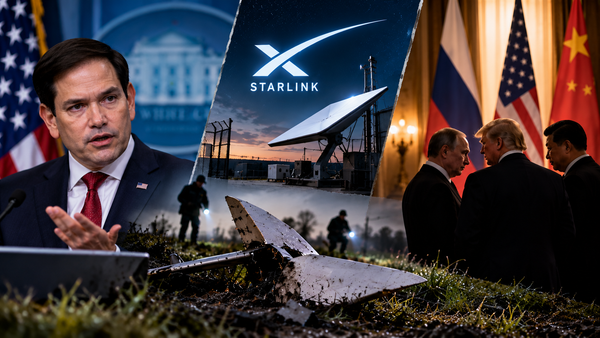
- On Saturday 17 October, at Joint Base Andrews, Rubio told reporters: "it wasn't deliberate. We have nothing to do with that." The State Department released the remarks (Al Jazeera, 18 Oct). The digest calls this an "interview"; it was an exchange with reporters.
- Rubio: "No one at the White House ordered anyone to slow down internet or slow down speed so that certain drones couldn't use it." He called the reports "categorically false".
- Per Newsweek, he also said "Nobody ordered that Starlink speed to be slowed down", "It sort of happened", and "my understanding is it's been restored" (Newsweek, 17 Oct). So he does not deny that a disruption occurred; he denies an order.
- Starshield, he said, is "a defence product, a military product", unlike the commercial Starlink. Ukraine "asked for access to it in order to conduct deep strikes inside of Russia. They do not have access to it at this moment." On the future: "That's under conversation." The "under discussion" wording is Al Jazeera's headline paraphrase, not his quote.
- The opposing account: on 15 October Reuters, citing three unnamed sources, reported that the White House instructed the Pentagon to reduce Starshield services for Ukraine's military. The sources could not say who in the administration started the decision. One unnamed senior official said: "No such request was ever made by the president" (as republished by Ukrainian News; I did not open the Reuters original). The digest speaks of "US officials", but the sourcing is three anonymous people, and the denial concerns the president specifically, not the White House as a whole.
- Elon Musk said earlier that Starshield is "owned and controlled by the US government" and that limits on speed or usage are set by the US military and ultimately the president (Al Jazeera, 15 Oct).
- Kyiv's side: presidential adviser Serhii Beskrestnov described a 100 mph (about 161 km/h) speed limit on terminals. On Saturday Zelensky said the satellites are not tracking antennas on objects moving faster than that (Al Jazeera, 18 Oct). That does not sit easily with Rubio's understanding that service is back to normal.
Lithuania
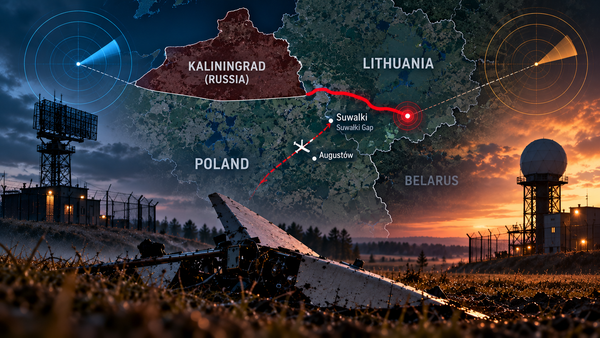
- After the National Security Commission met on 19 October, Prime Minister Mindaugas Sinkevičius said there is no doubt the drone came in from the Polish side, that it was a Ukrainian-origin FPV drone (he cited wreckage and a Ukrainian request), "likely the one that exploded" on Lithuanian territory, and that "there is no doubt it carried explosives". Whether it ran out of fuel or crashed is still under investigation (LRT, 19 Oct).
- He added that, unlike earlier cases, the drone came from Schengen airspace rather than Belarus, and that fighter jets picked it up on radar but could not make visual contact in poor weather.
- The attempted arson at a Vilnius company using SpaceX equipment is being treated as sabotage. From Monday, vigilance at state-significant critical infrastructure is being raised, with more staff and attention.
- Before the meeting, Defence Minister Robertas Kaunas had linked the drone to Ukraine's attack on St Petersburg; the LRT page notes that Ukraine apologised. He also ordered a review of why alerts were not sent sooner (LRT, 18 Oct). Per LRT, Šiauliai and Panevėžys counties were on red air alert and Kaunas county on yellow, for about an hour.
- A BNS preview listed additional powers to neutralise drones and residents' notification procedures on the agenda; President Nausėda was to meet intelligence chiefs and the Chief of the Defence Staff (BNS).
The summit proposal
- The WSJ, as relayed by Reuters (whbl.com): Putin proposed a summit next month with Trump and Xi Jinping to negotiate an end to the war; the WSJ's sources say the terms would favour Moscow. The Kremlin reportedly suggested holding it on the sidelines of APEC in Shenzhen on 18–19 November.
- The 9 October call date and the proposal itself come from a former Russian intelligence officer cited by the WSJ. The same source says the call also produced a deal for the US to buy Russian diesel.
- Peskov told the WSJ a possible meeting was being discussed but "there is no clear understanding yet regarding the meeting itself or its potential agenda". A senior US official told the WSJ that Trump has not agreed but could be receptive. The White House did not reply to Reuters; neither did the Russian and Chinese embassies in Washington.
- The report does not say whether Zelensky would take part. He has criticised the diesel deal and the US sanctions waiver.
2. BSM analysis
The dispute is about cause, not occurrence. Rubio does not say nothing happened; he says nobody ordered it ("it sort of happened"). Reuters's sources and Musk say the opposite: the decision sits with US authorities. Until Ukraine, the Pentagon or SpaceX publish technical detail, each version remains a claim. For the Baltic states the point is practical: operational communications depend on a product shaped both by a company and by a political decision. Starlink equipment in Lithuania, Poland and Bulgaria has also become a sabotage target, so the node needs protecting from both directions.
Lithuania: who, not what. The prime minister has removed the biggest open question of day one: by his account the drone was not Russian but Ukrainian. The digest adds that Kyiv concedes its drones may have been diverted by Russian electronic warfare; I did not verify that. The structural questions of the last 24 hours remain: the object was detected but not intercepted, alerts came late and the defence minister wants to know why, and no new powers have been adopted. For the Baltic states the gap between "we see it" and "we can act" matters more than the drone's origin.
The summit: a proposal without content. The two most concrete details, the call date and the APEC link, rest on a single source, and both official sides speak cautiously. The format is what matters for the Baltics: talks about Ukraine without Ukraine or Europe would deserve separate analysis. Nothing yet says that is the plan, and nothing says it is not.
Per the digest, not re-verified
| Topic | What the digest says |
|---|---|
| Patriot | Critically low interceptor stocks; no new deliveries identified (Washington Post, 15 Oct) |
| Black Sea | Bulgaria's request for more NATO aircraft and counter-drone capability; North Atlantic Council to discuss on 20 Oct |
| ZNPP | IAEA-confirmed local ceasefire; completion of repairs not confirmed |
| Saint Petersburg | Fires at the oil terminal and the Ruchi depot; effect on exports unknown (FT) |
| Sailors | Seven Wine Trader sailors and part of the HS Dignity crew still missing |
| Moldova | Drone fragments near Scăieni; type and origin unconfirmed |
| Ukraine and electronic warfare | Kyiv acknowledged its drones may have been diverted by Russian EW (Reuters, 18 Oct) |
| Kyiv metro | Strike of 18–19 Oct, two stations closed; outside scope under the editorial rule |
Conclusion
Three stories, three statements, no verifiable decision. The one genuinely new fact in this cycle, the origin of the Lithuanian drone, comes from the prime minister's mouth, not from a forensic report.
Next checks: the Lithuanian and Polish investigators' findings on the drone; a Lithuanian decision on counter-drone powers and warning procedures; public technical confirmation or rebuttal of the Starshield speed limit (Ukraine's military, the Pentagon, SpaceX); official Kremlin and White House positions on a meeting ahead of APEC on 18–19 November; the North Atlantic Council session on 20 October.
Baltic Security Monitor (osint-baltic.com) — an analytical outlet on security on NATO's north-eastern flank.
All OSINT assessments are prepared by an automated open-source monitoring system.