Two Capitals, Two Radar Pictures
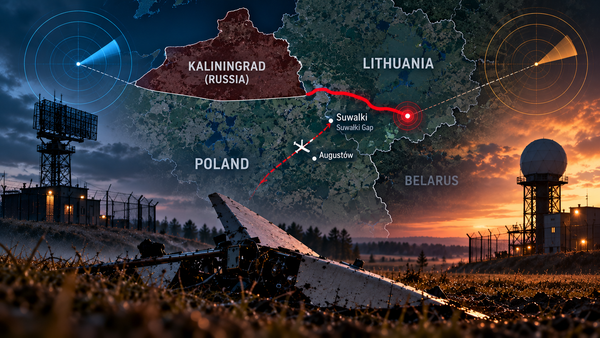
Lithuania says it has "well-founded data" that the drone which exploded in the north of the country crossed the Polish border. Poland's defence ministry said its radars did not record that, and a Polish broadcaster has cited ministry sources saying the drone was launched from Lithuanian territory…

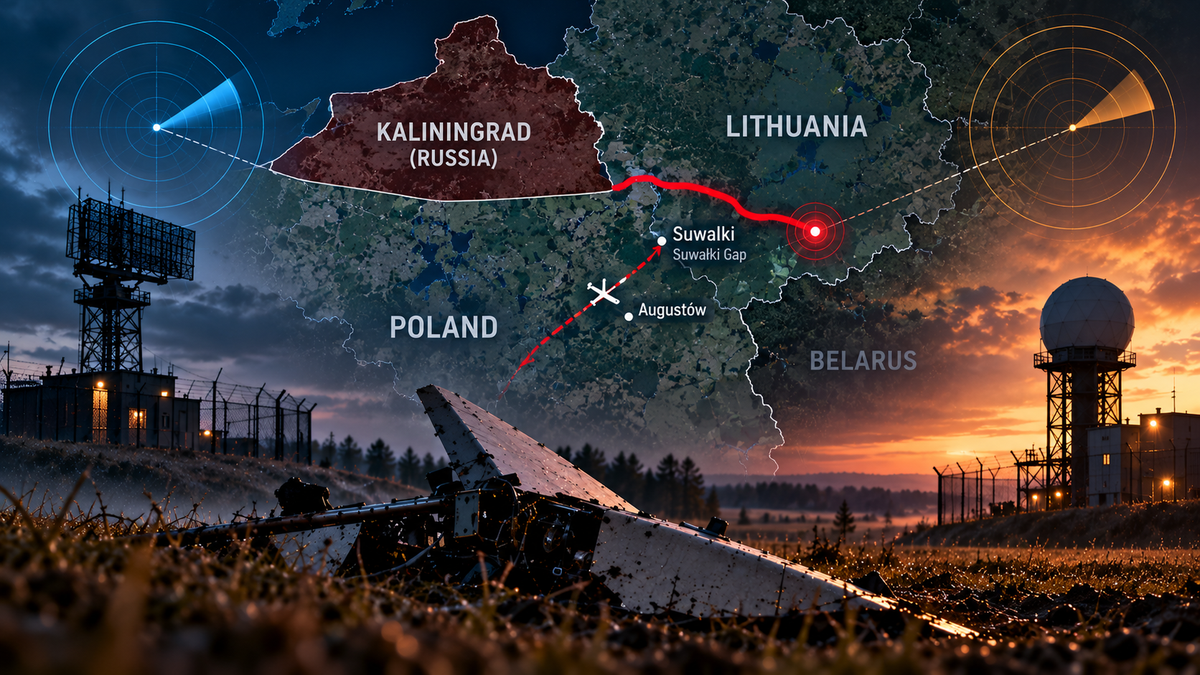
Lithuania says it has "well-founded data" that the drone which exploded in the north of the country crossed the Polish border. Poland's defence ministry said its radars did not record that, and a Polish broadcaster has cited ministry sources saying the drone was launched from Lithuanian territory. The identity of the drone is no longer the question. Its route is.
1. What is confirmed
The route dispute
- Presidential national-security adviser Deividas Matulionis told BNS on Monday 19 October: "I can say very unequivocally, we have well-founded data that the drone crossed the Polish border." The article gives no detail of the data (LRT, 19 Oct, in Lithuanian; translation mine).
- He was responding to a report by Polsat News, citing sources in the Polish defence ministry, that the drone was launched from Lithuanian territory about 30 km from the Polish border and never entered Polish airspace. This is how LRT describes the report; I did not see the Polsat original.
- On Sunday 18 October, Poland's defence ministry said its radars did not confirm that the object crossed the Polish–Lithuanian border and recorded no movement from Poland into Lithuania (via Interia, as relayed by UA.NEWS). That is an official Polish statement, unlike the Polsat claim.
- Later on 19 October, Prime Minister Mindaugas Sinkevičius said the drone was a Ukrainian-origin FPV that "likely" exploded in Lithuania and "no doubt" carried explosives, and that fighter jets saw it on radar but could not make visual contact in the weather (LRT, 19 Oct). His claims are statements, not a published forensic report.
The government's response
- Sinkevičius said that from Monday, vigilance at state-significant critical infrastructure is raised, with more personnel and attention. No numbers, facility lists or timetable have been given in what I read. The digest cites a Reuters report of the announcement at 13:15; Reuters was blocked for me and I could not confirm it.
- Police opened a pre-trial investigation into the attempted arson at Starlink equipment in Vilnius, a case of "damage to property in a generally dangerous way". No suspects are named or detained. The target was antennas and base equipment in Aukštieji Paneriai, on the premises of a company (LRT/ELTA, 19 Oct, in Lithuanian).
- The link to Poland and Bulgaria comes from Lithuania's Criminal Police Bureau, which calls it a possible connection to Russian hybrid operations. It is not presented as established. Police say the case has special priority.
Alongside: missile warnings
- Speaking in Uzbekistan on 19 October, Rubio said: "I don't know what happened last night", "a few nights ago, there was a software problem related to Ukraine's early-warning system", that US European Command is looking into it, and "there was no suspension" of intelligence sharing (UNN; Gwara Media). I read these secondary reports; the Reuters original was blocked.
- Gwara Media says an RFE/RL journalist, Alex Raufoglu, reported on X that the US did not warn Ukraine of the 19 October strike. Gwara does not say how he sourced it.
2. Confirmed versus outstanding
3. BSM analysis
Two radar pictures, one drone. Vilnius says the drone came across the Polish border; Warsaw's ministry says its radars did not see it. A third version, from unnamed ministry sources via Polsat, puts the launch inside Lithuania. These cannot all be right, and no one has shown the underlying tracks. Nothing in the sources I read says who might have launched a drone from Lithuanian soil, and I do not draw that conclusion. The point is narrower: two NATO allies are arguing about whose airspace a Ukrainian-origin drone with explosives crossed, a day after it fell. A joint radar reconstruction is the one document that would settle it.
A decision without content. The government's measure, raised vigilance, has no published numbers, facility list or timetable. The question that was on the agenda, additional powers to neutralise drones and changed warning procedures, has no reported answer. The defence minister had already ordered a review of why alerts came late.
The charge is smaller than the word "sabotage". Officials call the Vilnius arson sabotage, but the criminal case is for "damage to property in a generally dangerous way", an ordinary property offence. The qualification can change if suspects are found, but for now the legal record is more modest than the political language.
Intelligence sharing: the question shifted. Rubio does not say warnings were always delivered. He says there was no suspension and mentions a software problem with the early-warning system. That moves the question from "was it paused" to "what failed, and who is checking". It is also why the digest's link between Ihnat's statement and the overnight attack needs care: the Air Force statement is dated 14 October.
Per the digest, not re-verified by me
| Topic | What the digest says |
|---|---|
| Starshield | Restrictions unresolved; no verified technical restoration |
| Patriot | Reports of critically low stocks; no confirmed replenishment |
| Black Sea | Bulgaria's request to NATO; North Atlantic Council to discuss on 20 Oct |
| ZNPP | IAEA-brokered local ceasefire; repairs not confirmed |
| Saint Petersburg | No verified figures on sustained export disruption |
| Sailors | Seven Wine Trader sailors missing; HS Dignity crew unresolved |
| Moldova | No new forensic identification of the Scăieni drone |
| Lower-priority queue | Latvia's border counter-drone network, Estonia's PURL contribution, Lithuania's proposed permanent US base, the DF Peak and RAF Molesworth cases, Millerovo and Oryol, Borisoglebsk |
| Lithuania, classified information | A Vilnius resident detained on suspicion of unlawfully obtaining and passing on classified information; no foreign link established (digest: no material update) |
| Ukraine's energy system | Overnight strike damaged more than ten facilities; at least 550,000 households without power (Ukrainian figures); outside scope |
Conclusion
The identity of the Lithuanian drone is now settled in outline by the prime minister's account, though not by a forensic report. The route is in dispute between two allies, the government's response has no published content, and the arson case is, for now, a property offence.
Next checks: a joint Lithuanian–Polish radar reconstruction; a Polish ministry statement on the Polsat report; Lithuanian detail on infrastructure measures and any decision on counter-drone powers; arrests in the Vilnius arson and any evidence tying it to Poland or Bulgaria; the outcome of EUCOM's review of the early-warning fault; the North Atlantic Council session on 20 October.
Baltic Security Monitor (osint-baltic.com) — an analytical outlet on security on NATO's north-eastern flank.
All OSINT assessments are prepared by an automated open-source monitoring system.