The U.S. and Europe: June 2026 as a Strategic Crossroads

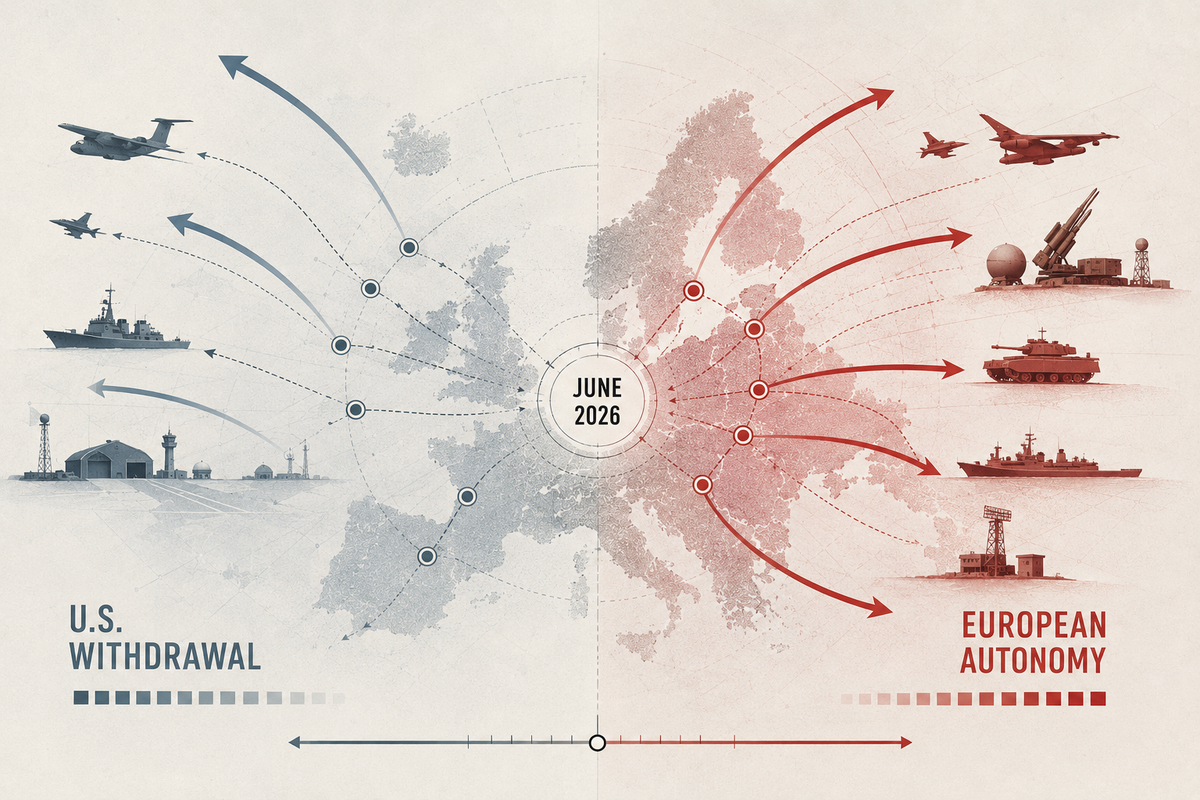
Analysis: American troop withdrawal is not negotiation — it is an announced program of structural reorientation
Structural Dynamics: The U.S. Prepares Formal Proposal
According to Reuters, the United States is preparing formal submission of proposals to NATO regarding accelerated withdrawal of American troops from bases across Europe.
What is known:
The Pentagon plans to present specific parameters during NATO's June 2026 force posture conference
This is not discussion — it is an announced program. The distinction is critical: negotiation implies possibility of compromise; announced program treats fact as the starting point.
Time Context:
The NATO June 2026 conference will be the point of official announcement. This gives allies limited time for reaction and adaptation.
Parallel Movement: $400 Million for Ukraine, But With Conditions
Simultaneously, the Pentagon unblocked $400 million in aid to Ukraine, withheld for months.
Why this matters as a signal:
The withholding indicates internal political fracture:
- Congress approved funding
- White House withheld disbursement
- External pressure (including Republican criticism) forced unblocking
Practical significance:
Allocation of $400 million does not guarantee actual use. Congress provided the financial pool, but final decision on distribution remains with the Secretary of Defense.
This means: money allocated, but execution depends on administration's political will.
Legislative Fracture: NDAA 2026 vs. National Security Strategy
The new NDAA 2026 revealed measurable distance between Congress and White House on European security issues.
Congress (NDAA 2026):
- Approved $400 million for Ukraine
- Included provisions supporting NATO
- Established mandatory funding levels for allies
White House (National Security Strategy):
- Preparing accelerated withdrawal
- Shifting emphasis to Indo-Pacific region
- Conditioning continued presence on European spending
Practical consequence:
Even the most NATO-friendly provisions of NDAA cannot convince the administration to refrain from implementing its own strategy.
American policy will likely be positioned between the politically significant (White House) but non-binding strategy and the legislatively binding (NDAA) but more moderate approach.
European Response: From Alarm to Calculations
The accelerating dissolution of presumed American security guarantees has placed NATO under unprecedented strain.
Measuring alarm:
Some European capitals view American withdrawal as potential complete abandonment of security guarantees.
This is reasonable alarm: a guarantee that can be recalled at any moment is not a guarantee. It is an option.
Diplomatic Reassessment:
Senior NATO diplomats view the forced transition not as an absolute blow but as an existential turning point.
Their position: if Europe builds military force proportional to its economic weight, overcomes industrial fragmentation, and assumes leadership in defense, this shift could generate a credible European military pillar that strengthens NATO.
If not — the gap between American expectations and European capabilities risks becoming the most dangerous failure point of the alliance.
Strategic Choices for Europe: Three Trajectories
Option 1: Passive Adaptation
Europe increases military funding, revises doctrine, and waits for a new American administration.
Risks: Time factor. If withdrawal executes quickly, adaptation time may be insufficient.
Option 2: Active Strategic Autonomy
Europe completely transitions to indigenous weapons, production, and defense doctrine, preparing for scenario where U.S. is partner but not guarantor.
Advantages: Long-term independence. Risks: Expensive and slow. Requires political unity that Europe often lacks.
Option 3: Diffuse Unpreparedness
Europe makes no radical changes, hoping American withdrawal will not be as rapid as announced.
Risks: Highest. If U.S. actually withdraws, Europe will be unprepared.
June 2026 as Breaking Point
Why June is critical:
- NATO conference with official American proposal
- Clear timeline for withdrawal (if proposed)
- Last moment when coordinated European response is still possible
After June, cards are revealed. Withdrawal begins (or is clearly scheduled), and Europe no longer has room for negotiation — only for adaptation.
Strategic Assessment: From Dependence to Autonomy
For 75 years, American presence in Europe has been guarantor of security and factor of stability, even when the alliance was strained.
This period is ending.
June 2026 will remain the date when:
- American guarantee became conditional
- Europe realized it must choose: either become strategically autonomous or risk alliance disintegration
- Troop withdrawal became not diplomatic proposal but real program
Consequence for NATO:
If Europe develops necessary capabilities and unity, NATO could emerge from this crisis stronger and more independent from the U.S.
If not — the alliance will exist in state of incapable defense, where each European member calculates for itself rather than collective security.
Date: June 2026 (NATO conference)
Source: Reuters, Pentagon, NDAA 2026, NATO diplomatic sources