OSINT Digest from June 1, 2026: Post-Exercise Spike — Drone Pressure After NATO Exercises

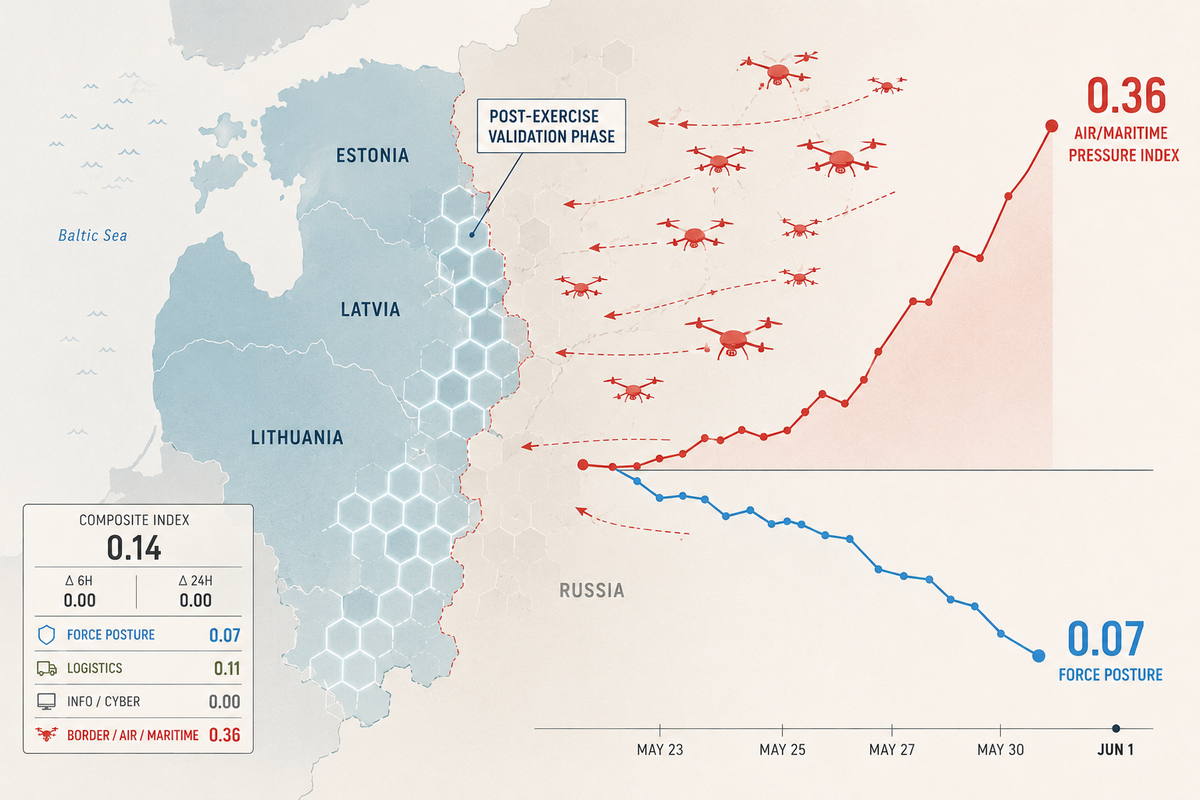
Breakdown: Border/Air/Maritime rises to 0.36 (highest reading in entire period), Force posture falls to 0.07 — signaling "readiness verification" by Russia following Project Flytrap 5.0 completion
Overall Assessment for the Day (Composite Index)
Composite: 0.14 | Delta 6h: 0.00 | Delta 24h: 0.00
The index has declined slightly from 0.16 to 0.14, yet this masks an important dynamic in component indices.
Force posture has fallen from 0.23 to 0.07 — Project Flytrap 5.0 exercises have concluded, system transitioning to routine mode.
Border/Air/Maritime has risen from 0.25 to 0.36 — the highest reading during the entire monitoring period.
This is neither good news nor bad news. This is verification.
Assessment Components
1. Military Posture (Force posture): 0.07
The drop from 0.23 to 0.07 indicates Project Flytrap 5.0 has officially concluded.
What this means:
- Exercises at Pabradė ended May 15, results now being analyzed and implemented
- French aviation flight has returned to standard Quick Reaction Alert mode
- System no longer in special exercises mode, but in baseline readiness mode
0.07 indicates systems are relaxed following exercises. This is normal. But Russia sees it.
2. Logistics (Logistics): 0.11
Has risen from 0.00 to 0.11 — new activity in the logistics domain.
What this means:
Project Flytrap 5.0 results revealed where new supplies are needed and where logistics routes need optimization.
New procurement requests — current requisitions from division commanders who identified gaps during Flytrap exercises.
Logistics nodes are being recalculated based on lessons from the exercises.
0.11 means NATO did not stop at exercises but began implementing results into the real system.
3. Information and Cyber (Info/Cyber): 0.00
Has fallen to zero, indicating media noise has decreased, with no heated discussions in the information space.
What this means:
After Project Flytrap 5.0, there are no new dramatic announcements.
Official information is being published and processed without dramatization.
This is normal mode.
4. Borders/Air/Maritime (Border/Air/Maritime): 0.36
Has risen from 0.25 to 0.36 — the highest reading in the entire monitoring period.
This is not a sudden spike. It is a progressive trend:
- May 23: 0.24
- May 25: 0.31
- May 26: 0.21
- May 27: 0.18
- May 30: 0.25
- June 1: 0.36
What this means:
Following Project Flytrap 5.0 completion, drone pressure from the Russian side has intensified. This is not coincidental. This is verification of NATO's new readiness.
The pattern of such action is classic:
- NATO conducts major exercises (Flytrap 5.0)
- NATO demonstrates new capabilities and operational methods
- Russia verifies how NATO responds to new conditions
0.36 indicates intense drone activity at borders. This is not panic. This is assessment of changes.
Top 5 Events Analyzed by the Digest
| # | Event | Source | Attention Index |
|---|---|---|---|
| 1 | NATO Military Committee in Chiefs of Defence Session | NATO | 0.44 |
| 2 | Allied troops test drone technologies (Project Flytrap 5.0) | NATO | 0.44 |
| 3 | French Rafales continue Baltic Air Policing | Allied Air Command | 0.41 |
| 4 | Joint NATO press conference | NATO | 0.38 |
| 5 | Military Committee in Chiefs of Defence Session (repeat) | NATO | 0.38 |
What 0.36 Means for the Northern Flank
This is not the first time Russia has tested NATO's new readiness.
Pre-2014: Russia regularly violated Estonian, Lithuanian, and Latvian airspace. NATO responded routinely.
2014 — Crimean Annexation: Suddenly this "routine" response proved insufficient. The system had to adapt.
2015-2020: NATO strengthened. Russian violations continued, but the system could now manage them better.
2020-2025: Drone component grew in importance. Traditional air defense partially adapted, partly did not address new scenario.
2026 — Now: System maturation. NATO demonstrated new capabilities (Flytrap 5.0). Russia tests whether they truly work under field conditions.
0.36 shows testing is underway. But this is controlled testing, not crisis.
Signals from Estonian Leadership
On June 1, Estonian Defense Minister Hanno Pevkur gave an interview to DW News about drone warfare and Baltic security, emphasizing:
- Drone component has already changed the character of regional defense
- Systems developed in Ukraine are now being applied on NATO flank
- Adaptation is happening rapidly but requires constant attention
This means Estonian leadership understands: Russia is not just launching drones; Russia is studying the new NATO.
Post-Exercise Spike: Why This Matters
In military theory, this is called "post-exercise validation" or "real-world verification":
- Exercise completed — systems demonstrated they can work together
- Systems relax — exercise provided personnel relief
- Opponent verifies — exploits this moment to check if real readiness has changed
This pattern is often seen in military practice: after major exercises, the opponent invariably increases activity to see how the new system responds under stress.
0.36 shows Russia is doing this. But it also shows NATO expected it and prepared for it.
Comparison: May 30 to June 1
| Metric | May 30 | June 1 | Change |
|---|---|---|---|
| Composite | 0.16 | 0.14 | ↓ -0.02 |
| Force posture | 0.23 | 0.07 | ↓ -0.16 (exercises complete) |
| Logistics | 0.00 | 0.11 | ↑ +0.11 (results implementation) |
| Info/Cyber | 0.07 | 0.00 | ↓ -0.07 (media calm) |
| Border/Air/Maritime | 0.25 | 0.36 | ↑ +0.11 (verification) |
Narrative: Project Flytrap 5.0 complete, now "real-world validation" underway from Russian side.
Conclusion: The Second Phase Has Begun
Throughout May, NATO progressed through three clearly defined phases:
- May 23-24: Response to drone pressure
- May 25-27: Logistics construction and integration
- May 28-30: Active testing of new systems (Project Flytrap 5.0)
- June 1 → onwards: Field verification — Russia tests whether new NATO readiness is real
0.36 indicates the second phase has begun. This is no longer exercises. This is real situation where Russia actively studies the new NATO.
But this does not mean NATO is unprepared. Conversely — NATO was prepared for this. Project Flytrap 5.0 concluded, logistics implementation has begun, and now you can observe how the system responds in real conditions.
For people at the border, this means: coming weeks will be about verification. Drone activity will be high because Russia will try to understand the new NATO. But systems are ready for this. Exercises concluded exactly in time.
OSINT Digest: June 1, 2026, 08:56:05 UTC
Released: June 1, 2026
Events Analyzed: 10
High-Confidence Events: 0
Errors in 24h: 0
Source: Baltic Security Monitor, configured to track security in NATO's northeastern region