Norway Seizes a Russian State Vessel in Svalbard: Naftogaz Moves From Court Ruling to Actual Asset Enforcement Against Russia

Baltic Security Monitor | Analytical Brief As of 4 September 2026, 20:00 EEST
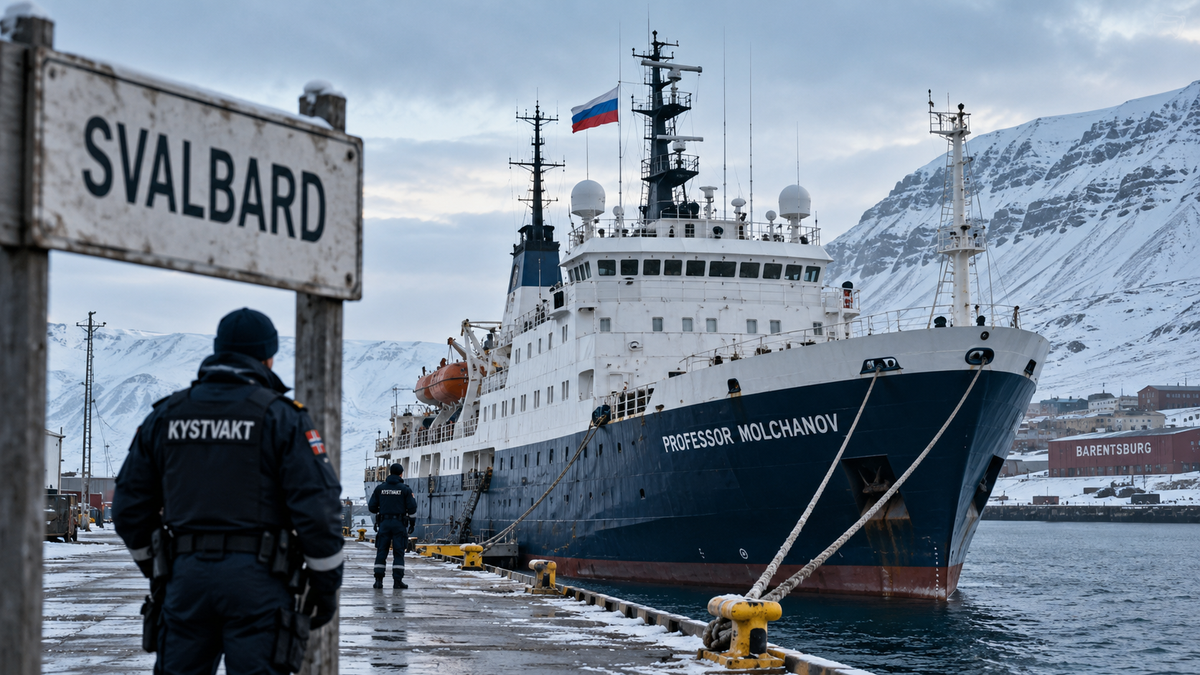
Norwegian authorities seized the Russian vessel Professor Molchanov at the port of Barentsburg on Svalbard following a 24-hour standoff with the Norwegian Coast Guard. The seizure took place on 2 September, based on an order from the Nord-Troms and Senja District Court issued on 31 August at the request of Ukraine's state-owned energy company, Naftogaz. The vessel is barred from leaving the port until further notice; Svalbard's governor is overseeing the welfare of passengers and crew together with the Russian state trust Arktikugol.
According to Naftogaz, the enforcement action stems from an April 2023 ruling by an arbitration tribunal in The Hague, which ordered Russia to pay the company $4.22 billion in compensation, plus interest and legal costs, over the unlawful expropriation of energy assets in Crimea following the 2014 annexation; company lawyers say the total, with interest, has now risen to roughly $6 billion. Naftogaz Acting CEO Sergii Fedorenko said: "Russia cannot evade responsibility simply by refusing to comply with an international arbitral award." Moscow reacted sharply: a Russian Foreign Ministry spokesperson called Norway's action "piracy," while Alexei Chekunkov, Russia's minister for the development of the Far East and Arctic, called it "another example of Western countries' legal nihilism and lawlessness." According to RT, President Putin personally described the seizure of a civilian vessel as "state terrorism" — a notably sharper escalation than the Foreign Ministry's initial statement. Norway's Justice Ministry emphasized that this is a dispute between Naftogaz and the Russian Federation, and that Russia can seek reconsideration by the Norwegian court.
The Professor Molchanov is Russian state property, officially a research vessel but effectively used for commercial cruises; since 2025 it has carried scientists, Arktikugol employees, contractors, family members, and supplies to Barentsburg and the other Russian settlement, Pyramiden. Ten round trips were planned for 2026. It is currently the only vessel providing direct passenger connection between mainland Russia and the archipelago, following the end of direct air links between Russia and Svalbard in 2020.
The notable part isn't the court ruling itself — the arbitral award in Naftogaz's favor has been known since 2023. What's new is that this is the first time the case has moved from legal recognition of the debt to physical execution: identifiable Russian state property is now actually detained on European soil, not merely "subject to" enforcement on paper.
BSM analysis: not the first Svalbard case, and not the only jurisdiction
This isn't Naftogaz's first attempt to enforce claims specifically on Svalbard: the company had previously secured seizure orders against two Trust Arktikugol properties on the archipelago, including a guest house, though Russia challenged those rulings in court. More broadly, according to Euronews, enforcement proceedings in the Crimea case are active in roughly ten jurisdictions, and Russian assets have already been physically seized — beyond Norway — in Finland and France. This is a systematic, multi-year campaign, not a one-off legal action.
At the same time, it's worth not overstating the immediate financial effect: the seizure itself does not transfer ownership or automatically generate compensation — further court proceedings would be needed before the vessel could be auctioned and proceeds transferred to Naftogaz, and Reuters reports its likely value represents only a small fraction of the overall $4.22 billion debt. This case also shouldn't be conflated with the separate debate over potentially confiscating roughly €200 billion in frozen Russian central-bank reserves — the legal basis and asset categories involved are different.
Why it matters for Ukraine and the Baltic region
For Ukraine, the significance lies less in the value of this particular ship and more in the precedent it sets: a European jurisdiction has allowed a Ukrainian claimant to use ordinary judicial enforcement mechanisms against identifiable Russian state property to satisfy losses from the occupation of Crimea. Naftogaz has pursued this case since 2016 and says it is also seeking Russian assets in the United States, France, Britain, and Finland — successful enforcement in Norway provides a practical template that could prove relevant to other Ukrainian state companies and claimants holding recognized arbitral awards.
The Nordic dimension of this case is unusually sensitive precisely because the seizure took place on Svalbard, where Russia maintains settlements and economic activity under the 1920 treaty regime. Moscow's diplomatic protest illustrates how an ostensibly civil asset-enforcement proceeding can become an additional source of friction between Norway and Russia in the High North — a region where BSM has already tracked other signs of growing tension between Russia and its northern neighbors.
Bottom line
Russia has already indicated it intends to challenge the Norwegian court's ruling. If subsequent proceedings allow an actual auction, the case would move from provisional attachment to monetization of Russian state property for Ukrainian compensation — a significantly stronger enforcement precedent. The next indicator to watch is exactly that: whether the case advances to an actual sale, and whether other Ukrainian claimants with recognized arbitral awards begin more actively invoking this Norwegian precedent in their own jurisdictions.
Baltic Security Monitor (osint-baltic.com) — an analytical publication covering security on NATO's north-eastern flank. All OSINT indices are calculated by an automated indexing system based on open sources.