Ukraine Discloses the Weapons Mix Behind the Moscow Strike: Flamingo, Palianytsia and Pelican in a Combined Long-Range Operation

Baltic Security Monitor | Analytical Briefing Digest: 20 September 2026, 20:00 (Europe/Tallinn)
This morning we knew only that something had hit Kapotnya. By evening, Zelensky had named ten systems in one list and five agencies in one sentence — among them a name that until now existed only in announcements: Pelican, the first combat use of a ballistic missile Fire Point had been promising since February. The gap between "something got through" and "here's exactly what and who" is today's material shift.
The lead event: official confirmation and the weapons list
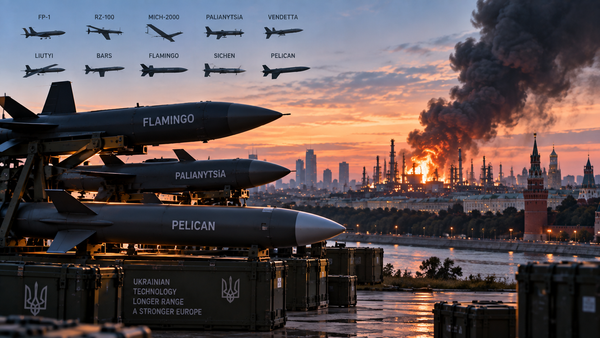
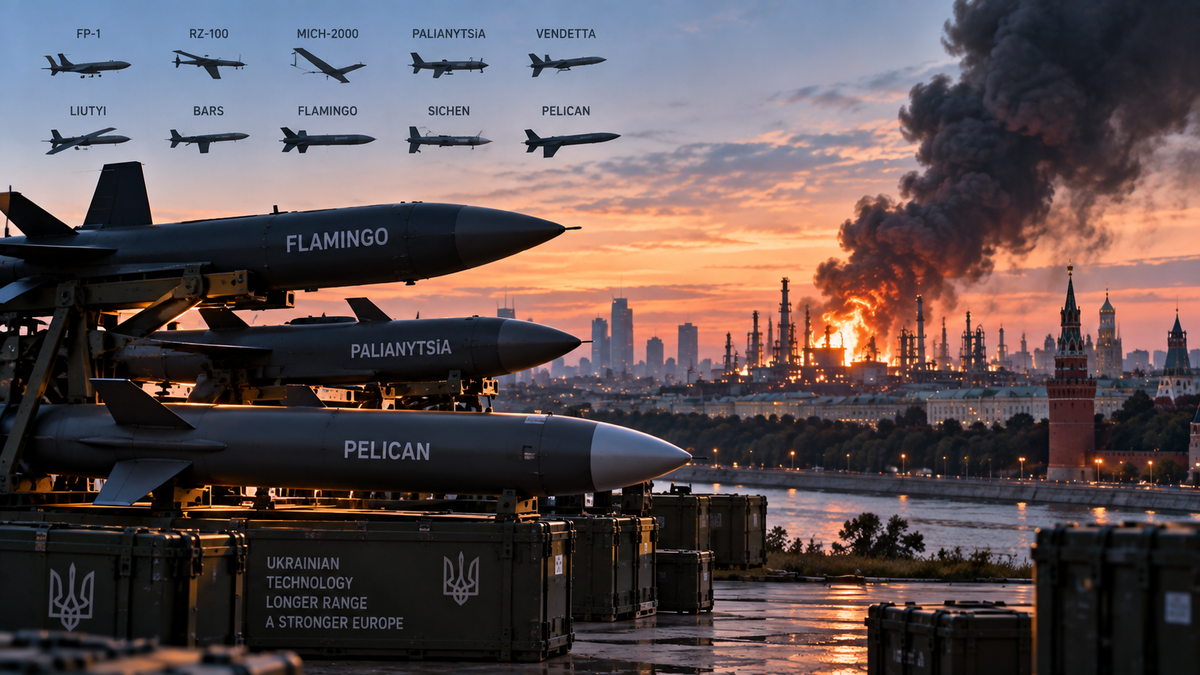
President Volodymyr Zelensky publicly confirmed that Ukrainian forces conducted the overnight long-range operation against the Moscow region and named the systems used: FP-1, RZ-100, MICH-2000, Palianytsia, Vendetta, Liutyi, Bars, Flamingo, Sichen and Pelican. He said one of Russia's key oil-industry facilities and a logistics site were hit, with the SBU, Unmanned Systems Forces, Special Operations Forces, Defence Intelligence and the Foreign Intelligence Service all taking part. AP independently reported Zelensky's acknowledgement and the use of domestically produced Flamingo and Pelican weapons.
BSM analysis: This is more significant than another casualty or damage update — it provides official attribution, the list of participating organisations, and identification of the weapon families used in an operation whose refinery damage was already established that morning. 🟡 The statement doesn't establish which specific weapon hit which target: specialist reporting links Pelican to the FP-7 ballistic-missile programme, but publicly available evidence doesn't yet independently confirm that Pelican struck the refinery, or that every named system reached its intended target.
Context: what Pelican is, and why this is a first
Open sources associate Pelican with FP-7, a ground-launched ballistic missile developed by Ukrainian company Fire Point: a declared payload of up to 150 kg, range up to 200 km, maximum speed of 1,500 m/s, flight altitude up to 65 km, and a claimed accuracy of 14 metres. Fire Point publicly showed early FP-7 tests back in February 2026; in June, Reuters reported tests of the FP-7.X variant, which the company treats as the basis for the future Freyja air- and missile-defence system — the same project Poland formally joined this week. As recently as August, Fire Point CEO Iryna Terekh said FP-7 was in final testing and certification, with first combat use expected by late September; as of mid-September, no public confirmation of combat use existed. The 20 September operation, if the identification holds, is that first instance.
Flamingo (FP-5) is a more familiar system by now: the cruise missile has previously been used against Russian defence-industrial targets, including a reported strike on the VNIIR-Progress plant in Cheboksary, roughly 1,000 km from Ukraine.
According to Ukraine's General Staff, the strike on the Moscow refinery itself damaged the AVT-6 primary processing unit, an integrated oil-refining unit and an isomerisation unit; long-range drones from the SBU's Alpha Special Operations Centre flew over 500 km and penetrated layered Russian air defences. Zelensky separately reported a hit on an industrial enterprise in Voronezh Oblast.
Why it matters for Ukraine and the Baltic region
The disclosure shows Ukraine's deep-strike architecture no longer rests on a single drone family. The Moscow operation combined several domestically produced systems and coordinated five military and intelligence organisations at once. A heterogeneous weapons package complicates the defence of strategic infrastructure, since detection and interception must simultaneously account for targets with different flight profiles and performance characteristics — and the fact that the operation still reached targets in the Moscow region despite the capital's dense air-defence network underlines the operational significance of that mix.
For NATO's eastern flank, Ukraine's experience cuts both ways: as a model of distributed long-range strike architecture, and as a preview of the problem of defending against increasingly heterogeneous drone-and-missile packages that Poland and the Baltic states will eventually have to manage themselves. It's worth noting that Fire Point is already pitching its Pelican/FP-7.X variant as the technological basis for Freyja — the joint Ukrainian-European air-defence project that formally expanded to include Poland this same week.
Bottom line
The most important developments to watch next: independently verified identification of which weapon actually struck the Moscow refinery; confirmation that Pelican does represent operational use of the FP-7 ballistic missile; production or fielding figures for the newer systems; or a confirmed extended shutdown and throughput loss at the refinery. 🟡 Whether the Moscow operation shows repeatable, mass employment of the newest missile systems cannot yet be established from public evidence.
Baltic Security Monitor (osint-baltic.com) — an analytical publication on security along NATO's north-eastern flank. Prepared from open sources (Ukrainska Pravda, AP, ANSA, Reuters, Kyiv Post, dev.ua, Euromaidan Press, Army Recognition) and an automated monitoring system.