“No Date, No Plan, No Perpetrator”: Threat Indices Continue to Ease Amid Diverging Signals

Baltic Security Monitor | Analytical BriefSnapshot: 2026-07-23T07:59:47.220Z
Executive Summary
The 23 July snapshot reinforces the pattern first observed two days earlier: no high-confidence events, zero quarantined items, zero source failures, and a Top 5 list still dominated by institutional rather than operational developments. The Composite Threat Index declined for the second consecutive reporting cycle.
At the same time, publicly available assessments of the threat remain mixed. On 15 July, the Presidents of Lithuania and Latvia warned that Russia could be preparing attacks against critical infrastructure in the Baltic states or Poland. By contrast, the most detailed publicly available comments from security officials—published earlier—contained no information indicating a specific date, an approved operational plan, or an identified perpetrator. Chronologically, these assessments do not directly respond to one another.
Key Signal: No Public Confirmation of a “Concrete Plan”
On 15 July, the Presidents of Lithuania and Latvia publicly warned that Russia might be preparing attacks against critical infrastructure in the Baltic states or Poland.
The most detailed publicly available account of the position held by security officials appears in Holger Roonemaa’s Baltic Flank investigation (published by Delfi on 7 July and subsequently covered by ERR the same day and LRT on 11 July).
An important chronological clarification is required: these comments were published before the presidential statements of 15 July. They therefore cannot be interpreted as either a response to—or a rebuttal of—the later political assessments. No publicly available updates from the relevant authorities issued after 15 July were identified during this review.
All three quotations remain anonymous, with only the officials’ areas of responsibility disclosed:
- An Estonian security policy official (Delfi, 7 July): “I have received no information indicating that a political decision has been taken to actually carry out such a provocation.”
- A Baltic intelligence source (Delfi, 7 July): “At present, there is no known date, no concrete plan, and no identified organiser of such a provocation.”
- A Latvian foreign and security policy official (Delfi, 7 July): “We see no signs of an imminent military provocation. We do not observe changes in Russia’s military presence or preparations directed against the Baltic states.”
Taken together, these sources indicated that, at the time of publication, they had no information pointing to a specific date, an approved operational plan, or an identified organiser of a potential provocation, nor did they observe signs of an imminent conventional military attack.
However, this should not be interpreted as disproving the later political warnings. Based on currently available open sources, it is simply impossible to determine how official assessments evolved after 15 July. 🟡
Meanwhile, practical border-security cooperation continues. According to The Baltic Times, Estonian Interior Minister Igor Taro inspected Latvia’s border security infrastructure during a two-day visit, described the situation along Latvia’s borders with Russia and Belarus as more challenging than Estonia’s, and discussed further bilateral cooperation on border security.
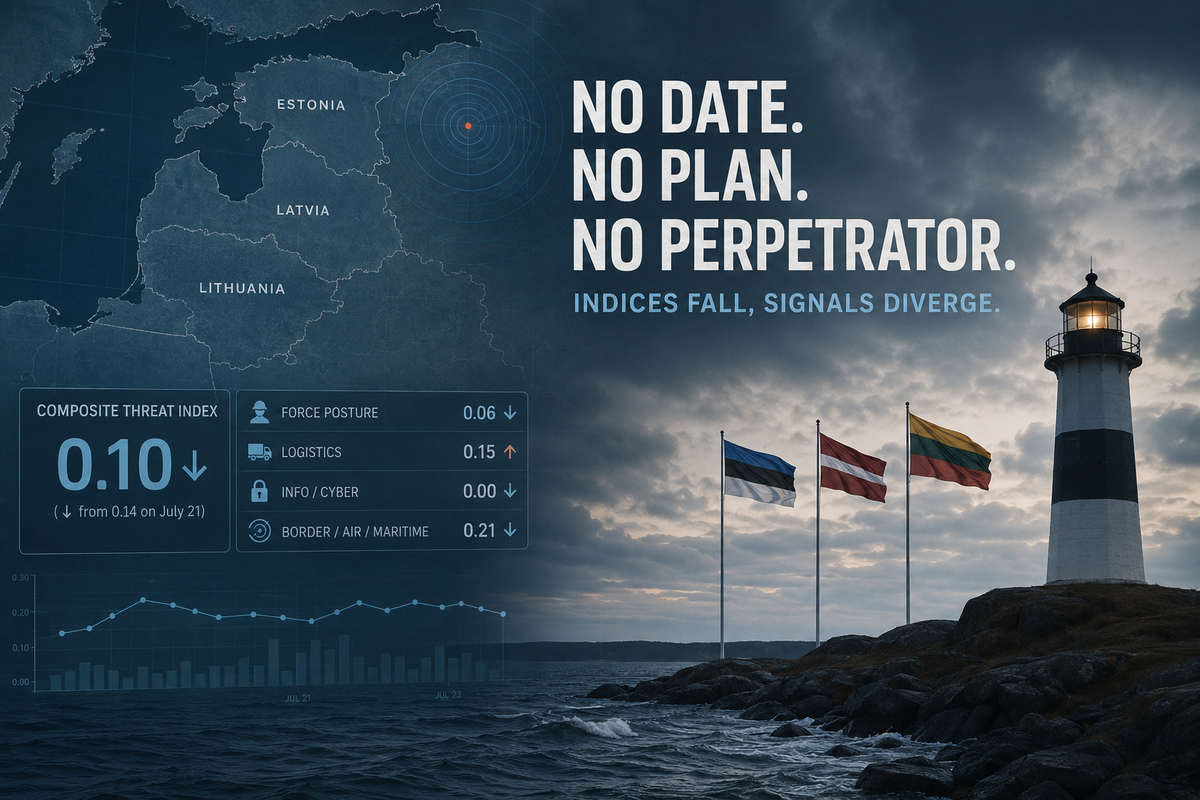
Comparing these developments with the index dynamics—Force Posture falling by half and Border/Air/Maritime also declining while remaining the highest sub-index—does not establish a causal relationship. It only indicates that the decline in most indicators coincided with the absence of new confirmed operational signals in publicly available reporting. 🟡
New Entries in the Top 5
🟣 NATO Strengthens Civil-Military Cooperation at CIMIC 2026 in Naples
OSINT score: 0.23 — WATCH (new entry, atypical category)
The 19th CIMIC Units Commanders Conference (CUCC) brought together more than 100 participants from 25 countries in Naples to discuss the use of artificial intelligence and civil-environment analysis in military decision-making. According to JFC Naples, the conference had already concluded before the date of this digest.
Its appearance in the index on 23 July may indicate delayed ingestion of institutional NATO content. Without internal event-level attribution, however, this remains a working hypothesis rather than an established finding. 🟡
Sub-index Interpretation
The increase in the Logistics sub-index (0.06 → 0.15) may be linked to the concluding phase of Neptune Strike 26-3, during which the UK Carrier Strike Group led by HMS Prince of Wales operated alongside the Spanish Amphibious Task Group centred on Castilla. Rotations, refuelling operations and force redeployments associated with the end of the exercise may have been classified by the system as logistics-related activity. Without a decomposition of individual event contributions, however, this explanation remains a working hypothesis. 🟡
The Info/Cyber sub-index reaching 0.00—its first zero reading in this series—has no obvious explanation in the reviewed source material. It may reflect a genuine absence of relevant events, characteristics of source coverage, or properties of the classification algorithm itself. Without additional technical evidence, broader conclusions would be premature. 🟡
Conclusion
The 23 July snapshot confirms the trend observed on 21 July rather than introducing a new operational development. The Composite Threat Index continued to decline, the highest-ranked events remained overwhelmingly institutional, and the Border/Air/Maritime sub-index weakened despite retaining the highest value among all categories.
At the same time, publicly available sources do not allow a definitive assessment of how the presidential warnings issued on 15 July relate to the earlier comments made by anonymous security officials. Those officials reported no information indicating a specific date, operational plan or identified organiser of a potential provocation, but their remarks predated the political statements and therefore cannot be treated as either confirming or refuting them.
Overall, the quantitative indicators continue to suggest a relatively calm regional picture, while the assessment of Russian intent remains subject to significant uncertainty in the open-source domain. 🟡