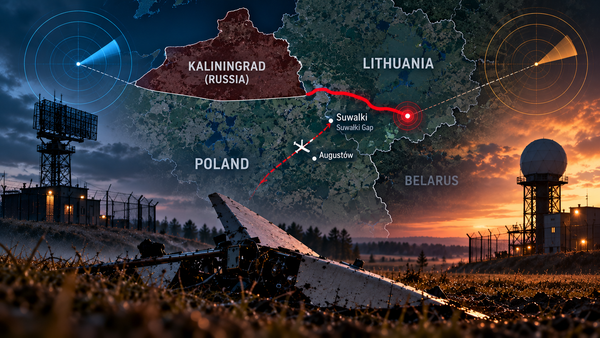
Starlink Arson Reaches Lithuania: A Pattern Is Suspected, Not Proven
Lithuanian officials say unknown people tried to set fire to a SpaceX Starlink site near Vilnius at about 02:00 on Sunday. The fire was put out quickly, with minor property damage and no disruption to operations (Reuters). The head of the national crisis centre calls it sabotage and links it to…

Baltic Security Monitor | Material OSINT Update
Snapshot: 18 October 2026, 20:00 (Europe/Tallinn). Late capture: the event was overnight and reported earlier in the day.
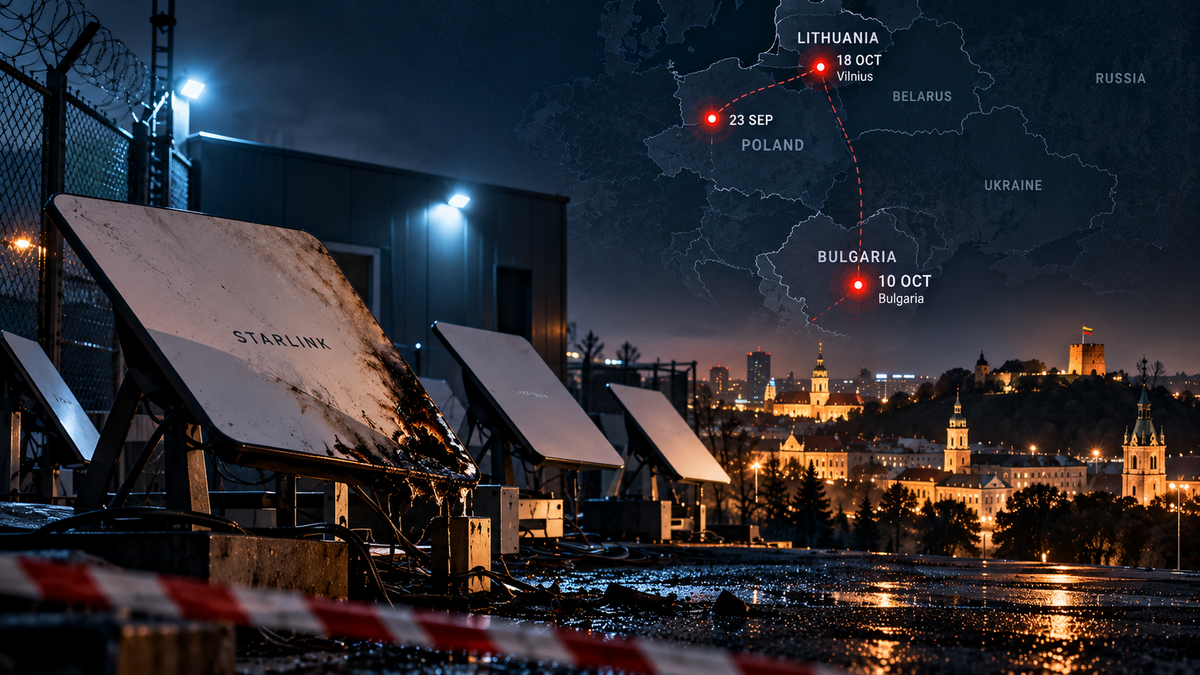
Lithuanian officials say unknown people tried to set fire to a SpaceX Starlink site near Vilnius at about 02:00 on Sunday. The fire was put out quickly, with minor property damage and no disruption to operations (Reuters). The head of the national crisis centre calls it sabotage and links it to arson at Starlink sites in Poland and Bulgaria; the prime minister says Russia likely ordered it. No suspects have been named. The link between the three attacks is an official assessment, not a proven finding.
Update status
| Indicator | Value |
|---|---|
| Cycle assessment | MATERIAL UPDATE — HIGH (late capture) |
| Category | Hybrid sabotage / critical communications infrastructure |
| Event | About 02:00 on 18 October 2026 (Reuters) |
| Uncertainty markers | 🟡 4 in the table below · 🔴 0 |
| Delta type | Third NATO country with a reported Starlink arson |
1. What is confirmed
- The attempt and its result. Reuters: an arson attempt at a SpaceX Starlink base station on the outskirts of Vilnius, at about 2 a.m. on Sunday (2300 GMT Saturday). The blaze was quickly put out, causing "minor property damage" and no disruption to operations. Vilmantas Vitkauskas, head of the National Crisis Management Centre, said: "We understand that this was not a routine arson attack but an act of sabotage."
- What the site is. LRT quotes Vitkauskas: SpaceX leases premises from a Lithuanian company, and the site is "working infrastructure, an integral part of the whole Starlink network". He said the attempt was "fairly successfully" prevented and the fire contained, called it a "unique case", and said the company had been contacted a day or two earlier with a warning. BNS reports that a pre-trial investigation has been opened.
- Method. Kyiv Independent: the attackers tried to set fire to satellite antennas and a control unit, and failed; investigators found incendiary liquids in containers of 3 to 10 litres.
- The prime minister. Per Kyiv Independent, Mindaugas Sinkevičius said the services had warned the company and security was raised, called the incident part of Russia's hybrid warfare and said it is likely clear that "the Russian side" ordered it. He will convene the National Security Commission on 19 October.
- Other countries. Reuters: Bulgarian authorities reportedly said fire was set to several Starlink antennas on 10 October (local media); a September fire at a Polish Starlink facility damaged its power system and backup generator, and Poland blamed Russia and detained four suspects. Moscow calls the accusations baseless and "anti-Russian hysteria".
2. Confirmed versus outstanding
| Claim | Status |
|---|---|
| An arson attempt at a Starlink site in Vilnius; quickly extinguished; minor damage | ✅ Reuters; Vitkauskas (LRT) |
| No disruption to operations | ✅ Reuters |
| The company had been warned beforehand | ✅ Prime minister (Kyiv Independent); Vitkauskas (LRT) |
| The site is in Aukštieji Paneriai | 🟡 That is the digest's wording. LRT, citing BNS, puts it on the territory of the Delska data centre; Reuters says only "outskirts of Vilnius" |
| It is linked to the Polish and Bulgarian incidents | 🟡 An official assessment. Same target and method, but no shared perpetrator or organiser shown |
| Russia ordered it | 🟡 The prime minister says "likely"; Moscow denies; no evidence shown |
| Who did it | 🟡 Suspects are being sought; none named or detained |
3. BSM analysis
A failed attack on a working node. The effect so far is nil: minor damage, no outage. The more interesting fact is the earlier warning. Someone expected this, and the company was told in advance. What prompted that warning has not been said.
Pattern is not organisation. Poland on 23 September, Bulgaria on 10 October, Lithuania on 18 October: three NATO states, one type of target, one method. That makes coordination a reasonable hypothesis and the officials are entitled to hold it. It is still a hypothesis. In Poland, the agency investigating has named no organiser, and its minister's "no doubt" about Russian intelligence was given without evidence (see our 17 October article). Reuters says four suspects are detained in Poland; our earlier count there was two charged and one separate scouting suspect, so I give "four" as Reuters' figure only.
The target is Ukraine's communications. Lithuania frames the attack as aimed at Ukraine's military capacity. That is its reading of the motive, and a plausible one, since Starlink is used heavily by Ukrainian forces. Whether this site mattered for Ukraine in particular is not shown.
For the Baltic states. The practical lesson is physical security of commercial sites that host satellite equipment, often on leased premises inside data centres. How the Polish attackers were found and recruited (messaging apps) is documented in the Polish case. Nothing shows the same was true here.
Per the digest, not re-verified by me
| Case | Status in the digest |
|---|---|
| NATO response to Bulgaria and Romania | North Atlantic Council to discuss the Black Sea on 20 October |
| Romania: two drones downed on 17 October | The defence minister reportedly named them as Geran-4; Kyiv Independent says jet-powered Geran, which Romania's ministry called Shahed-type |
| Zaporizhzhia NPP repairs | Plant representatives say about one week; the IAEA has not confirmed |
| Patriot interceptors, Starshield, Saint Petersburg oil damage | No new verified information |
| Black Sea sailors: Wine Trader (seven), HS Dignity | Outcome not established |
Conclusion
Established: an arson attempt at a working Starlink site in Vilnius, quickly extinguished, with no outage and a prior warning to the company. Not established: who did it, who ordered it, and whether it belongs to a campaign that also hit Poland and Bulgaria.
Next checks: the outcome of Lithuania's National Security Commission on 19 October (I found no report yet); named suspects; whether Lithuania, Poland and Bulgaria share evidence; the site's exact location.
Left out of this article: Zelensky's talks with Witkoff and Kushner, Hungary's grain-transit position and the 76 attacks on Ukraine's energy sites. The digest sees no new decision in them.
Baltic Security Monitor (osint-baltic.com) — an analytical outlet on security on NATO's north-eastern flank.
All OSINT assessments are prepared by an automated open-source monitoring system.