From Order Book to Firing Range: Germany Tests Loitering Munitions in Lithuania
The German Army has run its first tactical tests of loitering munitions, and it chose a Lithuanian range rather than a German one to do it. Earlier the same week, troops trialled AI software that fuses sensor data. Tools shaped by the war in Ukraine are now being built into the brigade that will…

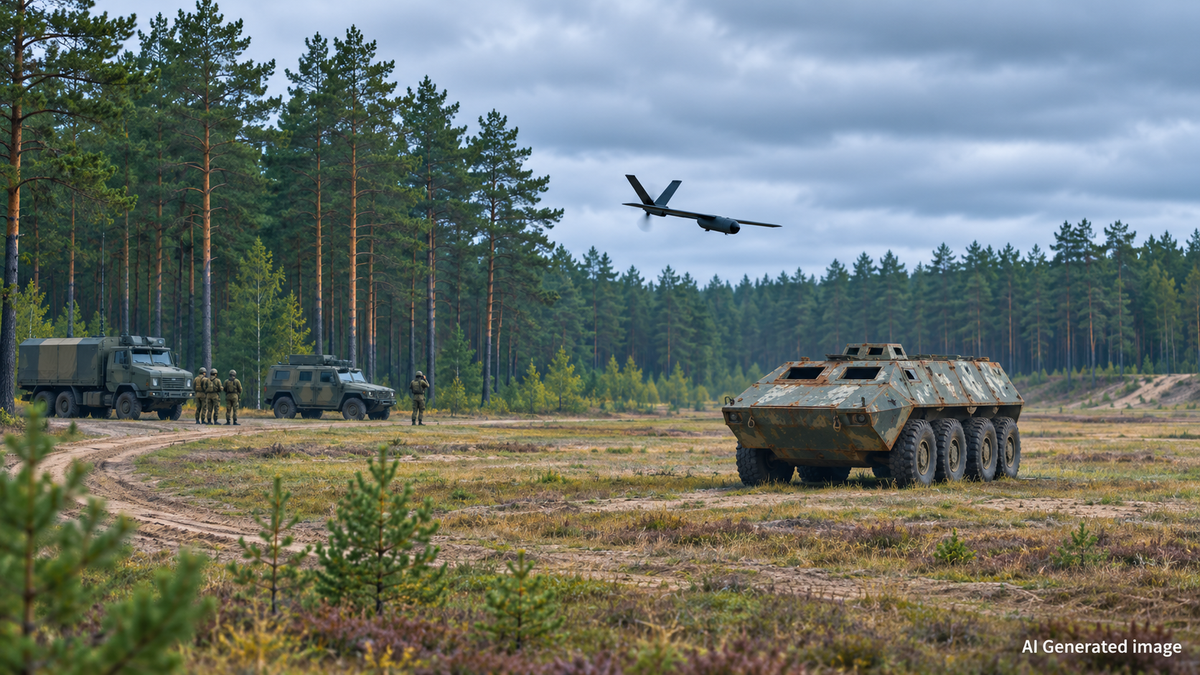
The German Army has run its first tactical tests of loitering munitions, and it chose a Lithuanian range rather than a German one to do it. Earlier the same week, troops trialled AI software that fuses sensor data. Tools shaped by the war in Ukraine are now being built into the brigade that will stand permanently on NATO's northeastern flank.
Baltic Security Monitor | Material Update · Security Watch cycle: 22 November 2026, 20:00 EET
Assessment
Classification: MATERIAL UPDATE, materiality MODERATE, category operational testing and defence technology. Event date 22 November; the software tests took place earlier that week. Source: Reuters on-site reporting. 🟡 Outstanding: operational adoption, procurement quantities, fielding timeline.
Berlin decided to buy loitering munitions in 2025. This week they hit targets in a tactical scenario for the first time. The distance between a procurement decision and a strike on the range is the distance between a political signal and an actual capability. Taking that first step in Lithuania, not at home, sends a message of its own.
The facts
On 22 November, during the Freedom Shield exercise at the Rudninkai training area in Lithuania, the German Army carried out its first tactical tests of loitering munitions. Reuters reported that systems from Helsing and Stark, fitted with inert warheads, struck tank targets. German Army chief Christian Freuding observed the trials.
Earlier in the week, troops tested Helsing's Clarity, AI-based software that processes data from multiple sensors and recommends courses of action. The trials took place where Germany is building a permanent presence: Panzerbrigade 45 is due to reach roughly 5,000 personnel by the end of 2027, and Reuters reported about 1,800 are already in Lithuania.
None of this amounts to operational adoption, combat deployment or a completed purchase of specific quantities.
BSM analysis. Loitering munitions and AI-assisted targeting are the two technologies the war in Ukraine turned from experiments into battlefield basics. The Bundeswehr is now carrying that lesson into the brigade tasked with defending Lithuania. For the Baltic states, the future German presence will be different in kind, not just in size, with its own long-range eyes and the ability to kill armour at distance without calling in artillery. At the same time, software that recommends actions raises questions about human control over the use of force that Berlin has not yet answered in public.
What to watch
Evaluation, procurement and integration into units may follow. 🟡 Test results, acceptance criteria and a fielding schedule have not been independently established. Verification priorities:
- the Bundeswehr's official findings from the trials;
- procurement decisions and quantities for Helsing and Stark systems;
- the equipment timeline for Panzerbrigade 45.
Bottom line
Lithuania is becoming more than the place where a German brigade is based. It is where the Bundeswehr is working out what that brigade will be. The 2025 order has become the first hits of 2026. The next step is from hits on a range to lines in an order of battle.
Baltic Security Monitor (osint-baltic.com) — an analytical publication on security across NATO's northeastern flank.
Prepared from the Security Watch monitoring cycle using open sources.