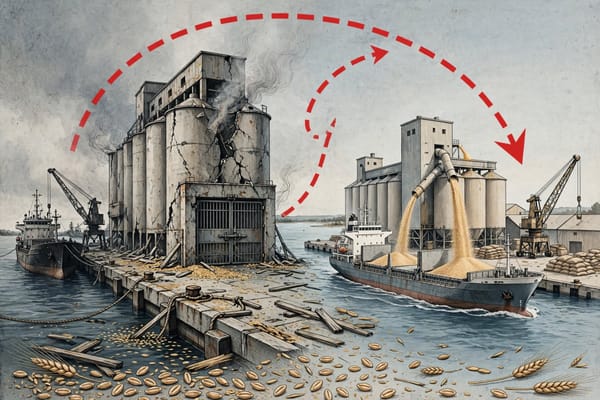
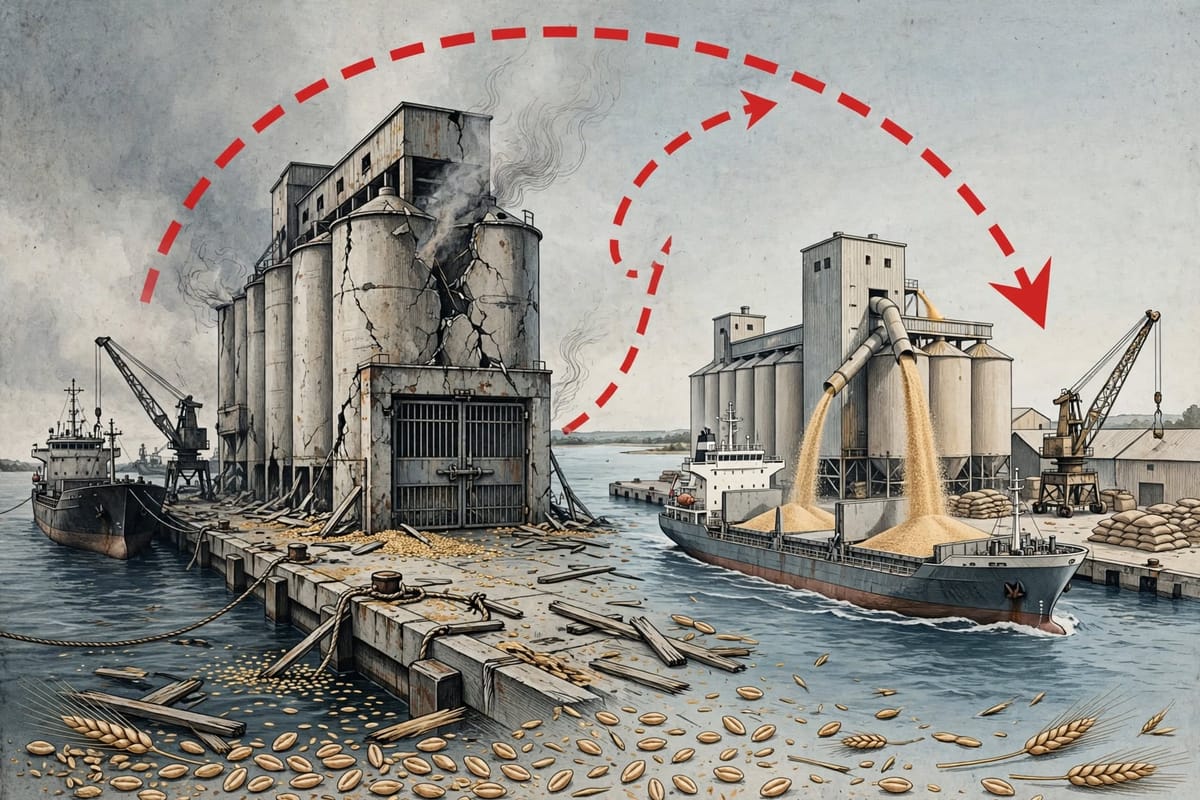
Black Sea Port Strikes Push Russia to Reroute Grain Exports Through the Baltic: Latvia May Gain a New Transit Flow

Baltic Security Monitor | Analytical Brief As of 31 August 2026, 20:00 EEST
Reuters reported on 31 August that Russian grain exporters are actively rerouting shipments toward the Baltic Sea, including ports in the Baltic states, after Ukrainian drone attacks disrupted maritime operations in the Black Sea and the Sea of Azov. According to the report, requests for rail shipments to Russia's own Baltic ports reached roughly 5 million tons by 18 August — mostly for August–September delivery — compared with about 6 million tons for the Black Sea ports of Novorossiysk and Tuapse. For scale: in the previous export season (July 2025–June 2026), Russia shipped 46.3 million tons of grain through Azov and Black Sea ports, accounting for 90% of total seaborne grain exports, while its own Baltic ports handled only around 1 million tons.
This confirms an already-documented physical collapse in the southern export system: Fastmarkets estimated that more than 95% of Azov-Black Sea grain-export capacity was offline as of 13 August, with navigation suspended in the Azov region and major Novorossiysk terminals halted following Ukrainian strikes. The damaged NKHP terminal at Novorossiysk could take up to four months to repair, Reuters reported on 26 August.
The point is not that a Baltic alternative was under discussion — that was already known. What's new is that Reuters now documents actual redirection of flows, not just contingency planning: requests for Baltic routing are already measured in millions of tons, and Latvia is expected to absorb part of that transit. At the same time, Russia's alternative routes combined — all other ports and land routes — can handle only about half the volume normally moved through the Black Sea and Azov.
BSM analysis: two distinct Baltic effects
It's worth separating two parallel trends that are easy to conflate. The first is the actual rerouting of Russian grain in transit through Baltic ports, mainly via Latvia: despite strained relations between Russia and its Baltic neighbors, that transit never fully stopped, though it fell to about 1 million tons last season from 2.5 million two years earlier. Arkady Zlochevskiy, head of the Russian Grain Union, told Reuters that exports through the Baltic states could rise substantially this season. The second trend is not transit at all but the Baltic states' own exports: about 1 million tons of wheat has already been booked for shipment from ports in Latvia, Lithuania and Estonia in August — up roughly 50% year-on-year, following a threefold jump in July bookings. Traditional buyers of Russian wheat — Turkey, the UAE, Sudan — are increasingly turning to Baltic-origin grain instead.
The gap between planned volumes and real throughput persists. Total Russian grain exports for August could fall to 1.8–2.5 million tons, according to SovEcon, Rusagrotrans and the Russian Grain Union — less than half last year's level and potentially the lowest August total in a decade. Rerouting to the Baltic adds roughly $40–50 per ton in logistics costs: wheat at the Baltic port of Vysotsk is priced at $250–260 per ton FOB versus about $212 at Black Sea ports — a gap that measures the real cost of adaptation, not just its feasibility.
Why it matters for Ukraine and the Baltic region
For Ukraine, the shift is evidence that strikes on Russian maritime infrastructure are producing system-level logistics effects rather than damage confined to individual terminals. Grain itself is not military cargo, but forced rerouting raises transport costs, shifts rail demand, redistributes insurance exposure, and increases the strategic weight of whichever Russian ports remain accessible.
For Latvia — and potentially Estonia — the relevance is direct. Reuters reports that Baltic-state ports may see rising transit of Russian-origin grain, mainly through Latvia. That creates a new intersection between commercial transit, sanctions policy, port security, and the region's broader effort to reduce economic dependence on Russia. At the same time, the shift raises the relative importance of Russia's own Baltic terminals, including Ust-Luga: grain operations there have continued following an 14 August attack, but market participants increasingly worry that further incidents could prompt shipowners and insurers to impose restrictions — meaning the risk is spreading into the Baltic, not staying confined to the south.
Bottom line
The next indicator to watch is not the rerouting itself — that is already documented — but how much of the booked volume actually converts into physical September deliveries, and whether Latvian and Estonian transport authorities release official transit figures that confirm or undercut the reported millions of tons. If Russia's southern capacity does not recover in the coming months — repairs at the NKHP terminal alone are estimated at up to four months — the Baltic route risks shifting from a temporary workaround into a permanent feature of Russian export logistics, with all the security and political-oversight questions that raises for the Baltic states.
Baltic Security Monitor (osint-baltic.com) — an analytical publication covering security on NATO's north-eastern flank. All OSINT indices are calculated by an automated indexing system based on open sources.