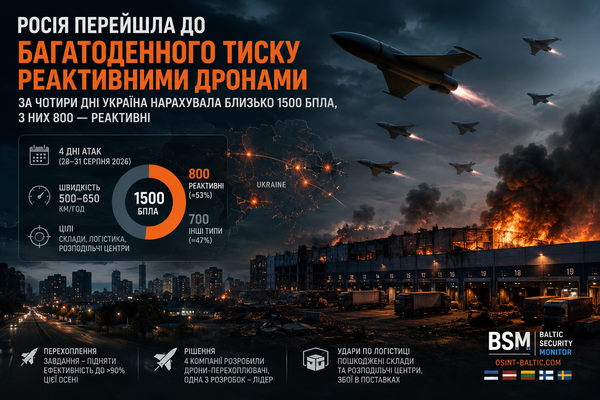
Russia Shifts to Multi-Day Jet-Drone Pressure: Ukraine Counts Nearly 1,500 UAVs in Four Days, 800 of Them Jet-Powered

Baltic Security Monitor | Analytical Brief As of 31 August 2026, 14:00 EEST
Russian drone attacks on Kyiv and the surrounding region entered a fifth consecutive day on 31 August, producing near-continuous air-raid alerts, repeated disruption to transport, and further strikes on warehouses and commercial infrastructure. President Volodymyr Zelenskyy said Russia launched nearly 1,500 drones of all types over four days — Thursday through Sunday — around 800 of them jet-powered. That is an official Ukrainian count rather than an independently audited figure, but the campaign's duration, the growing share of jet-powered drones, and their operational effects are independently documented by Reuters and AP.
Zelenskyy said the hardest category to intercept remains the jet-powered variants, with combat aircraft currently carrying most of that burden while four Ukrainian companies have developed dedicated interceptor drones, one of which is showing the strongest results so far. He set a target of raising the interception rate above 90% this autumn. Reuters reported major damage to food-distribution, courier, and warehouse networks, while AP documented temporarily empty supermarket shelves in parts of Kyiv following repeated strikes on distribution centers. Overnight into 31 August, strikes on warehouses in Brovary and Boryspil wounded at least four people, according to Kyiv Oblast military administration head Tymur Tkachenko. Ukrainian officials frame this as supply-chain reorganization rather than a nationwide food shortage; Zelenskyy adviser Serhii Beskrestnov urged the public not to give in to panic, adding that European countries stand ready to cover any shortfall.
Myla update. The death toll from the Myla ammunition-depot strike, which BSM covered on 29 August, has risen to 52, Zelenskyy confirmed today, 30 August. The investigation into the circumstances of the tragedy continues.
The notable part isn't the scale of any single raid — Russia has run large drone barrages before. What's new is that these attacks have merged into a sustained multi-day pressure campaign, with jet-powered systems accounting for roughly half of the four-day total — a category that is structurally harder to intercept than the classic Shahed. That shifts the problem from episodic saturation to a prolonged adaptation contest between fighter jets, dedicated interceptor drones, and industrial-scale counter-UAS production.
BSM analysis: from saturation to an endurance contest
The jet-powered Shahed/Geran variants (Geran-3/4/5) were developed as a direct response to Ukraine's success against the propeller-driven originals: combined Ukrainian air defenses had pushed interception rates for Geran-2/Shahed-136 to 80–93% depending on raid size, and that success is what pushed Moscow to accelerate the drones. Geran-3 and Geran-4 reach speeds of 500–650 km/h — roughly four times faster than the piston-driven Shahed-136 — and an interceptor drone needs to be roughly 25% faster than its target to reliably catch it. According to Ukraine's military command, Russia used around 1,400 jet-powered drones from the start of the year through mid-June, against just 180 in all of the previous year, and Commander-in-Chief Oleksandr Syrskyi has warned their share could reach 50% of all strike UAVs.
What's different this week is that the saturation is no longer a single spike but has stretched across five consecutive days. That wears down air-defense crews, increases the required number of combat sorties, and imposes continuous pressure on transport, logistics, and civilian life regardless of whether any individual raid is successfully intercepted. At the same time, strikes are deliberately shifting toward economic infrastructure — warehouses, distribution centers, and courier logistics — which is what produced the empty-shelf effect in parts of Kyiv.
Why it matters for Ukraine and the Baltic region
For Ukraine, the combination of mass and duration appears designed to exhaust not just air-defense assets but personnel and logistics reserves simultaneously. Faster jet-powered drones shrink the interception window and force the use of more expensive or scarcer defensive assets until dedicated interceptors are fielded at sufficient scale.
For the Baltic region, the relevance is direct. Finland, Sweden, and the Baltic states are already adapting their low-altitude surveillance and counter-UAS posture because of spillover from the war — including stray Ukrainian drones that have repeatedly entered their airspace during strikes on Russian Baltic Sea targets. A shift toward faster, longer-range jet-powered systems raises the value of cross-border track-sharing, rapid identification, and interception capability — particularly around the Gulf of Finland and eastern NATO airspace, where counter-UAS architecture has largely been built around slower, propeller-driven threats.
Bottom line
The near-term indicator to watch is not any single raid but whether Russia sustains multi-day attack cycles if they continue to impose disproportionate costs on Ukrainian air defense and logistics, and whether the share of jet-powered drones in strike packages keeps rising. In parallel, it's worth tracking whether Ukrainian manufacturers can field dedicated interceptors at a scale sufficient to lift the burden off combat aviation — a question that is no longer hypothetical for the Baltics and Northern Europe either, given how directly this tactic could translate beyond Ukrainian skies.
Baltic Security Monitor (osint-baltic.com) — an analytical publication covering security on NATO's north-eastern flank. All OSINT indices are calculated by an automated indexing system based on open sources.