America strengthens Poland presence, but strategy remains unpredictable. Trump transforms alliances into transactional relationships amid broader NATO reassessment

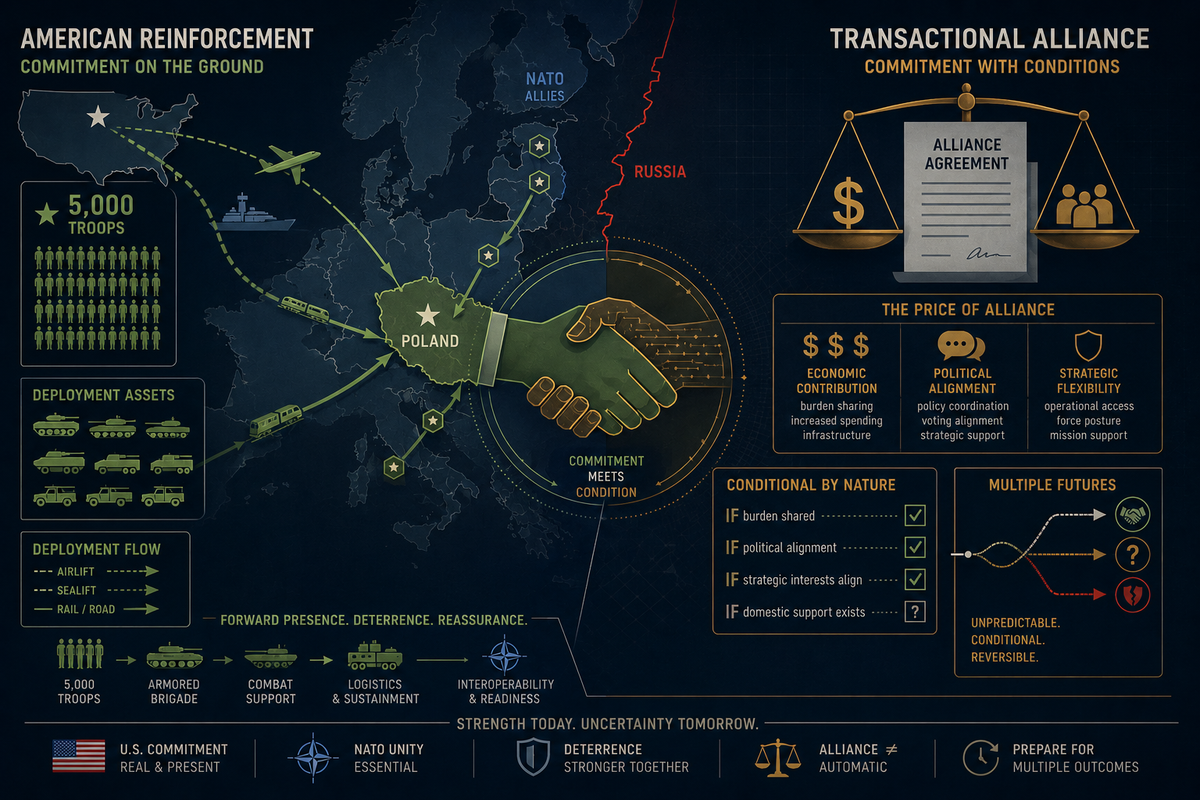
The geopolitical atmosphere in the White House has shifted sharply. While officially announcing reinforcement of military presence in Eastern Europe, beneath the surface churns unpredictability that forces European leaders to reassess their understanding of American guarantee.
The Pentagon announced deployment of additional five thousand military personnel to Poland—a decision that, superficially, appears as reinforcement of American commitment to NATO. But the context in which this decision was made tells a more complex story about how Trump understands "America First" and what this means for European allies.
Reinforcement, but conditional
The official narrative sounds straightforward. America strengthens presence in Poland. This positions American troops closer to the Russian border, reinforces NATO on its most vulnerable axis, demonstrates to allies that American guarantee remains real.
But acceptance of this decision is inseparably linked to another—significantly more complex. The Trump administration holds a visceral position on European defence that looks aggressive on paper but cold in execution. Reinforcement in Poland accompanies manifest distrust of how Europe manages its security, and particularly distrust of the German position regarding American strategy in the broader context of Middle Eastern conflicts.
German Chancellor Friedrich Merz permitted himself critical commentary on American strategy regarding Iran. In Washington, this was regarded not as legitimate policy debate but as unmotivated strike against American position. The White House reaction was sharp. A senior Pentagon officer termed German rhetoric "inappropriate and harmful," stating that the president "correctly responds" to such criticism.
This is the first signal of how new American logic of alliance relations functions. Allies must listen. Allies must support American positions. Allies who criticise can expect material consequences.
Unpredictability as strategy
What occurs simultaneously with reinforcement in Poland tells a deeper story. The Congress of the United States, controlled by Republicans, struggles through a labyrinth of contradictions. On one hand, the president reinforces presence in Poland—signal of NATO support. On the other, that same president demonstrates readiness for radical cuts in Europe if allies do not correct their behaviour and positions.
The Pentagon received authority to spend four hundred million dollars on Ukraine assistance, but this is not result of voluntary administration decision. This is result of Congress forcing the White House to act. The Republican chair of the House Foreign Affairs Committee frankly stated he expects no new large-scale Ukraine aid package. This means only one thing: Ukraine support depends on how forcefully legislators insist, not on administration conviction.
Allies have never witnessed such unpredictability in NATO's history. In place of predictable, clearly defined policy came unpredictability dependent on presidential mood and reaction to ally criticism.
Strategy of transactions: the end of unconditional alliances
At a deeper level, debate over American deployment in Europe reveals something more fundamental. Trump consistently translates American approach to alliances from guarantees to transactions. This means American presence in Europe is no longer regarded as common good of collective defence, but as commodity that allies must pay for materially and politically.
Allies must increase defence spending—okay, they are doing it. Allies must support American positions regarding Iran, China, other global questions—okay, they must seek alignment. Allies who do not correct their behaviour can expect reduction of American presence or unpredictable penalties in the form of statements about reassessing deployments.
This is genuinely the end of the epoch of unconditional alliances functioning on basis of shared values and common strategy. In its place come conditional alliances functioning on basis of mutual calculations.
Legislative journey: Congress attempts to hold line
In the background of this drama unfolds quiet struggle in Congress. There remain legislators who understand that unpredictability in American position toward NATO is bad for sustained global stability. They attempt to establish legislative constraints on reduction of American troops in Europe.
Below the level of legislation lies law constraining reduction of American military personnel in Europe below seventy-six thousand, unless the Pentagon certifies that this does not compromise security of the United States and NATO. But even such legislative constraints possess weakness: they can be circumvented through rotational reduction, as administration logic itself demonstrates.
The Republican chair of the House Foreign Affairs Committee has marked his position. He expects no new large-scale Ukraine aid package. This is understanding that the administration reorients. The question is not whether aid will arrive, but who will insist that it does.
European understanding: building independence
For European states, the signal became crystalline clear. Even reinforcement of American presence in Poland cannot be regarded as sufficient guarantee under conditions of administration unpredictability. The issue is that presence can be reduced not for strategic reasons but for reasons of presidential mood or reaction to ally criticism.
The Baltic states understand this. Ukraine understands this. France and Germany understand this. Europe enters a period when it must rely on itself in questions of defence. Not because the United States breaks NATO officially—it does not. But because Europe can no longer expect American guarantee to be consistent and predictable.
Defence spending rises in France, Germany, Poland, and the Baltics. This is not panic. This is realism. This is understanding that Europe must construct defence architecture that will function regardless of who occupies the White House.
Conclusion: alliances as commercial contracts
Reinforcement of American presence in Poland is important gesture. But it is gesture tainted by unpredictability. Trump demonstrates that "America First" means not the end of NATO but translation of NATO into model of transactional alliances where allies must listen, pay, and not criticise.
This alters the entire architecture of European security. No longer can one rely on America remaining in NATO as stable force defined by strategic calculation and allied values. America remains in NATO as force dependent on presidential mood and allies' willingness to listen and comply.
For Europe, this means future security depends on how rapidly it can construct independent defence capacity. Reinforcement in Poland is blessing, but blessing with conditions. And those conditions can change as rapidly as presidential calculation shifts to other directions.
Therefore Europeans build. They spend. They prepare. Not because America has abandoned them. But because they understand: unpredictability in alliance relations is worst form of risk in the long game of security.