One Queue for Interceptors: €3.3 Billion Lands in Kyiv, and the Problem Money Does Not Solve

Baltic Security Monitor | Analytical review Material update: 18 September 2026, 14:00 (Europe/Tallinn)
The numbers
| Indicator | Value |
|---|---|
| Tranche transferred on 18 September | €3.3 bn (missiles and drones) |
| Payment number under the defence window | 4th |
| Ukraine Support Loan, total for 2026–2027 | €90 bn |
| — defence window | €60 bn |
| — budgetary support | €30 bn |
| Ceiling for defence-industrial capacity, 2026 | €28.3 bn |
| Transferred to Ukraine year-to-date (defence + budget) | ≈ €15 bn |
| Commission decision of 11 September (air/missile defence, PAC-3) | €6.1 bn |
| SAFE instrument | €150 bn |
| Five European Defence Projects of Common Interest | €60 m each, €300 m total |
Category: defence financing / missiles and drones / EU–Ukraine military support Materiality: high Open factual gaps: 1 🟡 · Corrections: 0 🔴
The story today is not the sum. It is the crossing from decision to transfer. On 17 September Ursula von der Leyen said the EU would disburse €3.3 billion the next day; on 18 September the Commission confirmed the payment and Kyiv confirmed receipt. European defence money is ceasing to be a sequence of political gestures and becoming a repeatable procurement mechanism — a multi-year instrument with numbered tranches and annual ceilings. For NATO's north-eastern flank that cuts both ways: the resource is now predictable, but the bottleneck has moved from finance to manufacturing. Ukraine and the eastern flank are standing in the same queue for the same interceptors, explosives and electronics.
What happened
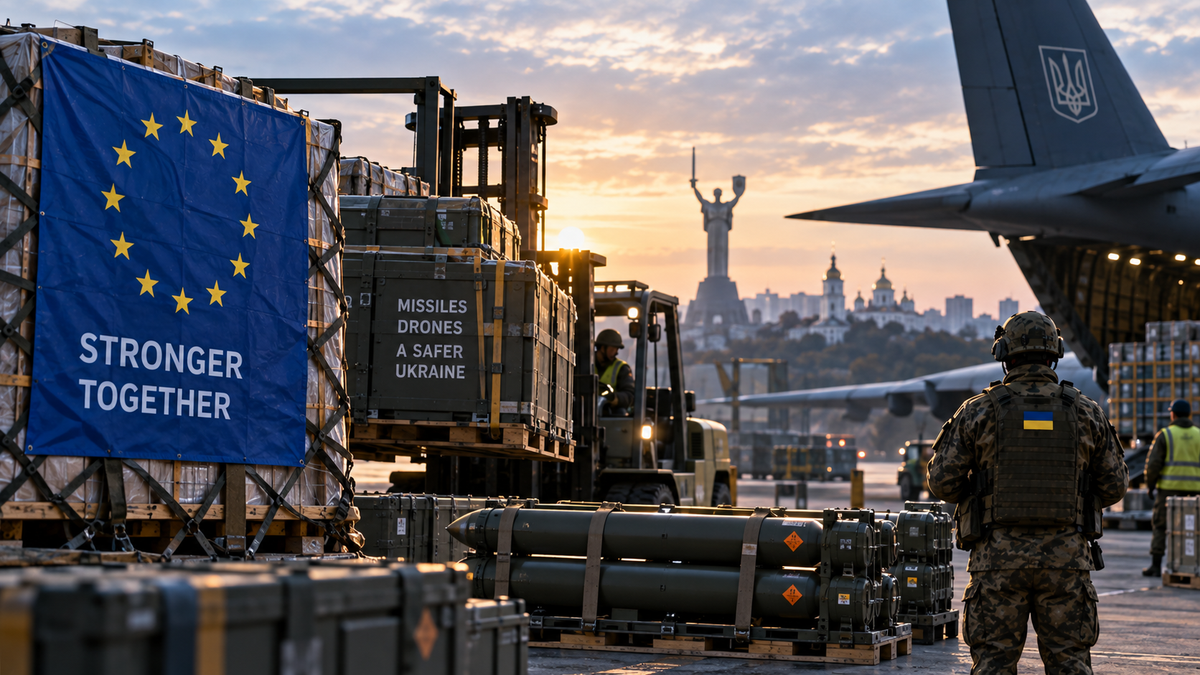
The European Commission confirmed on 18 September that it had disbursed €3.3 billion to Ukraine for defence procurement, specifically missiles and drones. The money comes from the €90 billion Ukraine Support Loan and is the fourth payment under the loan's defence window.
Ukraine's Prime Minister Serhii Koretskyi — in office since 16 July 2026, when parliament appointed him after Yulia Svyrydenko's resignation — confirmed the same day that the money had arrived and would go to critical defence needs including missiles and drones. Reuters confirmed receipt independently.
The chronology matters for verification. Von der Leyen announced the payment on 17 September after a call with Volodymyr Zelenskyy; the transfer itself happened on 18 September. This is an executed commitment, not a recirculated older funding announcement.
BSM analysis: a one-working-day gap between announcement and money on the account is itself the indicator. Through 2022–2024 the decision-to-disbursement cycle ran in weeks and months, and each package required its own political bargain. What is operating now is a regulatory frame: Regulation (EU) 2026/467, adopted in February 2026, and Ukraine's Financing Strategy submitted in March removed the need to renegotiate every time. Disbursement has become administration rather than diplomacy.
The architecture
The Commission also clarified the instrument's structure. The Ukraine Support Loan runs to €90 billion across 2026–2027: €60 billion for defence and €30 billion for budgetary support and core state functions. For 2026, up to €28.3 billion is allocated to defence-industrial capacity. With today's payment, roughly €15 billion has moved to Ukraine since the start of the year.
The tranche follows the Commission's 11 September decision allocating €6.1 billion for Ukrainian air and missile defence requirements, including PAC-3 interceptors for Patriot systems — a step Brussels says also opened the way for Ukraine to buy US interceptors used against ballistic threats.
BSM analysis: the shift is structural rather than numerical. Ukraine's defence is being financed as a line in a multi-year EU budget instrument rather than as a series of national donations from existing stocks. Repayment is deferred until Russia compensates the destruction it caused, and the EU has explicitly reserved the right to use immobilised Russian assets to service the loan.
Two tracks that should not be conflated
Today's tranche is not SAFE. The distinction is easy to blur in secondary reporting and worth holding firmly.
Track one — Ukraine Support Loan. Money already transferred, already Ukrainian, buying weapons against near-term consumption. Horizon: months.
Track two — SAFE / Freyja. On 17 September von der Leyen said the EU was ready to channel remaining funds from SAFE — a €150 billion instrument — into a new programme of joint EU–Ukraine defence projects, built around the joint anti-ballistic Freyja system and a European air and missile defence architecture. This is industrial integration, not procurement. Horizon: years.
In parallel, member states have provisionally agreed five European Defence Projects of Common Interest at €60 million of initial funding each (€300 million in total). A formal vote by EU defence ministers is scheduled for 28 September, with Ukraine expected to take part in four of the five.
BSM analysis: a two-tier model is emerging — immediate financing of Ukrainian purchases alongside long-term embedding of Ukrainian firms in Europe's defence-industrial base. For the Baltic states the second tier matters more than the first, because it determines whether Europe ever builds interceptors and counter-drone effectors at the volumes the flank actually needs.
The event outside the update: borrowed fighters over a Latvian election
While Brussels was moving €3.3 billion to Kyiv, the region produced a smaller item that illustrates the underlying problem better than any figure.
On 17 September it emerged that four German Air Force Eurofighters will arrive at Lielvārde air base at the end of September to temporarily reinforce the defence of Latvian airspace, including during the 15th Saeima elections on 3 October. Latvian air defence has not previously been reinforced specifically for an election period.
The background is a steady rhythm of airspace alerts: warnings in Latvia's Latgale and Vidzeme regions and in Ludza municipality, and in Estonia drones approaching Narva with one crossing into the country's south-east.
BSM analysis: the contrast is the asymmetry in miniature. Ukraine receives €3.3 billion and buys missiles and drones on its own account. Latvia — an EU and NATO member spending above 5% of GDP on defence — borrows four foreign aircraft to cover its own election. The region does not lack money. It lacks interceptors, radars and command-and-control capacity in the quantities required. That is not a criticism of Riga; it is a diagnosis of European industrial output.
Why it matters for the Baltic states
Missiles and drones are Ukraine's two highest-consumption capability categories. They are also the two categories in which Estonia, Latvia, Lithuania, Poland and Finland are short.
The competition is not for money but for physical inputs: interceptor bodies, explosives, electronics, solid propellant, production lines. The Commission itself says that sustaining Ukraine's military edge requires destocking, reprioritising existing orders and raising output — an admission that financing alone is no longer treated as sufficient.
Regional context, in figures:
- The Baltic states are investing at least 5% of GDP in defence.
- Poland has submitted 26 of more than 100 East Shield projects worth €10 billion in total; the SAN counter-drone system, presented as Europe's largest such solution, is valued at roughly PLN 15 billion (≈ €3.5 bn) and is part-funded through SAFE.
- Estonia, Latvia and Lithuania are jointly building the Baltic Defence Line and coordinating it with Poland's East Shield to enable joint procurement under SAFE.
- Eastern Flank Watch begins implementation in 2026, with full functionality expected by the end of 2028; Finland and Poland co-lead the framework.
- The drone wall remains more concept than capability: financing, sensors, effectors and C2 architecture are unresolved, and Baltic officials have observed bluntly that nobody has such a system yet — Ukraine included.
BSM analysis: the Ukrainian tranche indirectly serves the flank, because it funds the industrial expansion the Baltic states will eventually draw on. But inside the 2026–2027 window it also sharpens competition for the same scarce items. Who gets interceptors first is decided on production lines, not in Brussels.
What is not known
🟡 The Commission has not published the split between missiles and drones, the suppliers, quantities, delivery schedules, or the share of procurement going to Ukrainian versus EU manufacturers.
Those parameters determine how fast this money becomes capability — and whether it displaces European customers in the queue or pays for new lines that eventually serve both. Until the breakdown appears, any assessment of flank impact stays structural rather than quantitative.
A note on sourcing: the primary source is European Commission communication, with parts of the story circulating through aggregators. BSM relies on Reuters confirmation and the Ukrainian government's own statement.
Conclusion
On 18 September 2026 European financing of Ukraine's defence crossed the line from politics into accounting. This was the fourth tranche, not the first and not the last; further defence-window payments are expected, and von der Leyen travels to the UN General Assembly with an agenda of expanding international support.
For NATO's north-eastern flank the conclusion is uncomfortably simple. The question of whether the money exists is settled. The question of whether the factories exist is not. Ten days to the EU defence ministers' vote on the five common projects. Fifteen to the Latvian election that German Eurofighters will be covering.
Baltic Security Monitor (osint-baltic.com) — an analytical publication on security along NATO's north-eastern flank. All OSINT coefficients are calculated by an automated indexing system based on open sources.
Sources
- European Commission / European Sting — €3.3 bn disbursement, Ukraine Support Loan structure, 18 September
- Reuters — Ukraine receives €3.3 bn, PM statement, 18 September
- Reuters — von der Leyen announcement, 17 September
- Brussels Morning — fourth defence-window payment, ≈€15 bn year-to-date, Regulation (EU) 2026/467
- Kyiv Post / Euromaidan Press — SAFE, Freyja, five projects of common interest, 28 September vote
- LSM.lv — German Eurofighters at Lielvārde for the Saeima elections, 18 September
- LRT — airspace warnings in Latvia and Estonia
- FPRI — East Shield, SAN system, €10 bn of submitted projects
- European Parliament / EPRS — Eastern Flank Watch, European Drone Defence Initiative, timelines
- RFE/RL — state of readiness of the drone wall, Baltic officials' assessments