Ukraine Shows Combat Use of a New Interceptor Against Russia's Jet-Powered Shaheds for the First Time: From Testing to a Real Kill

Baltic Security Monitor | Analytical Briefing Digest: 19 September 2026, 20:00 (Europe/Tallinn)
Four days ago, Reuters described this as a race Ukraine was losing: jet-powered "Shaheds" flying past 400 km/h, and the cheap interception architecture that worked against propeller drones struggling to keep up. Today Zelensky released footage that makes that race look different — at least in one specific episode. The gap between "successfully tested" and "already used in combat" sounds small, but it's exactly what will determine whether Ukrainian air defence holds up through the next phase of the drone war.
The lead event: from testing to combat
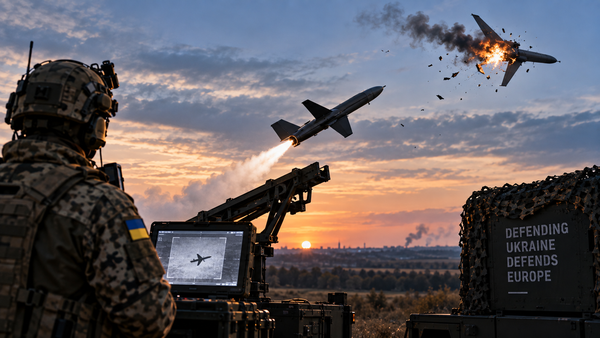
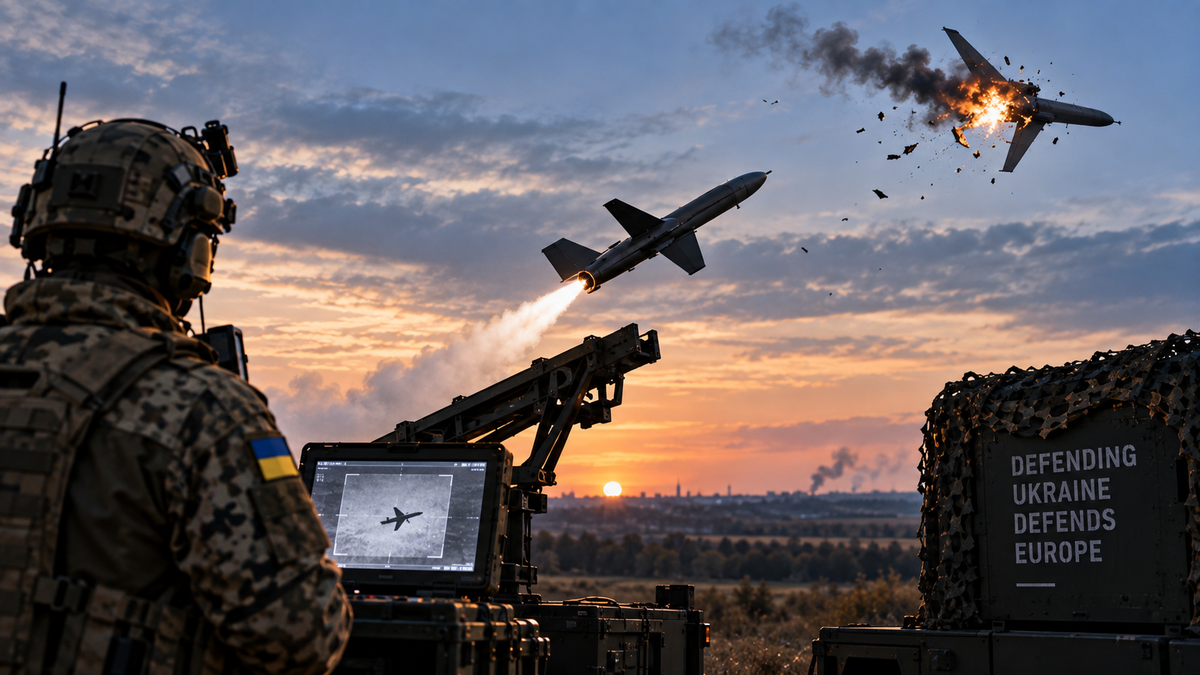
President Volodymyr Zelensky said on 19 September that the Security Service of Ukraine's (SBU) military counterintelligence unit has developed a new interceptor drone against jet-powered Shahed-type threats and has already deployed it successfully in combat. "Step by step, we are moving forward to give Ukraine greater protection," the president said. Zelensky released combat footage, and the SBU separately confirmed to Interfax-Ukraine that this is the first published footage showing destruction of jet-powered Shaheds by the new system.
Specialist outlet Militarnyi assesses the target in the footage as a Geran-5 — an upgraded jet-powered Shahed variant flying at roughly 600 km/h and substantially harder to intercept than propeller-driven versions.
BSM analysis: This is a genuine escalation in status, not just another announcement. On 15 September, Zelensky spoke of one interceptor passing successful trials. On 18 September, he said two companies had completed successful combat tests and that the priority was now mass production, adding that 67 Ukrainian companies are working on jet-drone interception technologies and contracts are already being signed. On 19 September, the status moved up another level: the SBU system was described as already deployed in combat, backed by video. 🟡 Worth flagging: the specific identification of the target as a Geran-5, and the interceptor's broader combat effectiveness, have not been independently technically verified — this is a specialist outlet's assessment from footage, not an official confirmation.
Context: why jet-powered drones are a different problem
Reuters reported on 15 September that Russia's rapidly expanding jet-powered drone campaign had created a major air-defence problem for Ukraine, with the new weapons routinely exceeding 400 km/h while existing interceptor technology struggled to keep pace. By that reporting, Ukraine was achieving roughly 90% interception against older, propeller-driven Shaheds but doing significantly worse against the new jet-powered generation.
This isn't the first attempt to solve the problem: the Ukrainian-made Sting interceptor, for instance, became the first system to down a jet-powered Geran-3 in December 2025 and, by April 2026, was credited with roughly 70% of all jet-Shahed interceptions. The 19 September announcement concerns a separate, SBU-developed interceptor rather than Sting; four interceptor models are currently being tested at the front, with ten more manufacturers evaluating prototypes.
🟡 Ukraine has not disclosed the new interceptor's specifications, production rate, unit cost, number fielded, or a verified kill rate. Combat use alone does not yet establish a scalable solution.
Why it matters for Ukraine and the Baltic region
The Geran-4/Geran-5 generation changes the geometry of drone defence: higher speed compresses warning and engagement time, making both gun-based mobile teams and slower propeller interceptors less effective. A scalable jet interceptor would give Ukraine an intermediate defensive layer between mobile gun-based defence and expensive conventional surface-to-air missiles — critical if Russia can manufacture high-speed attack drones in quantities large enough to saturate missile-based defences.
This has direct relevance for Poland and the Baltic states too. Polish PM Donald Tusk warned this week specifically that faster jet-powered UAVs are becoming harder to intercept, and recent drone incursions have already forced NATO fighters and national air-defence systems to respond to relatively cheap unmanned threats. Ukraine's combat experience with purpose-built, low-cost interceptors could feed directly into the counter-UAS architecture now being built across NATO's eastern flank.
Bottom line
The next material developments to watch are serial-production contracts, concrete fielding numbers, and sustained interception statistics — or independently documented, repeated kills against Geran-4/Geran-5-class targets. For now, 19 September marks the shift from "successfully tested" to "used in combat" — a meaningful but not conclusive step. Whether this becomes a scalable answer will depend on production pace and verified effectiveness over the coming weeks.
Baltic Security Monitor (osint-baltic.com) — an analytical publication on security along NATO's north-eastern flank. Prepared from open sources (Interfax-Ukraine, Ukrainska Pravda, Militarnyi, Reuters, Kyiv Post, Newsweek) and an automated monitoring system.