Repaired, Then Destroyed: IAEA Charts Zaporizhzhia's Shrinking Safety Margin
A backup transformer near the Zaporizhzhia thermal plant was repaired under an IAEA-brokered ceasefire. Less than a month later it was destroyed again. The same week, the nuclear plant spent hours on diesel generators and three energy workers were killed. There has been no radiation release — but…

Baltic Security Monitor | Material Update · HIGH
Nuclear safety / Critical infrastructure · 15 November 2026
A backup transformer near the Zaporizhzhia thermal plant was repaired under an IAEA-brokered ceasefire. Less than a month later it was destroyed again. The same week, the nuclear plant spent hours on diesel generators and three energy workers were killed. There has been no radiation release — but the margin meant to prevent one keeps getting thinner.
What the IAEA reported
On 14 November the IAEA published Update 375 on the situation in Ukraine. Its key facts concern events of 8–10 November, but this is the first time the agency has set them out together in an official statement.
At 02:36 on 8 November the Zaporizhzhia nuclear plant lost power from the 330 kV Ferosplavna-1 line, its only remaining external connection. An automatic reconnection attempt failed. Safety-critical systems switched to emergency diesel generators. It was the plant's 27th complete loss of off-site power since the war began — and, according to Energoatom, the 16th this year alone. At the time the IAEA could not establish where or why the line had failed.
During the outage the IAEA team on site was told that available fuel could keep a limited number of generators running for about two weeks.
BSM analysis: before the war the plant had ten external power lines. Now it has one, and it drops out regularly. Each outage is not an accident but a test of the last line of defence. The trouble is that this line has now been tested 27 times.
A transformer that lasted under a month
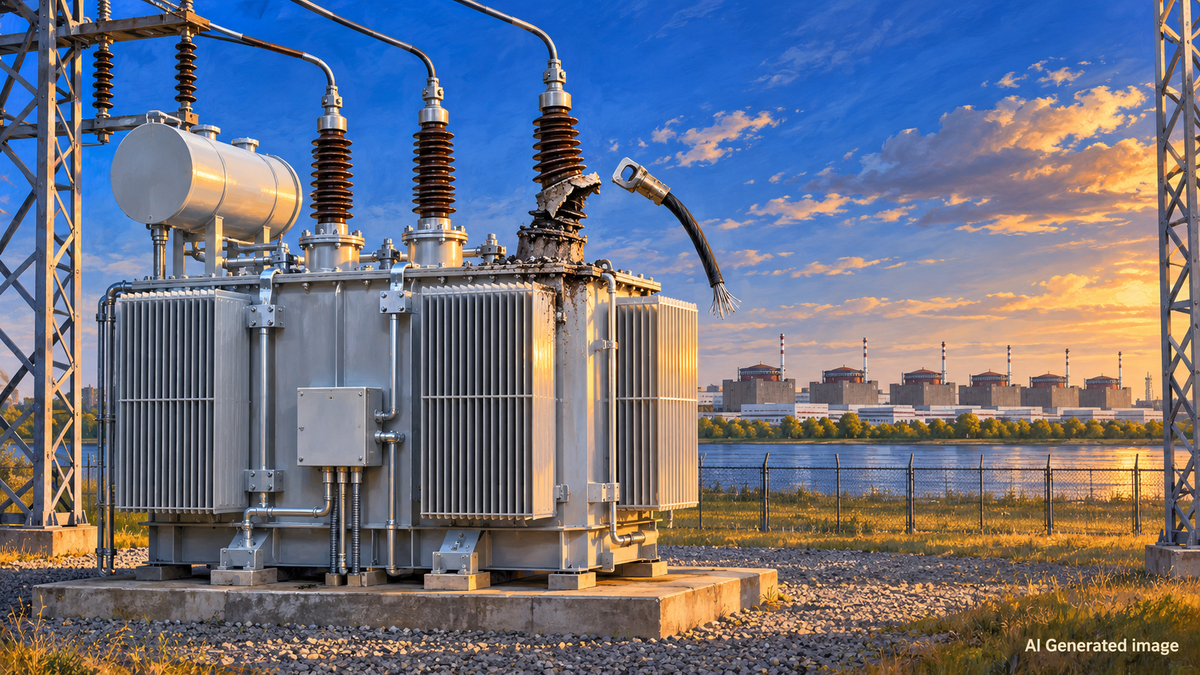
The most significant new detail in the report concerns a backup transformer near the Zaporizhzhia Thermal Power Plant. Drone strikes damaged it in September. In October the IAEA brokered its eighth localised ceasefire between the two sides, and the transformer was repaired, strengthening the nuclear plant's link to Ferosplavna-1.
This week the IAEA team was informed that the transformer had again been destroyed by military activity. Rafael Grossi said he was disappointed that infrastructure repaired under a ceasefire the agency had negotiated in good faith had been wrecked.
BSM analysis: the localised-ceasefire mechanism works — eight times the two sides have agreed to a "window of silence" for repairs. But nothing protects the repaired equipment once the window closes. The result is a loop: damage, negotiation, repair, damage again. Each round costs weeks, and redundancy never actually recovers.
Workers killed
According to the IAEA, a plant employee was killed in a drone attack on 9 November and another in an explosion on 10 November. Separately, a drone killed an employee of the neighbouring thermal plant. In late October the agency had already reported the death of a welder from the plant's repair workshop.
🟡 As usual, the IAEA has not assigned responsibility. Each side blames the other, and there is no independent attribution.
The wider picture: an unstable grid
The problem extends beyond Zaporizhzhia. The IAEA says grid instability caused by military activity led to several power reductions at operating units of Ukraine's other nuclear plants this week. The agency also continues to record drone activity near nuclear facilities.
The IAEA is still working with both sides on restoring the Dniprovska substation and the plant's 750 kV line. Grossi has said that bringing that line back would significantly improve nuclear safety and cut dependence on limited diesel stocks.
Why it matters for the Baltic states
Europe's largest nuclear plant now depends on a single power line and some twenty diesel generators. For states on NATO's northeastern flank this is first a monitoring question: the region already lives with the risk of attacks on energy infrastructure, from Baltic seabed cables to substations.
There is a political dimension too. Control of the plant is among the most contested issues in talks on ending the war. The transformer episode shows what local arrangements without enforcement are worth: results measured in weeks, not months.
The IAEA reports no direct radiological threat to the region.
Still unverified
- 🟡 responsibility for the transformer's destruction and the workers' deaths;
- 🟡 repair timelines and whether a new localised ceasefire is possible;
- 🟡 actual diesel reserves at the plant.
Next checks: further IAEA updates on Ferosplavna-1, the transformer and Dniprovska.
Conclusion
Zaporizhzhia's nuclear safety now rests less on its systems than on the gaps between strikes. Eight ceasefires have shown the two sides can agree on repairs. A destroyed transformer has shown they cannot agree on keeping them.
A ceasefire can repair equipment. It cannot repair safety.
Baltic Security Monitor (osint-baltic.com) — an analytical publication on security across NATO's northeastern flank.
Materiality classification is assigned by BSM's automated open-source monitoring system.