Quiet Index, Dark Plant: BSM Roundup for 8 November 2026
BSM's automated index registered near-total calm on 8 November: a composite of 0.07, unchanged over six and twenty-four hours. Meanwhile, at 02:36, the Zaporizhzhia nuclear plant lost its last external power line and fell back on emergency diesel generators. The day's most consequential event…

Baltic Security Monitor | Analytical Review
Roundup sources: Security Watch 08:00 and 14:00 EET; Daily Digest, snapshot 2026-11-08T09:07:50Z
BSM's automated index registered near-total calm on 8 November: a composite of 0.07, unchanged over six and twenty-four hours. Meanwhile, at 02:36, the Zaporizhzhia nuclear plant lost its last external power line and fell back on emergency diesel generators. The day's most consequential event never reached the indexing system — and that gap between signal and noise is the real story of this roundup.
Three Cycles, One Day
- Security Watch — 08:00 EET · NO MATERIAL UPDATE · 0 HIGH, 8 lines on WATCH
- Daily Digest — 11:07 EET (snapshot) · Composite 0.07 · 1 batch event, 0 high-confidence
- Security Watch — 14:00 EET · MATERIAL UPDATE · HIGH · ZNPP off external power
The morning cycle could not have caught the outage: Energoatom's first public statements surfaced only around 11:00. The afternoon cycle picked it up and confirmed it through three independent sources — Energoatom, the IAEA and Reuters. The Daily Digest, compiled at 11:07, does not include it.
OSINT Indices
- Composite threat index — 0.07 · = (Δ6h 0.00, Δ24h 0.00)
- Force Posture — 0.00 · zero
- Logistics — 0.33 · the only non-zero sub-index
- Info/Cyber — 0.00 · zero
- Border/Air/Maritime — 0.00 · zero
Batch events: 1 · High-confidence: 0
Quarantined (24h): 3 (low information density) · Source failures: 0
Freshness: top-5 median age 61h · ingest lag median 16.5h, p90 34.4h · stale publications received (24h): 30
Three of four sub-indices sit at zero, with all activity concentrated in Logistics — the familiar pattern of an artificial lull, where the system sees one category and misses the rest. But on 8 November the problem runs deeper than the index configuration. Four of the five top events are Estonian news items with no security content, and their median age exceeds two and a half days. A composite of 0.07 on a day like this describes the source feed, not the region.
The Main Event: Zaporizhzhia With No Lines Left
MATERIAL UPDATE · HIGH — nuclear safety / critical infrastructure
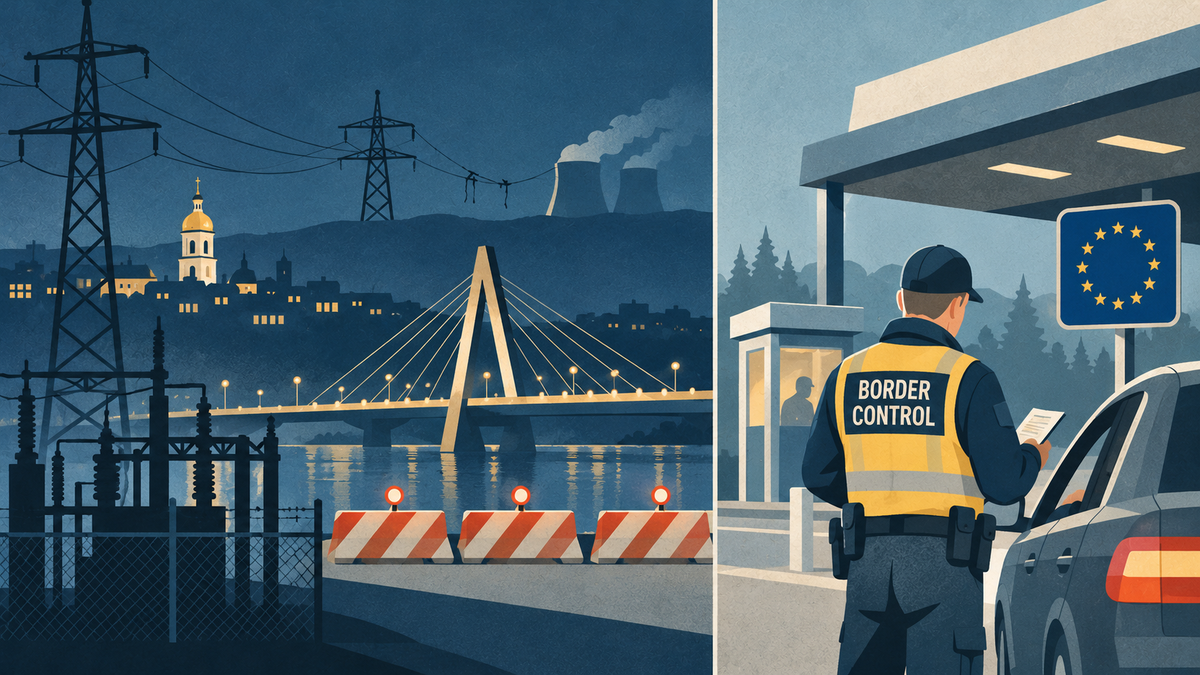
At 02:36 on 8 November, the Russian-occupied Zaporizhzhia Nuclear Power Plant lost power from Ferosplavna-1, its last working 330 kV line. An automatic reconnection attempt failed, leaving the station's own needs supplied solely by backup diesel generators. Energoatom counts this as the plant's 16th complete loss of off-site power since the start of 2026.
The IAEA confirmed the outage and estimates there is enough fuel to run a limited number of generators for roughly two weeks. Another key line has been down since late October. The Russian-installed management said automatic protection had disconnected the damaged line and that radiation levels remain normal.
All six reactors are shut down, but spent and core fuel still needs continuous cooling — and cooling needs electricity. Energoatom warns that prolonged blackout operation creates a direct risk of cooling failure should the generators break down or run dry.
The cause of the line damage has not been established. 🟡 Attribution to any specific strike or party remains unconfirmed.
An information angle followed within hours. Reporting the outage, the Russian Telegram channel "Two Majors" hinted that other Ukrainian nuclear plants could face similar scenarios. That proves no intent, but it shows how nuclear safety is being folded into Russia's messaging.
BSM analysis
The danger at Zaporizhzhia now lies in repetition. Sixteen full blackouts in ten months mean emergency mode has become the operating mode. Each repair in the combat zone requires a local ceasefire brokered by the IAEA — exactly the arrangement that allowed Ferosplavna-1 to be restored in September. The plant's power supply has effectively become a negotiating item rather than an engineering task. For the Baltic states and Europe more broadly, the takeaway is uncomfortable: the continent's largest nuclear station runs on a margin set by diesel deliveries through occupied territory and by the warring parties' willingness to agree a repair window.
The Digest's Top Five: Noise Over Signal
- 1 — Tribuntsov sets a new national record in Poland · 0.16 · ERR · 39h
- 2 — Sweden says Russian hybrid threats make internal border checks necessary · 0.23 · Reuters EU · 64h
- 3 — Käidi and Kristal's home club opens its European cup win tally · 0.14 · ERR · 61h
- 4 — Eesti Pank economist: prices likely to keep rising at the same pace · 0.07 · ERR · 40h
- 5 — Maritime Museum orders a €1m research vessel from Latvia · 0.07 · ERR · 62h
Four of five entries cover sport, the economy and a museum procurement — all flagged WATCH, none with security content. That is a classification error, not a signal.
🟠 2. Sweden ties internal border checks to Russian hybrid threats OSINT score: 0.23 — WATCH (new entry)
Stockholm will run targeted checks at its internal Schengen borders for six months to prevent sabotage and other hybrid attacks by Russia-linked hostile actors. The regime runs from 12 November 2026 to 11 May 2027.
Sweden previously justified such checks by illegal migration and organised crime. The government now links them directly to threats stemming from Russia's full-scale war against Ukraine. France, Germany, Norway and Denmark already operate internal border controls. Swedish military intelligence warned earlier this year that Russia had stepped up hybrid activity around Sweden and appeared willing to accept greater risk.
BSM analysis
The shift in rationale matters more than the measure itself. Schengen's internal borders are being repurposed as a tool against state-directed hybrid operations, not just irregular migration. For the Baltic states and Finland, linked to Sweden by ferry and air routes, that could mean added checks on connections long treated as purely domestic within the Schengen area. It is also a tacit admission that the threat already operates inside the free-movement zone.
Why the Index Missed Zaporizhzhia
No source failures were logged, so the problem is editorial rather than technical. Three factors stand out:
- Feed composition. Four of the top five items come from ERR, and three are unrelated to security. The relevance filter is letting a general news stream through unsorted.
- Freshness. Top-5 median age is 61 hours, ingest lag p90 is 34.4 hours, and 30 stale publications arrived in one day. The index is effectively measuring the day before yesterday.
- Category coverage. Ukrainian nuclear safety has no sub-index of its own, and judging by the top five, nuclear sources such as the IAEA and Energoatom are absent from the feed.
Separately, the Logistics reading of 0.33 is not explained by any top-five entry, the highest of which scores 0.23. 🟡 The likely source is the single batch event, whose content the digest does not show.
The reading for subscribers is straightforward: a composite of 0.07 on 8 November does not mean "calm in the region". It means the system read nothing relevant.
WATCH: Open Lines
- Rassvet (satellite links for Russian UAVs) — Ukrainian intelligence claim, no independent technical confirmation · Terminals, telemetry, combat use
- Rzeszów–Jasionka — French mission previously covered · Actual deployment
- European aviation threats — Attribution not established · Police investigations
- Latvian drones — No final technical attribution · Debris forensics
- JEF / Baltic Sea — Stronger maritime cooperation announced; no new signed mission confirmed · Documents and operational commitments
Context on JEF matters here. All ten JEF nations — the UK, Denmark, Estonia, Finland, Iceland, Latvia, Lithuania, the Netherlands, Norway and Sweden — formally agreed the Maritime Proposition back in July 2026, committing to move from periodic deployments to a persistent maritime presence across the North Atlantic, the High North and the Baltic. The JEF defence ministerial in Iceland on 1–2 October reaffirmed that region as the framework's core area of interest. The latest British statements extend an existing track; they do not launch a new operation.
Conclusion
8 November produced two different silences. One sat in the index: a composite of 0.07, three zeros and a top five built on sports news. The other ran along Zaporizhzhia's transmission lines, where since 02:36 not a single external source of power has remained. The first is a problem of method; the second is a problem of security.
By the IAEA's estimate, the plant has fuel for about two weeks. Sweden's internal border checks start in four days, on 12 November.
An index measures what it reads. This time it was reading the sports pages while Europe's largest nuclear plant switched to diesel.
Baltic Security Monitor (osint-baltic.com) — an analytical publication on security across NATO's northeastern flank.
All OSINT indices are calculated by an automated indexing system based on open sources.